Closing the Convergence Gap: A Process for Campaign Design
By Jeremiah Monk and Monte Erfourth
The September 2026 Prism Insights article “Bridging the Convergence Gap” staked the claim that the Joint Planning Process (JPP) prescribed by joint doctrine is fundamentally a convergent process, built to narrow a field of alternatives to one approved course of action. Campaigning, as Joint Publication 3-0 describes it, runs continuously, indefinitely, and without a terminal state. A tool built to converge on an answer, applied to a condition that has none, yields a plan that is procedurally correct and substantively wrong for the environment it claims to govern. That article closed with a recommendation: the Department of War should task the Irregular Warfare Center (IWC) as the center of excellence for competition, and have it build the toolkit doctrine has diagnosed but has yet to produce.
This article takes the next step. With the doctrinal diagnosis established, it introduces a process for campaign design built for the conditions doctrine describes, and makes the case for where that process should be developed.
The Doctrinal Architecture
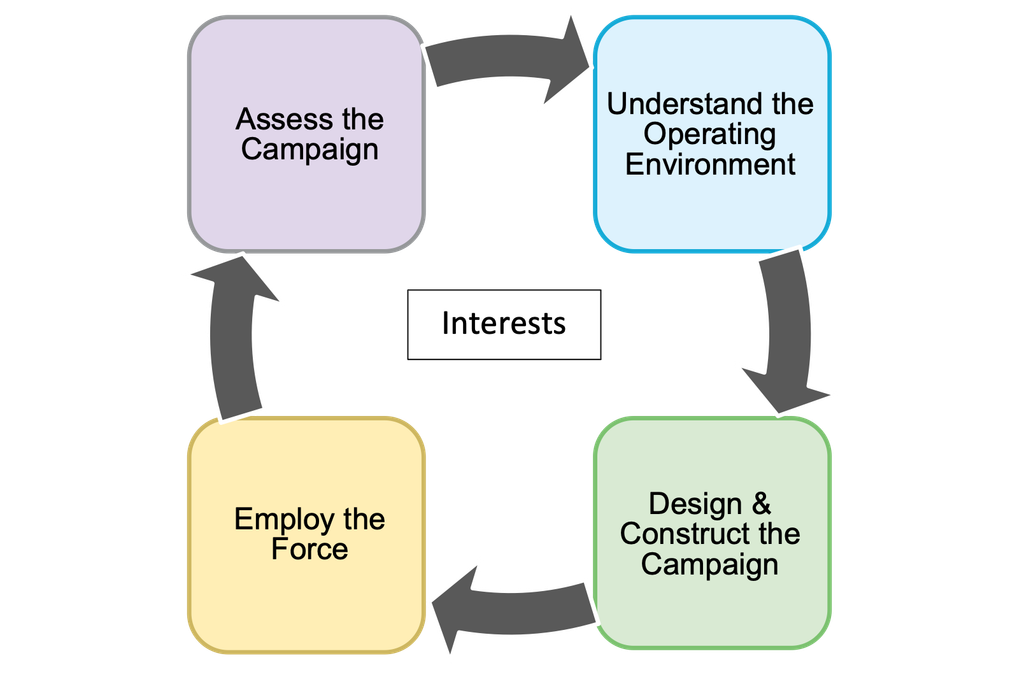
Doctrine has already sketched the shape of the answer. The Joint Concept for Integrated Campaigning (JCIC) organizes campaigning into four elements, arranged as a continuous cycle with no exit: understand the operating environment, design and construct the campaign, employ the integrated force and secure gains, and assess and adapt the campaign. Figure 1 depicts a simplified adaptation of that cycle, with “Interests” added as the central pivot. Doctrine names the four elements but says little about how to perform them, and it supplies none of the instrumentation JP 5-0 provides for convergent operational planning.
Figure 1. The Integrated Campaigning Cycle
Illustration developed from the JCIC’s (2018) four interrelated elements of integrated campaigning, not official joint doctrine
JP 5-0 concedes the underlying problem. In the same chapter that prescribes JPP, it states that commanders “will never know everything about their [operational area] and will never be able to fully define its problems,” and that “many of the problems of the [operating environment] may not have solutions” (JP 5-0, IV-8). Having made that admission, doctrine still hands planners a single convergent process. JPP remains the right instrument for the complicated problems nested inside any campaign, such as a named contingency or a noncombatant evacuation. What follows is a companion process for the complex, continuous work of campaigning that JPP was never intended to address.
Name the Interest, Then Sort the Problem
The first discipline this process requires is one doctrine states but fails to operationalize: naming the interest at stake before defining the problem. JP 3-0 calls a nation’s interests the primary element of competition and an interest-led orientation “the cornerstone of a comprehensive approach to competition.” A planning team that starts from the problem as presented inherits someone else’s frame, usually a threat, and a threat reveals only what stands to be lost. A team that starts from the interest asks what could be advanced as well as what is at risk, and asks it of every rival positioned around that interest. As Terry Deibel argues, threats and opportunities exist only in relation to an interest. The interests themselves come from national strategy and policy; the campaign’s task is to identify which ones a situation touches.
The second discipline is one doctrine omits entirely: deciding, before planning begins, what kind of problem the team actually faces. The Cynefin framework developed by Kurtz and Snowden sorts problems by how cause and effect relate. In a complicated problem, cause and effect exist and yield to expert analysis. In a complex problem, they become visible only in retrospect, and the correct discipline is to probe, sense, and respond.
Campaigning sits on the complex side of that line. It has no terminal state, and its effects emerge from adversaries adapting to friendly action while friendly forces adapt to them. Applied to that problem, JPP succeeds procedurally while converting an unresolvable condition into a confident-looking plan. Confident error is a worse failure than acknowledged uncertainty, because it conceals that nothing has actually been secured.
A campaign still contains bounded, complicated sub-problems, and those belong in JPP without apology. This process makes the sort an explicit step, run early and repeated whenever a sub-problem’s character is in doubt, so each piece of the problem reaches the tool it calls for.
Borrowing the Language of Capital Allocation
The military is not the only profession to operate without a terminal state. Institutional investing has governed itself under that condition for a century. The chief investment officer of a sovereign wealth fund, a pension system, or a university endowment does not pick individual securities. A board sets objectives, risk tolerance, and constraints without naming a holding. The officer forms a thesis about how the institution’s capital can grow, allocates that capital across managers who run their own mandates, then monitors and rebalances. No board asks its chief investment officer to describe the portfolio’s end state, because an endowment is managed in perpetuity and judged continuously against a thesis.
A theater commander occupies the same role. National strategy and the guidance for employment of the force serve as the board’s policy statement. The commander’s theory of success is the thesis, the distribution of forces and authorities across lines of effort is the allocation, and subordinate commands and country teams run mandates inside it. The commander answers for the whole campaign rather than any single line of effort, which is the only frame in which a failed probe counts as information instead of a career-ending error. Across the interagency, the commander resembles an outsourced chief investment officer, able to analyze, propose, and align but unable to compel. That seam between authority and persuasion runs through every tool in the process.
Of course, this investment analogy has limits. Forces and authorities move less freely than capital, a failed probe can cost lives or provoke escalation, and an adversary counters in ways a market does not. Each difference argues for sizing probes conservatively, and none undoes the central lesson: an institution can be governed without an end state if it is governed against a thesis it continually tests.
However, the investment analogy’s deeper value lies in what replaces the end state: a cycle of forming a view, committing capital against it, observing what the environment returns, and revising the view. A losing holding is sold and its capital redeployed without condemning the thesis. Campaigning’s lack of a terminal state, a defect when viewed through a convergent planning process, is the ordinary operating condition of every institution that manages capital in perpetuity.
A Cycle, Not a Checklist
That cycle is where Colonel John Boyd’s observe-orient-decide-act (OODA) loop earns its place, through a claim more specific than the one usually attributed to him. Boyd’s own writing, most fully in A Discourse on Winning and Losing, treats speed as a consequence of shared orientation rather than an end in itself. The mechanism is implicit guidance and control, the channel running from orientation directly to action and observation, bypassing explicit decision wherever shared understanding makes deliberation unnecessary. A distributed force that must ask before it acts has surrendered the advantage the loop exists to produce, however fast any single cycle turns.
That claim sets the design requirement for everything upstream of action. Understanding the operating environment, the first of Joint Concept for Integrated Campaigning’s (JCIC) elements, corresponds to orientation in Boyd’s terms. Its product must be concise enough for a subordinate commander or country team lead to carry in their head and act on without waiting for instruction. A process that generates an ever-larger analytical record sacrifices the independent action it was meant to enable. The rigor belongs before the moment of action, so the echelon who must carry out the action holds something simple and understandable in guidance. The U.S. Army calls this “mission command.”
The Four Phases
In place of an end state, doctrine supplies the measure the cycle pursues. JP 3-0 defines competition as “the interaction among actors in pursuit of the influence, advantage, and leverage necessary to advance and protect their respective interests.” Read as a planning instruction, the definition gives the campaign an anchor, the interest, and a measure, position: where the United States stands relative to its rivals and its own interests, read across influence, advantage, and leverage. The campaign counts its returns in position gained or lost.
The process builds one phase on each of JCIC’s elements and runs them as a closed loop on Boyd’s logic: Understand is Orient, Design is Decide, Employ is Act, and Assess is Observe. Boyd framed decision as a hypothesis and action as its test, and every phase adopts that posture.
Understand builds a working hypothesis of how the environment behaves, accepting JP 5-0’s own judgment that a complete picture is out of reach. The team anchors on the national interests at stake, reads where the United States now stands against its rivals, maps the system and the actors inside it, sorts the resulting sub-problems by the reasoning each one demands, and builds several plausible futures to test its thinking against, keeping all of them in play. The phase closes when its product fits on a page: an interest, a map, and a hypothesis tested against several futures.
Design turns that hypothesis into a theory of success, and the theory into a portfolio. In place of selecting one course of action, the team identifies where the system will respond to influence, states the causal chain from action to effect in testable form, and builds a diversified set of probes, each small enough to lose. A premortem against the whole portfolio sets a stop-loss condition for each probe and the triggers that would signal the theory itself has failed, all before any probe is funded.
Employ is where the portfolio meets real conditions. Probes are resourced and run, while a standing campaign cell, a small permanent staff team that owns the campaign between reviews, watches the triggers set during Design and rebalances without waiting for a scheduled review. Boyd’s tenet from Organic Design for Command and Control applies: emphasize implicit over explicit guidance “to gain a favorable mismatch in friction and time.”
Assess marks the campaign against observed conditions: which probes held, which failed, whether the campaign’s position around the interest improved or eroded, and which assumptions events have overtaken. Its findings return to the start of the loop rather than to a closeout report. A failed probe sends the team back to Design. A failed thesis sends it back to Understand, because the hypothesis the campaign runs on was built against conditions that have since moved. That return path makes the process a cycle, accountable to what the environment reports rather than to what the campaign cost to build.
Giving the Process an Owner
A process does not develop or institutionalize itself. “Bridging the Convergence Gap” argued that the Department of War already has an institution positioned to own this work: the misnamed Irregular Warfare Center, which should become the Department’s center of excellence for competition and the champion of the Joint Concept for Competing. The IWC has begun preliminary work on this process and on courses to teach it.
Three features make the IWC the right home. Its charter already spans the competition activity this process is built to plan, so the work extends an existing mission. It sits outside any single combatant command, which lets it test the process against several theaters’ problems. And it connects to the professional military education system that teaches JPP as the default, the channel any durable change in planning habit must travel.
The process outlined here remains a proposal that use has yet to validate. It assembles tools from complexity theory, decision science, and institutional investment management against an architecture doctrine has already endorsed. The IWC should take that proposal through three stages: refine the tools behind each phase with practicing planners, to include the staffs already developing campaign playbooks; test and refine them in wargames and exercises against live theater problems; and develop the training and doctrinal inputs needed to carry what survives into professional military education alongside JPP. None of this requires new legislative authority, but rather only an institution willing to claim a mission already within its reach.
Conclusion
The joint force already has the vocabulary for competition and an architecture for campaigning; JCIC named the four elements in 2018. It still lacks the tools that turn those elements into work a planning team can perform, and the willingness to accept that some campaign problems have no single right answer to converge upon. A plan forced through a convergent process gains no rigor and loses honesty about the uncertainty it operates under. The distance between the plan’s confidence and the environment’s behavior is where campaigns quietly come apart. Doctrine has already admitted that many of these problems may not have solutions. Taking that admission seriously is the precondition for building campaigns honest enough to survive contact with an adversary who gets a vote.
Operations in the Information Environment in Support of Homeland Defense
The Irregular Warfare Center (IWC) invites unclassified paper submissions on the topic of Operations in the Information Environment (OIE) in Support of Homeland Defense.