This research is funded by the Irregular Warfare Center, U.S. Department of War under HQ0034-24-C-0108
Table of Contents
Abstract
This article analyzes how Iran leveraged Syria’s narcotics and arms trafficking networks from 2018 to 2024 to generate both revenue and political pressure on Jordan and Saudi Arabia. Following Russia’s 2022 redeployment of forces from Syria to Ukraine, Iranian proxies consolidated control of Jordan’s northern frontier, transforming the country into a primary corridor for Captagon and weapons smuggling. The study draws on field interviews, leaked Jordanian security documents, and regional reporting to trace how trafficking not only financed Iran’s Levant strategy but also reshaped Jordan’s domestic politics.
Findings show that arms routed through Jordan coincided with a ten-fold increase in violence in the West Bank, while the Jordanian Muslim Brotherhood (JMB)—Iran’s top proxy in the country that took part in trafficking—rose to become the largest bloc in parliament during the 2024 elections. Jordan’s tolerance of the JMB reflected fears of Iranian reprisals amid proxy deployments on its borders. The case demonstrates how illicit economies function as instruments of geopolitical coercion, destabilizing states internally while advancing Tehran’s strategic objectives regionally.
Executive Summary
From mid-2018 until the overthrow of former President Bashar al-Assad on December 8, 2024, Iran and its allies converted Syria into a hub for Captagon production and weapons trafficking, with Jordan serving as the primary corridor to regional markets and militant groups.[1] Trafficking provided both revenue to offset sanctions and a lever of political coercion against Jordan and Saudi Arabia.
Drawing on forty-four semi-structured interviews with Jordanian Bedouin tribesmen, JMB affiliates, and Israeli security experts, as well as leaked Jordanian government documents and regional reporting, this study examines how illicit flows reshaped local and regional dynamics.
Iranian-backed regional trafficking grew significantly after February 2022, when Russia redeployed thousands of troops from Syria to Ukraine, enabling Tehran’s proxies to assert more direct control over infrastructure and territory along the Syrian-Jordanian border.
By late 2022, arms shipments through Jordan to Palestinian groups in the West Bank coincided with a 800 percent increase in attacks on Israeli forces relative to the previous fifteen-year average. To facilitate these flows, Iran relied on three primary cohorts: marginalized tribes in northern Saudi Arabia, cross-border clans straddling the Syrian-Jordanian border, and the JMB , which since 2002 had been infiltrated and at times controlled by a Palestinian-led faction with direct ties to Hamas.
Initially, both Amman and Riyadh engaged with Iran’s pressure. In September 2021, King Abdullah II successfully lobbied the Biden administration for a sanctions waiver on a gas pipeline deal that benefitted Damascus. In May 2023, Saudi Arabia invited Assad back into the Arab League after more than a decade of suspension. Yet, neither step reduced trafficking and, by late 2023, both governments had abandoned normalization.
Iran’s greatest leverage came in Jordan. Fearing reprisals from Iranian proxies deployed simultaneously on its northern and western borders for the first time, Jordan’s monarchy refrained from cracking down heavily on the JMB between 2021 and 2024, despite the JMB’s involvement in trafficking. During this period, the JMB openly campaigned in elections on a radical platform, and in September 2024, their political wing, the Islamic Action Front, defeated other parties to become the largest bloc in parliament.
This marked a sharp departure from previous eras (2006, 2014–15), when the state harshly repressed the JMB in response to the group’s subversive activities. The monarchy’s toleration of the JMB from 2021–2024 reflected deep concern over Iranian-backed infiltration and revived fears of a repeat of the 1970 “Black September” civil conflict, in which militias led by the Palestinian Liberation Organization (PLO) launched a failed coup against the monarchy that escalated into a short civil war that left 4,000 dead.
For Saudi Arabia, Iran’s effort focused on reactivating historic networks among northern tribes long associated with dissent. Captagon inflows produced a public health crisis but did not yield the same level of political concessions that Iran achieved in Jordan.
The December 2024 fall of Assad disrupted these dynamics, forcing Iran and its proxies to retreat from Syria. Freed from immediate coercion, Jordan moved quickly in April 2025 to outlaw the JMB and arrest dozens of its members, reversing Iran’s most significant political gains.
This case illustrates how illicit economies can be weaponized as tools of irregular statecraft—financing operations, pressuring neighbors, and reshaping domestic political balances. It underscores the need for policy responses that integrate border security, economic resilience, and political inclusion, as well as sustained external support to vulnerable states like Jordan.
Introduction
In December 2023, Jordanian security forces launched their final crackdown on a network of Bedouin smugglers that since 2018 had trafficked billions of dollars of weapons and narcotics into the country from Syria. Beginning with airstrikes targeting traffickers’ headquarters in Syria, Jordan’s military imposed lockdowns across the country, killed dozens of smugglers crossing the border, and throughout 2024 seized at least 16.2 million pills of Captagon, a cheap form of amphetamine. The traffickers were directed by Iran and the regime of Bashar al-Assad, both of which mass-produced Captagon in Syria for export to neighboring states to plug financial gaps caused by western sanctions.
Illicit economies have long served as both the fuel and the fog of irregular warfare. From opium in Afghanistan to cocaine in Latin America, trafficking networks provide insurgents and state actors alike with resources that finance operations, build patronage, and destabilize adversaries.[2] In the Levant, the rise of Captagon production after Syria’s civil war has generated a multi-billion-dollar trade the impact of which extends far beyond addiction. It has become a weapon of statecraft.
This article argues that between 2018 and 2024 Iran and its allies deliberately leveraged Syria’s drug and arms trafficking networks to exert pressure on Jordan and Saudi Arabia. Trafficking served a dual function: filling financial gaps created by sanctions and cultivating leverage by empowering Iranian proxies inside Jordan—most notably the Jordanian Muslim Brotherhood (JMB)—and in the West Bank that could threaten the monarchy and constrain its freedom of action.
By late 2022, this strategy helped generate a 800 percent increase in violence by Iran-backed Palestinian militant groups in the West Bank and by September 2024 enabled the JMB to emerge as Jordan’s largest parliamentary bloc.
The analysis draws on forty-four semi-structured interviews with Bedouin tribesmen in Jordan’s Mafraq province, JMB affiliates, and Israeli security experts, as well as leaked Jordanian security court documents and regional media. This fieldwork provides rare insight into the local networks and kinship ties that enabled Iranian proxies to expand their influence south of Syria and into Jordan.
The study makes three central claims. First, trafficking in this period was not merely criminal activity but part of Tehran’s irregular warfare toolkit, designed to achieve political concessions. Second, Jordan—more so than Saudi Arabia—proved vulnerable to this pressure due to historical anxieties over Palestinian mobilization and the monarchy’s dependence on delicate communal balances. Third, the case demonstrates how illicit economies can rapidly alter domestic political landscapes, forcing governments to tolerate radical actors under external duress.
The article proceeds in four sections. The first reviews regional efforts by Jordan and Saudi Arabia to lobby Western governments to normalize relations and lift sanctions on the Assad regime as an incentive for Iran and its allies to stop their trafficking efforts. The second examines Jordan and Saudi Arabia’s internal vulnerabilities, identifying the tribal and ideological cohorts that Iran sought to exploit in order to exert pressure on both countries. The third provides a detailed account of how trafficking networks functioned on Jordan’s northern frontier, with particular attention to the role of cross-border Bedouin networks in facilitating the flow of weapons and drugs into the country from Syria. The final section assesses the implications of Assad’s December 2024 overthrow and offers policy recommendations for countering the continued use of illicit economies as instruments of coercion.
Drug Trafficking in Syria – Background
As trafficking between Syria and Jordan grew in 2021–2022, Western states took notice and— following encouragement from Jordan and Saudi Arabia—undertook tentative steps to normalize with the Assad regime. As host to more than 5,000 American soldiers and important United States (US) air and counter terrorism assets, the destabilizing impact of Syrian drug and weapons trafficking into Jordan and Saudi Arabia represented a tangible threat to the US security posture in the region.
For Iran, trafficking served as a means to establish or solidify contact with cohorts in Jordan and Saudi Arabia, including Bedouin tribes and the JMB, that Tehran aimed to repurpose into subversive armed groups that could help plan or carry out attacks within both states. Beginning in 2018, and increasingly after Russia’s partial withdrawal from the country in February 2022, Iran’s presence on the Syrian-Jordanian border made it easier for its proxies to smuggle weapons to groups like the JMB that could carry out attacks inside Jordan itself, stoking fears of a repeat of the 1970 events of “Black September.”
That year, militias aligned with the Palestinian Liberation Organization (PLO) launched a failed coup against the monarchy that escalated into a short civil war from September 16–27, 1970, that left 4,000 dead. Since then, Jordan’s monarchy has viewed the rise of Palestinian militant organizations in the West Bank and within its own borders as the top threat to national security.
That said, by facilitating the threat of militancy within the country, Iran aimed to pressure Jordan’s monarchy to grant the JMB greater political influence despite its members’ involvement in trafficking, an effort that met with significant success.
By securing Western recognition of Assad in Syria and greater freedom for the JMB in Jordan, Tehran aimed to strengthen its footprint in the two countries, linking its forces in Iran and Iraq to its top proxies on Israel’s immediate periphery: Hizbollah in Lebanon and Palestinian Islamic Jihad (PIJ) and Hamas in the West Bank.
During this period, many in Washington, such as National Security Advisor Brett McGurk, and many in Europe were open to normalizing with Assad as the most practical means of facilitating the repatriation of Syrian refugees and combating ISIS remnants active in parts of Syria’s central desert.[3] The first tangible step taken toward US normalization occurred in September 2021, when the Biden administration approved plans to allow gas transfers from Egypt to Lebanon to alleviate fuel shortages in the latter via a pipeline network that passed through Jordan and Syria, for which the Assad regime would receive transit fees.[4]
This plan came as a direct result of lobbying done by Jordanian King Abdullah II, who as part of the deal also secured assurances from President Biden that Jordanian businessmen operating in Syria would be exempt from strict American sanctions.[5] As a result, over the next several years, delegations of Jordanian officials, businessmen, and chambers of commerce regularly met with their Syrian counterparts to propose new initiatives for cross-border trade, energy and water security, and counter-terrorism cooperation.[6] Though a minor achievement, the gas deal provided the Syrian regime with a new source of desperately needed foreign currency and served as a tacit form of recognition of Assad by the United States that Iran hoped might lead to further normalization.
Later, on May 7, 2023, Saudi Crown Prince Muhammad Bin Salman invited Bashar al-Assad to attend the Arab League as Syria’s official representative for the first time since November 2011. Many in the region interpreted the move as having received tacit US approval, citing public statements made one month prior by US Assistant Secretary of State Barbara Leaf, who said, “Our basic message has been if you’re going to engage with the regime, get something for that.”[7] However, as a result, by late 2023, as trafficking from Syria continued unabated, both Jordan and Saudi Arabia abandoned their normalization efforts and instead resorted to more serious crackdowns against traffickers within their borders.[8]
Literature Review
As Western interest in the subject grew, a body of literature soon emerged alongside these efforts to track the smuggling of drugs between Syria and Arab states, and weapons between Jordan and the West Bank and Israel.[9] However, much of this research lacks granularity and focuses almost exclusively on the number and size of seizures at ports of entry, with little work done on the networks in Jordan, Saudi Arabia, and other states responsible for facilitating smuggling.
Matthew Levitt and Lauren von Thaden’s paper on trafficking between Jordan and Israel, along with most other work on the subject, limits its description of smugglers to “Bedouins with cross border kinship ties,” without providing further markers about their identity.[10] Similarly, network analysis conducted by Caroline Rose in Syria is largely limited to top figures within the former regime of Bashar al-Assad, in particular Assad’s relatives Maher al-Assad, Wasim Badia al-Assad, Samer al-Assad, Rami Makhlouf, and their associates.[11]
Such analysis is incomplete as trafficking networks in southern Syrian often enjoyed a degree of independence and could choose the extent to which they cooperated with the Assad regime. This is particularly relevant since Assad’s December 8, 2024, overthrow, as many of these networks remain in place. Prior to Assad’s overthrow, many researchers correctly identified the Syrian Arab Army 4th Division and figures like Mari al-Ramthan and Aimad Abu Zrayg as the link between drug manufacturers in Lebanon, Damascus, and southern Syria. Others have produced valuable research identifying the role of the Army of Free Tribesmen (AFT) faction in Suwayda province.[12]
However, this prior research remains several degrees of separation removed from identifying key figures responsible for cross-border trafficking in coordination with Jordanians who physically oversee the movement of contraband deeper into Jordan itself. It further fails to provide context about the kinship and other networks that traffickers like Ramthan and Abu Zrayg exist within and rely on to protect against rivals, the connection of these networks to others in Jordan, division of routes between traffickers, and other key information. Understanding such information is a necessity for researchers to expand their analysis outward and identify similar figures in northern Jordan and Saudi Arabia responsible for managing additional legs of regional trafficking routes.
Identifying such figures along with the broader communities and networks they operate within is an important task for researchers attempting to understand Iran’s irregular warfare strategy, in which trafficking serves not just a financial function but also a political function. By understanding which groups Iran seeks to cultivate as traffickers, researchers can better predict which cohorts might serve as vectors for Iranian destabilization efforts in Saudi Arabia and Jordan and develop models for how Tehran might seek to replicate these efforts in other contexts.
This paper argues that the top cohorts that Iran hopes to cultivate include poor tribes in northern Saudi Arabia with a history of radicalism along with similar Bedouin networks in northern Jordan and the JMB.[13] It dedicates larger focus to the latter two cohorts, for which a larger corpus of literature exists, none of which, however, covers either group’s involvement in trafficking. Most histories of Jordanian Bedouins have been conducted by Western anthropologists who prioritize the period from the 18th to mid-20th centuries.[14] Few address the modern-day state of Bedouins in northern Jordan, which has largely been subsumed as a component of the broader divide between Palestinians and native Jordanians.[15] Most available literature on the JMB has been written by the group’s members and can be separated into four categories:
Histories of the organization written by defectors[19]
Of these, the fourth category offers the most critical take and is the most useful for understanding the trends and causal factors that have pushed some JMB members to align with Hamas and take part in subversive activity, including arms trafficking. In particular, it focuses on the shift in the group’s membership toward Palestinians in the 1990s, along with the influence of key leaders such as Abdullah Azzam and others on the organization as a whole.
Iran’s Strategy and Vulnerabilities in Jordan and Saudi Arabia
Iran was able to influence the behavior of Saudi Arabia and Jordan during this period by threatening to upset a delicate balance within both countries between the state and key cohorts. In both countries, trafficking provided Iran a means to establish contact with these cohorts, provide them with financial incentives, and develop a history of cooperation that could later be exploited. In particular, Iran hoped to repurpose trafficking networks into subversive armed groups, coming closer to succeeding in Jordan than in Saudi Arabia. This section will identify these cohorts in Saudi Arabia and Jordan and analyze relations between them and both countries’ governments leading up to and during the period from 2018–2024.
Saudi Arabia: Northern Expanse
Most contraband arriving in Saudi Arabia consisted of large shipments of Captagon rather than weapons, triggering an acute crisis of addiction in the country. This crisis was worst in poor, northern areas of the central Najd region, where tribes are among the country’s strictest adherents to Wahhabist doctrine and have frequently shifted from serving as zealous defenders of the royal family to being its staunchest opponents, having led three rebellions against the state over the last hundred years.[20]
The third and most recent rebellion, from 2002–2006, was directed by Sayf al-Adl, an Al-Qa’ida Central (AQC) leader based in Iran who directed cells of Najdi tribesmen that killed and wounded hundreds of people, including a large number of foreigners.[21],[22]a Beginning in 2018, Saudi leaders feared that Iran might re-establish ties to tribes and extremist groups in the northern Najd region using trafficking as a means to make contact, coordinate, and establish incentives.
Such fears were exacerbated in light of security reforms led by Crown Prince Muhammad bin Salman (MBS) in 2017 that reduced the influence of northern Najdi tribes within the Saudi Arabian National Guard (SANG), the country’s most important military unit whose leadership these tribes had traditionally dominated.[23] These reforms were part of a broader effort by MBS, starting in 2015, to eliminate rival centers of power, including sections of his own family but also specific Saudi royals with mixed northern Najdi lineage who represented the region in elite circles since 1962. In particular, the reforms centered around the creation, in August 2017, of the General Authority for Military Industries (GAMI), a regulatory body that issues licenses and permits for new facilities and procurement within the ministries of defense and interior and SANG.[24]
Historically, military procurement in Saudi Arabia was a chaotic process overseen by individual commanders who led units composed of their kin whose loyalty to the royal family was secured via payments, appointments, and other forms of patronage acquired through procurement. MBS’s decision to centralize procurement through GAMI was followed by purges of northern Najdi SANG leaders in November 2017 and late 2018. These leaders were replaced by commanders from outside the region, while SANG’s importance as an institution was downgraded relative to other branches of the military.[25] Such moves triggered a rare outburst of dissent amongst tribal leaders, who feared both for their loss of status and their ability to provide the necessary patronage to their relatives to ensure support for Saudi rule.[26] It was at this time that Iran began trafficking billions of dollars of Captagon into Saudi Arabia through the al-Haditha and al-Umari land crossings, with Jordan working with northern tribes such as the Shammar and Huwaytat, whose members live on both sides of the border.[27]
The Brotherhood
Formed in 1962, SANG emerged from a much older organization known as the Ikhwan (“Brotherhood”), an army of Wahhabist zealots formed by Najdi tribesmen in 1902 who fervently believed in the Saudi family’s religious claim to serve as custodians of Islam’s holy sites and kings of the Arabian Peninsula. The Ikhwan’s first target was the Shammar Emirate, a northern Najdi kingdom whose capital, al-Ha’il, the Ikhwan captured in 1921. After the fall of Ha’il, the Saudis exiled members of the Shammar tribe’s sheikhly family—the al-Rashidhi household—and began marrying into second tier Shammar clans in order to solidify control.[28] This included Saudi king Ibn al-Saud, whose eighth wife, Fahda bint Asi al-Shuraym, was the daughter of the leader of the Shammar tribe’s Abda clan, and in 1924 gave birth to Ibn Saud’s tenth son, Prince Abdullah bin Abd al-Aziz, who much later became Saudi king in 2005.[29]
Throughout the 1920s, the Ikhwan similarly incorporated Utayba, al-Qahtani, Mutayri, Huwaytat, Harbi, Bani Hilal, and other northern Najdi tribes through marriage and conquest, with many clans pledging allegiance to the Saudis in exchange for the right to carry out raids against their rivals.[30] By the end of the decade, these raids penetrated the borders of Iraq and Jordan, triggering opposition from the British, who backed the governments in both countries and ordered Ibn Saud to limit Ikhwan attacks. In response, the Ikhwan launched a rebellion in 1928 that only ended after the British deployed air power to support the Saudis during the two-day battle of al-Sabila in March 1929.
After the uprising, Ibn Saud dissolved and replaced the Ikhwan with a professional cadre of military officers from the western Hijaz region who had been trained by the Ottomans. However, after leftist-Hijazi officers led a failed coup in 1955, the Saudis revived the Ikhwan, which was restructured in 1962 as the SANG.[31] From 1962–2013, SANG was led by Prince Abdullah, the half-Shammar son of Fahda bint Asi al-Shuraym, who was succeeded from 2013–2017 by his son, Prince Muta’ib. During this period, SANG became the largest and most powerful security force in the country and the royal family’s preferred unit tasked with internal repression.[32]
Under his stewardship, Prince Abdullah ideologically conditioned the SANG to prevent new acts of rebellion, converting the organization into one of the country’s most puritanical institutions whose academies promoted extreme Wahhabist doctrine and extolled the royal family’s religious claim to serve as custodians of Islam’s holy sites. These efforts ran counter to a period of modernization in the mid-1960s under King Faysal, who opened girls’ schools, outlawed slavery, introduced television, and limited the influence of the Wahhabist clerical establishment.[33] These reforms created a rift between SANG and broader society that grew following the influx of oil wealth into the country in the mid-1970s. This added a layer of income inequality on top of growing resentment felt by the SANG rank and file, who came to view the Saudi royal family as decadent and corrupt.[34]
This rift exploded on November 20, 1979, when ex-SANG corporals Juhayman al-Utaybi, Muhammad ibn Abdullah al-Qahtani, and several hundred of their relatives forcibly seized control of the Grand Mosque in Mecca and for three weeks fought off attempts to recapture the site, killing hundreds.[35] Rumors circulating at the time claimed that some in SANG sympathized with the attackers and provided them with intelligence and logistical assistance.[36] As a result, throughout the 1980s, the royal family leaned even harder into puritanical Wahhabism in order to placate other potential radicals who might threaten the regime.
This radicalism reared its head again from 2002–2006, when a local al-Qa’ida faction directed by AQC lieutenant Sayf al-Adl in Iran launched another uprising that killed and injured more than 700 and included several large massacres of foreign workers and diplomats that appeared to implicate members of SANG. During the first massacre on May 12, 2003, many of the attackers wore SANG uniforms and possessed detailed knowledge of a residential compound that housed ex-US army officers that trained SANG units.[37] In 2004, Saudi ambassador to the US, Prince Turki bin Faysal, told the BBC that there was “evidence of collusion between SANG and Al-Qa’ida,” while US intelligence alleged that massacres in Khobar and the US Consulate in Jeddah in May and December 2004 were carried out with “insider knowledge” from SANG.[38] Despite this, SANG remained Saudi Arabia’s most privileged units over the next decade, particularly after its commander, Prince Abdullah, was made king in 2005.
After Abdullah’s death in 2015, his successor, King Salman, and the latter’s son, Crown Prince MBS, immediately worked to marginalize northern Najdi tribesmen within elite circles and downgrade SANG’s significance within the armed forces. Evidence of this first emerged on March 26, 2015, when MBS announced the launch of Saudi Arabia’s intervention in Yemen without informing Prince Muta’ib, who purportedly learned of the campaign via news reports.[39] Later, on November 4, 2017, Muta’ib was among the first detained as part of the “Ritz Carlton purge”—an anti-corruption arrest campaign of 500 Saudi businessmen and officials—only being released after allegedly paying $1 billion in fines.[40]
Today, SANG is led by Prince Abdullah bin Bandar, a minor royal whose father was the son of Ibn Saud and a Moroccan mother, while many of the force’s top northern Najdi commanders were removed following another purge in October 2018.[41] Under Prince Abdullah’s leadership, Saudi Arabia has withdrawn contracts from Vinnell, Northrup Grumman’s local subsidiary that led SANG procurement since 1975 and was run by King Abdullah’s brothers-in-law, Saleh and Mansur Fustok, with the royal family issuing Interpol warrants for both Fustok brothers in 2022.[42]
In the meantime, Saudi media has reported a frequent stream of Captagon seizures via the al-Haditha and al-Umari land crossings with Jordan. Though little public information exists about the Saudi nationals involved, SANG officers have repeatedly been implicated near Ha’il, including in seizures on October 16, 2024, and July 6, 2025.[43]
However, irrespective of turmoil within SANG, persistent instability in Jordan—where the impact of trafficking was far worse—undoubtedly served as the primary factor driving the growth of smuggling across the region. It was there that Iran’s irregular destabilization efforts achieved their greatest success.
Jordan: The Shadow of Black September
In addition to drugs, beginning in 2021, Iranian-backed traffickers in Syria began smuggling large quantities of weapons through Jordan to militant groups in the West Bank. However, in August 2022, growing demand for weapons in the West Bank, driven by Israel’s killing and arrest of top Palestinian militia commanders, pushed the volume of arms traffic to increase significantly, leading to an even larger influx of contraband pouring across Jordan’s northern border.[44]
The first event to trigger this demand occurred on August 1, 2022, when Israeli troops arrested Bassam Sa’adi, a senior PIJ leader who oversaw weapons shipments to Palestinian militant groups in the West Bank including those affiliated with Hamas and Fatah.[45] Sa’adi’s arrest triggered a three-day conflict between Israel and PIJ forces in the Gaza Strip, which, from August 5–7, 2022, killed forty-six Palestinians, including Taysir al-Jabari, commander of PIJ’s military wing. During the fighting, PIJ Chairman Ziad al-Nakhala and Chairman of Iran’s Islamic Revolutionary Guard Corps (IRGC) Hossein Salami met in Tehran and signed the first ever agreement between the two sides to expand weapons trafficking to Palestinian militant groups in the West Bank to create a second front that could relieve pressure on forces fighting in the Gaza Strip.[46]
Over the next week, Israel arrested dozens of other PIJ and Fatah commanders in the West Bank and in a raid in Nablus killed Ibrahim al-Nabulsi, the city’s most revered militant commander known as “the Lion of Nablus.”[47] On April 15, 2022, local Hamas and Fatah commanders in Nablus formally merged their forces and announced the formation of the “Lions’ Den” militia in honor of al-Nabulsi, which over the next year unleashed a new wave of violence across the West Bank not seen in years.[48] By October 2022, the West Bank saw an 800 percent increase in Palestinian attacks against Israeli troops compared to the previous year, the largest spike in violence in the area since the end of the Second Intifada in 2005.[49]
Members of the JMB—which since 2002 had at times been controlled by a Palestinian-led, pro-Hamas faction—were among the top traffickers smuggling arms between Syria and the West Bank during this period. These events, along with the JMB’s role in trafficking, quickly became a major cause for concern for Jordan’s monarchy, which has viewed the rise of Palestinian militancy within its borders as the top threat to national security since 1970. That year, Palestinian militias affiliated with Palestinian Liberation Organization (PLO) led by Yasser Arafat launched a failed coup to overthrow the Jordanian monarchy that escalated into a short civil war from September 16–27, 1970, that left 4,000 dead.
Dubbed “Black September,” the events left a permanent stain on the Jordanian conscience and transformed the government’s relationship toward its citizens, in particular those descended from Palestinian refugees, which make up half of Jordan’s population.[50] Prior to Black September, Jordan allowed the PLO to establish bases in the country, launch attacks against Israel, and recruit refugees as fighters. By 1969, the PLO commanded 20,000 fighters in Jordan distributed across hundreds of bases, including in the capital of Amman.[51] During this period, the JMB opened its own network of military bases and utilized its ties to Palestinian Muslim Brotherhood branches in the West Bank to carry out a similar militant campaign against Israel.[52]
However, following Black September, Jordan’s government unleashed a wave of repression, expelling the PLO from the country and purging the armed forces, intelligence agencies, and state bureaucracy of Palestinians, who were viewed with suspicion. This purge was accompanied by a rapid expansion of these same agencies over the next two decades, which came to be exclusively staffed by native Jordanians, known as “East Bankers” —hailing from the east bank of the Jordan River— seen by the state as more loyal. This expansion aimed to bind East Bankers to the monarchy by creating new forms of patronage, but also expanded government surveillance, particularly via the General Intelligence Directorate (GID), which grew to become one of the region’s most powerful spy agencies.[53] For the rest of its history, nearly all Jordanian state policy centered around maintaining the balance between East Bankers and Palestinians and preventing similar uprisings.
The Jordanian Muslim Brotherhood (JMB)
In the years following Black September, Palestinians in Jordan were largely marginalized from political life; however, by the late 1990s, they came to dominate the JMB, the country’s oldest opposition movement.[54] Despite organizing attacks against Israel alongside the PLO from 1968–1970, during Black September, the JMB sided with the monarchy and closed its military bases. In the years after, many of the JMB’s more radical Palestinian members turned their attention abroad, helping to organize Islamist insurgencies in Syria and Afghanistan.
One such member, Abdullah Azzam, became the godfather of the Arab mujahideen who fought the Soviet Union in Afghanistan and served as a key mentor to Osama bin Laden. During the war, Azzam influenced a generation of Palestinian-Jordanian Salafi-Jihadists who, after the Soviet withdrawal from Afghanistan, returned home and became the vanguard of a new fundamentalist movement in the country.[55] By the mid-1990s, this vanguard became the ascendant faction within the JMB, which adopted a more confrontational stance towards Jordan’s monarchy and established closer ties with Hamas, an organization that emerged from the Palestinian Muslim Brotherhood in 1987.[56]
Soon, the JMB’s rank and file separated into easily discernible dovish and hawkish wings, a division that mapped neatly onto a broader divide emerging between East Bank and Palestinian members. By the early 2000s, many JMB moderates defected from the organization, a move that was encouraged by Jordan’s monarchy and the GID.[57] In March 2002, a JMB faction openly allied with Hamas and led by Hamam Sa’id and Zaki Bani Arshid performed well in the group’s internal elections and captured the leadership of its political wing, the Islamic Action Front (IAF). Many in this group were openly involved in trafficking weapons to Hamas during the Second Palestinian Intifada and were often arrested, though usually quickly released, by security forces.[58]
Jordan’s monarchy became concerned with the rise of the JMB’s pro-Hamas faction between May 2005–January 2006, when Iranian-backed Islamists including Hizbollah, the Muslim Brotherhood, and Hamas won elections in Lebanon, Egypt, and the West Bank and Gaza Strip, respectively.[59] In Lebanon and Gaza, these victories failed to moderate Hizbollah and Hamas’s activity, with the former provoking a war with Israel in July 2006 and the latter seizing control of the Gaza Strip in July 2007.[60] These events led Jordanian King Abdullah II to fear that if the JMB also performed well in parliamentary elections scheduled for November 2007, it might engage in comparable acts of violence, conjuring up fears of another Black September.[61]
These fears were exacerbated by an uptick in terror attacks inside Jordan that generated support amongst some JMB members, including the November 9, 2005, Amman bombings carried out by al-Qa’ida in Iraq (AQI) that killed sixty people and wounded 115. Dubbed “Jordan’s 9-11,” these attacks targeted three hotels frequented by Westerners and were masterminded by AQI leader Abu Musa’ab al-Zarqawi, an East Bank tribesman from the city of Zarqa who fought in Afghanistan.[62][JP1][jh2] Later, on April 18, 2006, security forces arrested twenty Hamas members in possession of improvised explosive devices (IEDs) and rockets smuggled into Jordan from Syria, allegedly intended for use against Jordanian intelligence targets in Zarqa’s al-Hashemia district.[63]
Both events attracted scrutiny onto the JMB due to its ties to Hamas and later statements made by its members that appeared supportive of Abu Musa’ab al-Zarqawi after the latter was killed by US troops in Iraq on June 7, 2006.[64] One such figure was Muhammad Abd al-Qadr Abu Faris, an IAF parliamentarian and prominent JMB Salafist who delivered a sermon three days after al-Zarqawi’s death describing him as a “martyr.”[65] That day, four other IAF parliamentarians, including Ibrahim al-Mashwakhi, the party’s representative from Zarqa, attended a funeral for al-Zarqawi held in the city.[66] Beginning in 1968, al-Mashwakhi oversaw the JMB’s network of military bases and later traveled to Afghanistan with Abdullah Azzam. At the height of the Palestinian intifada in 2003, he was arrested for trafficking weapons to Hamas.[67]
For Jordan’s monarchy, al-Mashwakhi and other JMB members’ presence at the funeral was a watershed moment, as for the first time since Black September there appeared to exist a Palestinian-led movement in the country with access to weapons that openly supported groups that committed violence against the state. Within days, security forces launched a major crackdown against the JMB and IAF that aimed to weaken both groups’ ability to compete in elections. First, al-Mashwakhi and other IAF parliamentarians who attended al-Zarqawi’s funeral were arrested, while Hamas-linked IAF Chairman Zaki Bani Arshid was forced to resign from his position. In July 2006, authorities seized the Islamic Center Society, the JMB’s largest charity which generated thirty percent of its revenue and served as its main vehicle for financing activists.[68] Over the next year, authorities blocked the appointment of JMB members at universities and religious institutions, passed an anti-terror law that expanded their ability to arrest critics, and forced the JMB to divest from Zarqa University, a private college it controlled.[69]
Unsurprisingly, in parliamentary elections held in November 2007, the IAF won just six of 110 seats, its worst performance ever. The results served as the death blow for the JMB’s moderate wing, with pro-Hamas leader Hamam Sa’id formally taking over the organization in April 2008.[70] Under Sa’id’s leadership, the JMB and IAF boycotted all parliamentary and municipal elections. Following the 2011 Arab Spring and the rise of ISIS and Al-Qa’ida in Syria, many feared that the group might itself resort to violence.[71] These fears came to fruition on November 20, 2014, when security services arrested thirty-one JMB members accused of trafficking weapons to the West Bank.[72] The arrests came three months after Israel arrested ninety-three individuals who, according to Hamas West Bank leader Saleh al-Arouri, intended to launch a “third intifada” using weapons smuggled from Jordan and paid for by Hamas operatives in Zarqa.[73]
The arrests marked a major political shift for the JMB and the beginning of a second crackdown on the group.[74] In March 2015, Jordanian courts issued orders outlawing Hamam Sa’id’s JMB and instead granted operating licenses to the “Muslim Brotherhood Society,” a new group made up of moderate JMB defectors, which was given control of the IAF and began issuing statements using the JMB name and logo.[75] In July 2015, twelve of the thirty-one JMB members arrested on weapons trafficking charges were given sentences of up to fifteen years, far harsher penalties than those given to traffickers in previous years.[76] Under the JMB’s new leadership, the group continued to perform poorly in elections, losing significant votes in Palestinian constituencies. However, the events of the 2020s provided the group one final opening to assert itself within Jordan’s political sphere.[77]
On April 3, 2021, Jordanian King Abdullah II’s brother and former Crown Prince Hamza led a failed coup alongside members of the Royal Court and leaders of the country’s most prominent East Bank families.[78] The coup was the most serious challenge to the monarchy’s grip on power since Black September, while the fact that it was led by East Bankers presented a new challenge never before faced by previous kings. In fact, dissent had long been brewing amongst East Bankers due to repeated waves of austerity carried out since the 1990s that forced Jordan to downsize its public sector, the top employer of East Bankers in the country.[79]
After the coup, the monarchy looked for ways to restructure its domestic balance of power to marginalize the traditional East Bank elite, and in July 2021 established a committee to draft a new electoral law that was implemented in April 2022. The new law required that forty-one of 138 seats in parliament be reserved for the newly created “national district,” a constituency that included all of Jordan that voters from all over the country could vote in. Prior to April 2022, all candidates running for seats in Jordan’s parliament campaigned in local districts whose boundaries corresponded with local municipal borders. The changes further stipulated that “national district” seats could only be contested by candidates from political parties, and not independents. Though seemingly trivial, this change signaled an unprecedented shift, as independents held more than 80 percent of seats in parliament since 1993, most being East Bank leaders elected along kinship lines.[80]
For most of this period, the IAF was the only large political party in the country and often the only party to contest elections. As a result, the April 2022 changes gave an extreme advantage to the IAF in elections scheduled for September 2024, as it was the only group with decades of experience appealing to diverse voters in multiple districts on an ideological rather than kinship-based platform.[81] In addition to changing the country’s electoral system, over the next two and a half years authorities granted JMB, IAF, and even Hamas officials a conspicuous level of impunity to campaign on a platform of explicit radicalism that would have been unprecedented prior to and after the crackdowns of 2006 and 2014–2015.
On August 12, 2022, ex-Chairman of Hamas’s Political Bureau Khalid al-Mesha’al took a two-week tour of Jordan despite being expelled from the country in 1999, meeting with leaders of security services and various public figures, many of whom called on the monarchy to re-establish ties with Hamas.[82][JP3][jh4] In January 2023, when interviewed during a protest, IAF Chairman Murad al-Adhayla openly told cameras that, “we [the JMB] call on the Jordanian government to help [arm the resistance]… and facilitate the flow of weapons into the West Bank.”[83] When formal campaigning for the upcoming parliamentary elections began in 2024, IAF candidates adopted Hamas slogans and symbols on billboards and in literature, portraying a vote for the party as support for Hamas.[84] At the same time, the majority of JMB arms traffickers arrested during this period were released, including Abd al-Rahman al-Mashwakhi, son of former IAF parliamentarian Ibrahim al-Mashwakhi.[85] By contrast, leaders of smaller parties were regularly harassed and arrested, in particular members of the Partnership and Salvation party, a group of moderate JMB defectors that was forcibly dissolved by court order in April 2024 due to a technical error in its registration files.[86]
Unsurprisingly, the IAF performed extremely well in the September 2024 elections, winning thirty-one of 138 seats, its best showing ever, becoming the largest party in parliament.[87] However rather than moderate the JMB, the IAF’s victory emboldened the JMB, whose members immediately escalated their militant activities. On October 18, 2024, two days after the death of Hamas Gaza commander Yahya Sinwar, two JMB members wearing Jordanian army uniforms crossed into Israel and fired on Israeli reservists, injuring one before being killed. Prior to the attack, both men recorded statements acknowledging their membership in the JMB, a fact confirmed by JMB spokesman Moaz al-Khawalda.
Though certainly not the first cross-border raid carried out from Jordan, the assault was the first instance of the JMB claiming responsibility for an attack on Israel since 1970 and of an Iranian proxy publicly acknowledging having done so from within Jordanian territory.[88] In so doing, Iran and its allies were signaling to Israel that the gap separating its proxies in Syria and the West Bank had begun to be narrow.
Uncovering Iran’s Exploitation of Drug Trafficking
The data presented in this section of the paper derived from a qualitative approach, using forty-four semi-structured, hand transcribed interviews, lasting between one to three hours, conducted between April 8–May 15, 2025, with three categories of subjects:
twenty-six interviews conducted in Arabic with Bedouin in the northern province of Mafraq
ten interviews conducted in Arabic with Jordanian Muslim Brotherhood (JMB) affiliates in Zarqa and Amman provinces
eight interviews conducted in English with Israeli experts from Israeli universities and security services in the broader Tel Aviv area and in Jerusalem.
Interviews were not audio-recorded, due to the preferences of the subjects, while hand transcriptions reflected specific points in conversation and not full records of conversations. After the conclusion of interviews, hand transcriptions were typed into Word documents and encrypted using BitLocker until the author left the countries where field research was conducted. Due to the preference of subjects, all sources were anonymous.
Mafraq Bedouins interviewed hailed from the Bani Khalid, Sirhan, al-Shanabala, al-Masa’id, and al-Ghiyath tribes, and were asked about the routes and identity of leading smugglers responsible for overseeing the trafficking of contraband between Syria’s southeastern Suwayda province and Mafraq’s northeastern Ruwayshid district. JMB members were asked about the history of the organization, in addition to questions related to trafficking. However, the author’s interviews with JMB subjects were left incomplete, as security forces carried out a mass arrest of JMB members and outlawed the organization on April 16, 2025, and April 23, 2025, while the author was in country. The argument in this paper also relies on evidence from news reports, policy literature, and statistics and announcements from the Jordanian Public Security Directorate and other government bodies.
Information for this report was confirmed by an evidentiary standard of three sources of corroboration for all allegations of figures involved in trafficking, with additional weight given to press releases regarding the identity of traffickers released by official law enforcement, security forces, and tribal groups speaking on behalf of large populations. This methodology ascribes additional significance to public statements due to Jordan’s strict laws governing libel, slander, and defamation between private citizens, violations of which can carry penalties of two months to one year in prison. Jordanian tribal law, which in many Bedouin areas operates in parallel to the country’s penal code, similarly requires violators pay large indemnities for slander.
As a result of these penalties—far harsher than those in most Western and regional countries— public-facing statements that are not retracted, challenged by aggrieved parties, or officially labeled false by authorities are treated as fact due to the high cost and standard of evidence imposed and required by Jordan’s criminal and tribal courts.
Two-Pronged Assault
By August 2022, Iran and its allies were highly active on Jordan’s northern border for the first time in history, making it more difficult for security services to crack down on the JMB than in 2006 and 2014–2015 due to fears of reprisals by Iranian proxies that had infiltrated the country. In both prior cases, both the JMB and Palestinian armed groups in the West Bank were geographically isolated from Iranian operatives in Syria, making it more difficult to coordinate weapons shipments into Jordan that could be used to carry out attacks.
First, in 2006, Syria had not yet descended into civil war, and though the Assad regime was allied with Iran, it remained independent of the latter, whose proxies did not enjoy the freedom to move unobstructed across the country while heavily armed. In 2014–2015, though Syria’s civil war had peaked, most territory along the border was controlled by rebels who were armed and trained by the United States and Jordan and protected the area against Iranian-backed groups.
In July 2018, Jordan was confronted with a far different set of circumstances. That month, a newly militant Assad regime battered by seven years of war re-established full control of southern Syria, relying primarily on Russia, Iran, and Hizbollah to maintain control. During this period, Russia coordinated closely with Jordan to support anti-Iranian factions such as the Syrian Arab Army 5th Corp’s 8th Brigade based in the town of Busra al-Sham, and other factions, that limited Iranian influence along the border.[89]
However, in February 2022, Russia redeployed thousands of troops from Syria to Ukraine and cut funding for local proxies, enabling Iran, Hizbollah, and their allies to establish direct control over Syria’s border infrastructure and more freely direct Bedouin tribes with kinship ties in Jordan to smuggle contraband into the latter.[90] The 800 percent increase in Palestinian militant activity in the West Bank that occurred in late 2022 following these events additionally created a second front on Jordan’s western border, which put further pressure on the monarchy.
Facing this two-pronged threat for the first time in its history, from 2021–December 8, 2024, Jordan’s monarchy could not risk cracking down on the JMB as it had previously. That said, Iran’s ability to cultivate influence among Jordan’s Bedouin was critical for its ability to expand its influence in Jordan after 2022 compared to previous periods and support the expansion of its top Jordanian proxy, the JMB.
Bedouin Smugglers
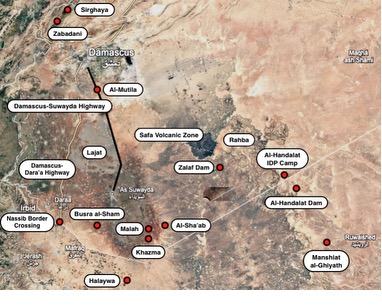
By mid-2022, most drugs and weapons trafficked into Jordan passed through Syria’s southeastern Suwayda province, part of the larger Harrat al-Sham volcanic region that extends into the al-Ruwayshid district in Jordan’s al-Mafraq province.[91] Trafficking between Suwayda and Ruwayshid is led by the Ahl al-Jabl Bedouin confederation, an alliance of non-kin tribes who live in both areas. One of the chief coordinators of this network is Rakan al-Khudayr, a Syrian-Jordanian dual national and member of the al-Shanabala tribe, whose members live in neighborhoods and towns immediately in and around Suwayda city in addition to the villages of Malah, Um Shama, and al-Sha’ab in the east Suwayda countryside and thirteen towns in Jordan’s al-Ruwayshid district.[92]
Figure 1. Relevant Smuggling Locations Along the Lebanon-Syria-Jordan borders – Image crated by author.
From al-Sha’ab, members of the al-Shanabala tribe’s al-Ramthan clan move contraband east toward the Rahba plain south of the Zalaf dam where it is transferred to al-Ghiyath tribesmen, a branch of the Shammar tribe that live east of the Safa volcanic zone in the Damascus desert and in the town of Manshiat al-Ghiyath in Ruwayshid. From Rahba, al-Ghiyath tribesmen move contraband to al-Handalat, the site of a former Syrian internally displaced persons (IDP) camp that was abandoned when the area was taken over by pro-Assad forces from US-backed rebels.[93]
The al-Handalat camp is located adjacent to the al-Handalat dam in Jordan’s Ruwayshid district, which is connected by a valley that provides cover to smugglers to cross the border without being noticed. Despite being abandoned, the tents of the former al-Handalat camp remain in place, providing smugglers cover from aerial surveillance.[94]After crossing into Ruwayshid from al-Handalat, al-Ghiyath tribesmen in Manshiat al-Ghiyath move drugs south to Saudi Arabia via the al-Haditha crossing—where they are received by Shammar and other northern Najdi tribes—while weapons are moved west toward the town of al-Halaywa, also home to members of the al-Ramthan clan.[95]
For most of this period, the al-Ramthan clan’s role in these efforts were led by Mara’i al-Ramthan, a trafficker from al-Sha’ab who was killed in a Jordanian airstrike on his home on May 8, 2023, after which his brother, Muhammad al-Ramthan, took over this role.[96] Muhammad al-Ramthan and his relatives remain frequent targets of Jordanian airstrikes, including on May 16, 2025, when Muhammad’s home in al-Sha’ab’s southern district was struck.[97]
Rakan al-Khudayr’s role in this network stems from his unique network of contacts in several key parts of southern Syria critical for smuggling. Though originally from the town of Malah in the east Suwayda countryside, early in life Rakan al-Khudayr’s father Khalid—a prominent livestock merchant—relocated the family to al-Mutila, south of Damascus, to be closer to the city’s large cattle markets. As he grew older, Rakan became a prominent exporter of Syrian livestock to Gulf and other regional markets, establishing contacts that would later prove useful following the 2011 outbreak of Syria’s civil war.[98]
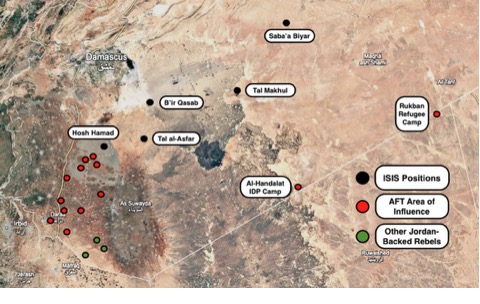
In October 2015, Rakan al-Khudayr founded the Army of Free Tribesmen (AFT) Syrian rebel group with funding from the Jordanian Armed Forces (JAF) and GID. AFT’s primary task was to protect Jordan’s border with Syria from penetration by ISIS cells based in areas south of Damascus, such as B’ir Qasab, Tal al-Asfar, and Hosh Hamad, and provide aid distribution and security at the Rukban and al-Handalat refugee and IDP camps, home to 85,000 displaced Syrians.
Figure 2. AFT-ISIS Geographical Distribution, October 2015-July 2018 – Image crated by author.
As a result, AFT established a significant presence in the east Dara’a and northwest Suwayda countryside and Lajat, the latter a volcanic rock field that has long served as a refuge for smugglers and separates the Syria-Jordan border from ISIS strongholds in the Syrian Central Desert.[99] However, by late 2016, allegations of embezzlement leveled against AFT leaders at Rukban and al-Handalat, along with the group’s failure to prevent a string of ISIS attacks on the border, pushed the JAF and GID to reduce their support for the group, limit AFT’s functions in both camps, and increase funding for other factions.[100] Keen to preserve its status in southern Syria, AFT quickly sought new ways to self-finance.
A leaked copy of a Jordanian State Security Court report reviewed by this author reveals that in early 2017, Jordan’s GID allowed AFT to traffic and resell $21.8 million in low-cost Syrian tobacco into Jordan in order to plug its funding deficits.[101] The report —circulated internally on December 3, 2019—was initially commissioned to investigate allegations that Rakan al-Khudayr and senior JAF officials embezzled funds from tobacco sales, which were not used to fund AFT. The report was part of a state crackdown on illicit tobacco smugglers starting in July 2018 in response to a popular protest movement against a sales tax increase on retail tobacco. Demonstrators protested the increase on the grounds that wholesale tobacco traffickers had been allowed to evade taxes and would not be affected by the law.[102] In response, that month a ministerial committee charged Awni al-Muti’a, the largest wholesale purchaser of Rakan al-Khudayr’s tobacco, and Wadah al-Hamud, Jordan’s Director of Customs, with tax evasion, arresting both men several months later.[103]
However, in July 2018—as Awni al-Muti’a was being charged—the Assad regime recaptured southern Syria, providing Rakan al-Khudayr with a convenient replacement for his lost tobacco revenue: Captagon. Despite having previously fought against Assad, AFT was one of many rebel factions in the area during this period that received amnesty as part of a reconciliation program with the Syrian regime brokered by Russia. As a result, AFT was able to expand its presence into previously inaccessible areas that had remained under the control of the Assad regime since 2011, including Rakan al-Khudayr’s hometown of al-Mutila and parts of the southeast Suwayda countryside.
For Iran, AFT’s expanded remit made it a useful ally, as it now controlled a wide swath of territory including al-Mutila, the Lajat volcanic field, and large parts of both the Damascus-Dara’a and Damascus-Suwayda highways. From these areas, AFT and Iranian proxies such as Hizbollah could collect, package, and assemble contraband before disbursing it to traffickers closer to the border who often had to evade Russian- and Jordanian-backed groups such as the 8th Brigade and others that aimed to thwart this traffic. In addition to assisting along the al-Sha’ab-al-Handalat route, AFT’s presence in the south Dara’a countryside also provided it a role in smuggling contraband via the Nasib Border Crossing with Jordan. Once in Jordan, Rakan al-Khudayr could use his Jordanian citizenship along with a network of companies at his disposal to move contraband deeper into the country.[104]
This operation expanded significantly following Russia’s February 24, 2022, invasion of Ukraine, after which Moscow withdrew thousands of troops from Syria, including in the south of the country. Iran, operating primarily through Hizbollah, took advantage of the vacuum to further insert its operatives into key positions. These efforts began in March 2022, when unknown assailants assassinated Maher Wasuf, Director of the official Nasib Border Crossing between Syria and Jordan. Wasuf had specifically been appointed to the position shortly before via a formal order issued by the Office of Syrian President of Bashar al-Assad, who tasked Wasuf with curbing Captagon flows in response to complaints received from Jordan. Wasuf was replaced with Yahya Miya, a Hizbollah affiliate. After that, a leadership shuffle of security officials in Dara’a province west of Suwayda resulted in other Hizbollah affiliates being appointed to lead Dara’a’s three local intelligence bureaus.[105]
Several months later, Hizbollah launched a campaign to eliminate the Anti-Terror Force, a US-backed faction formed one year prior in the town of Khazma, southwest of al-Sha’ab, tasked with trying to prevent smuggling along the al-Sha’ab-al-Handalat trafficking route. On June 9, 2022, 500 Hizbollah and other pro-Assad troops besieged Khazma and killed the group’s commander, Samir al-Hakim.[106] These and other killings led to a new outpouring of contraband into Jordan, with security forces seizing thirty-three million Captagon pills from January–September 2022, more than the sixteen million seized in the entirety of 2021.[107]
In the six months from October 2022–March 2023, Syrian smugglers made at least 108 cross-border attempts into Jordan, adopting new and expanded tactics, often moving in groups of hundreds separated into teams, including drone-equipped units tasked with reconnaissance.[108] Following the outbreak of the Israel-Hamas war on October 7, 2023, smuggling increased again, with traffickers carrying out 282 raids from October 2023–March 2024, as part of an Iranian attempt to increase the flow of weapons to militant groups in the West Bank in order to relieve pressure on Hamas in the Gaza Strip.[109]By December 2023, Jordan’s armed forces were violently clashing with large groups of smugglers nearly every day, while Saudi and Jordanian diplomatic efforts to negotiate an end to trafficking with the Assad regime had largely ended in failure.
Over the next several months, Jordanian security forces launched a final crackdown on Suwayda-Ruwayshid traffickers, beginning with a wave of airstrikes targeting smugglers on December 19, 2023, and a total lockdown imposed over Ruwayshid on December 27.[110] On December 30, al-Ghiyath notables in Manshiat al-Ghiyath recorded a statement from the home of tribal sheikh Ali Ayyad Hamir al-Sakran, saying, “we, notables of the al-Ghiyath tribe, condemn all acts [carried out] over the last several years that threaten…national security, and reiterate our pledge of loyalty to the Hashemite leadership, our glorious King His Majesty Abdullah II bin Hussein…and our noble armed forces…we call on our security forces not to tolerate any individual who threatens national security…and we disown [all those who do].”[111]
Over the next six months, Jordanian security forces continued their campaign of air raids in al-Sha’ab and elsewhere and seized at least 16.2 million Captagon pills on the border.[112] During this period, Jordan’s Public Security Directorate identified and issued arrest warrants for eight of the top traffickers based in Manshiat al-Ghiyath.[113] At least three, Abd al-Karim Ghiyath, Ayyad Hussein Ayyad al-Ghiyath, and Saud Ubayd Mukhlif al-Ghiyath, were arrested between February–April 2024.[114] By March 2024, Jordan experienced its first drop in cross-border trafficking, a trend that continued throughout the year, narrowing the space for Iran and its proxies to be able to threaten Jordan from its northern border.[115]
In so doing, Jordan was also able to contribute toward a significant reduction of violence on its border with the West Bank. By reducing the flow of weapons into the area—including at least three major seizures of high-quality explosives from March–June 2024—Jordanian security forces denied Palestinian militants key materials needed to produce homemade IEDs, which had increasingly been used to target Israeli troops starting in late 2022.[116] Without these weapons, both Israel and the Palestinian Authority (PA) were able to more easily pursue militant groups in the West Bank, launching three separate crackdowns in and around the cities of Jenin, Nablus, and Tulkarem between September 2024–January 2025, which have since led to a seventy-five to ninety percent reduction in violence in the area.[117]
For Jordan, the domestic threats the monarchy faced from 2021–2024 were largely driven by the new security dynamic created following the introduction of new Iranian-backed proxies on the country’s northern border, which helped trigger the growth of similar proxies on its western border. By successfully combatting the former, Jordan enabled Israel and the PA to more easily reduce the threat posed by the latter. Today, Jordan faces few state-sponsored threats on its borders, particularly following the December 8, 2024, overthrow of Bashar al-Assad, which forced Iran and its proxies to withdraw from Syria. Nevertheless, Iranian-linked actors from the Assad era remain active in the country, creating the potential for new challenges.
Risks in the Post-Assad Era
The December 8, 2024, overthrow of Bashar al-Assad in Syria has completely upended regional dynamics and led to a collapse in trafficking between Syria and Jordan from January–April 2025.[118] Assad’s removal also emboldened Jordan’s monarchy to finally crack down on the JMB, with security forces arresting sixteen JMB members who built a drone and missile production facility in Zarqa that manufactured rockets sent to the West Bank on April 16, 2025. One week later, authorities issued a final decree to outlaw the JMB, including the Muslim Brotherhood Society organization created in March 2015 to replace the group’s pro-Hamas wing.[119]
Nevertheless, persistent instability in Syria’s southeast Suwayda province has allowed for a resurgence in cross-border trafficking, with thirty-nine smuggling attempts between Syria and Jordan made over 106 days between April 4–July 22, 2025, one every 2.71 days.[120] That rate more than doubled between July 30–September 7, 2025, when thirty-two cross-border attempts were made over forty days, i.e., one every 1.27 days.[121] Since January 2025, Jordanian security forces have killed at least thirteen traffickers attempting to cross the border from Syria.[122][JP5][jh6] Similar to the period before Assad’s overthrow, many traffickers have been al-Ghiyath tribesmen.[123] The latest increase in smuggling post-July 30, 2025, came following a week of clashes in Suwayda province from July 11–18, 2025, between Bedouin tribesmen and the Druze religious community in Suwayda in which nearly 2,000 people were killed.[124] The clashes were the latest of five rounds of Bedouin-Druze clashes in Suwayda and Damascus, largely the result of disputes over land or familial blood feuds.[125]
Tensions in the area have been exacerbated by the Druze community’s reluctance to recognize the legitimacy of Syria’s new interim government led by the Salafi-Jihadist group Ha’it Tahrir al-Sham (HTS), formerly known as Jabhat al-Nusra, Al-Qa’ida’s former Syrian branch. Despite having split from Al-Qa’ida in 2016–2017, many in HTS still view the Druze minority as a heretical cult and legitimate targets for ethno-sectarian cleansing.[126] As a result, since Assad’s overthrow, Druze militias have refused to allow Syrian interim government military forces or police to enter Druze parts of the province. On August 6, 2025, Druze spiritual leader Hikmat al-Hajari went so far as to declare an autonomous republic in Druze parts of Suwayda, with security provided by a new Druze “National Guard.”[127] Many within the National Guard are former Assad loyalists who have sought refuge in Suwayda and have a history of involvement in trafficking.[128]
Due to limited state capacity in the months since the overthrow of Assad, during the July 11–18, 2025, fighting Syria’s interim government relied on a number of non-state armed groups to help confront Druze forces, in particular factions of Bedouin tribesmen from provinces outside Suwayda who quickly mobilized thousands of troops that deployed to the frontline.[129] These factions possessed no formal mandate and were commanded by tribal leaders, many of whom possess their own sordid history of trafficking, including a faction from Syria’s easternmost Deir Ezzor province commanded by Farhan al-Marsumi that deployed large numbers of fighters to Suwayda.[130] Since the fighting ended, many of these factions remain stationed on the frontline and have become one of the de-facto powers enforcing the Syrian interim government’s control over Bedouin parts of Suwayda.
Meanwhile, Rakan al-Khudayr’s AFT faction has become a formal arm of Syria’s new interim government, becoming a faction of the General Security Service (GSS), a militarized police unit under the country’s Ministry of Interior, in February 2025.[131] Since then, ex-AFT units have re-established control over parts of the Damascus-Suwayda highway, including Rakan al-Khudayr’s hometown of al-Mutila, from which AFT can impose sieges on Druze parts of Suwayda.[132]
Though Captagon production has largely shut down in Syria since Assad’s ouster, much of it has shifted to Hizbollah-controlled parts of Lebanon, with regular shipments passing into Syria via the towns of Sirghaya and Zabadani in the West Damascus countryside before heading south toward Suwayda and Jordan.[133] Rakan al-Khudayr’s historic ties to Iran and Hizbollah, along with its control over al-Mutila and other parts of the Damascus-Suwayda countryside, likely have played a role in ensuring the continued flow of narcotics to the area, along with the influx of non-state Bedouin armed groups into the area led by figures such as Farhan al-Marsumi.
In the aftermath of Assad’s overthrow, many observers proclaimed that the era of Iran’s influence in Syria had ended. However, should Syria’s interim government fail to successfully rebuild its economy and institutions and remain reliant on non-state armed groups and ex-traffickers to maintain stability, Iran’s influence may return in the medium to long term.
Policy Recommendations
In response to these ongoing challenges, the United States should build a strategy to combat trafficking remnants using a three-pronged approach:
Facilitate the disarmament of Hizbollah in Lebanon
Expand Syria sanctions regulations to include traffickers and insert stronger language aimed at combatting smuggling
Increase training of Jordan’s security forces and provision of expanded border security facilities, radars, sensors, and advanced anti-drone equipment
Since the collapse of the Assad regime, much Captagon production has shifted to parts of Lebanon controlled by Hizbollah, which, despite having been expelled from Syria and suffering numerous military setbacks against Israel since September 2024, remains the most heavily armed non-state armed group in the country.[134] Though Hizbollah’s capacity to contest Lebanese state control has been degraded, it remains sufficiently armed to operate as a highly effective organized criminal cartel that can repel efforts by the Lebanese Armed Forces (LAF) and other security services to stop Captagon production in areas under its control.
Hizbollah’s uncontested status in the Beqa’a Valley on the border with Syria further enables the group to act as a patron to Assad loyalist groups in Syria’s western Alawite coastal region, which continues to launch low-level insurgent attacks against the country’s interim government and carry out low-scale Captagon production.[135] Any strategy to combat ongoing Captagon trafficking in Syria that fails to account for the source of production in Hizbollah-controlled parts of Lebanon will prove unsuccessful, as any Syrian trafficking network taken down by security services will likely be replaced by new cohorts eager to reap the benefits of smuggling contraband between Lebanon and Jordan.
That said, on September 5, 2025, Lebanon’s Cabinet approved a five-point LAF plan to disarm Hizbollah within fifteen months in five geographical sectors, including the capital of Beirut, which Hizbollah and other Shi’a political parties have refused to comply with.[136] The United States should extend as much assistance as possible to the LAF in support of these efforts, building on recent positive steps taken in March 2025 to unfreeze $95 million in Foreign Military Financing to the LAF that had previously been paused by the Trump administration for review. Once disarmed, LAF and other security forces will find it far easier to shut down Hizbollah-controlled Captagon production sites and apprehend traffickers smuggling contraband into Syria.
Second, the United States should revisit its Syria sanctions regulations in the aftermath of Assad’s overthrow to include stronger language aimed at targeting traffickers and periodically update its list of designated individuals to include smugglers that have become active in recent months. Despite the general easing of the US position toward Syria more generally since Assad’s overthrow, the United States retains significant options for sanctioning such individuals.
On June 30, 2025, the Trump administration issued Executive Order 14312 “Providing for the Revocation of Syria Sanctions,” which removes most sanctions imposed on Syria during the rule of Bashar al-Assad in lieu of a formal Congressional repeal. However, sanctions targeting specific members of the former Assad regime, along with others linked to terrorism, human rights abuses, and chemical weapons remain in place.[137] This list of exceptions should be expanded to include more explicit references to trafficking and those involved in cross-border smuggling.
On August 26, 2025, the US Commerce Department’s Bureau of Industry (BIS) relaxed export controls on Syria, with the exception of dual-use and other sensitive items such as weapons and military hardware that are still subject to a US arms embargo on the country. The US Treasury Department’s Office of Foreign Assets Control (OFAC) has similarly removed Syria’s Sanctions Regulations from the Code of Federal Regulations and renamed remaining applicable sanctions as the “Promoting Accountability for Assad and Regional Stabilization Sanctions Regulations.”[138]
That said, considering that current trafficking between Syria and Jordan likely implicates groups with close affiliation to the former Assad regime, including Hizbollah in Lebanon and ex-Assad era traffickers such as AFT, Farhan al-Marsumi, and others, going forward, US officials should consider expanding the list of individuals included as part of new sanctions regulations. The continued existence of some export restrictions on Syria means that the United States retains carrots along with sticks that it can wield in order to entice the country’s government to deal more forcefully with traffickers. However, should such incentives fail, the Trump administration can issue new amendments to Syria’s sanctions regulations that would have a significant real-world impact, especially considering that Congress has yet to issue a formal sanctions repeal.
Ideally, sanctioned parties, including those within official state bodies and informal non-state structures, would be decommissioned, demobilized and forcibly expelled from border regions, or at least subject to leadership shuffles that marginalize sanctioned members. However, at this current stage in Syria’s development, significant mitigating circumstances would likely hinder the success of new sanctions on traffickers. First, Syria’s interim government is highly reliant on AFT and Bedouin non-state armed groups to maintain its authority and prevent further breakdowns in security in Suwayda and elsewhere in the country. Furthermore, considering that many of these factions draw from highly networked kinship-based tribal groups, the removal or targeting of individual traffickers or leaders will likely do little to stop any one group’s activity, as individuals could easily be replaced with front figures to act on behalf of actual power brokers. Sanctioning pillars of Syria’s current security regime further risks creating security gaps that could be penetrated by Hizbollah networks based in neighboring Lebanon or push sanctioned individuals to work closer with these networks than they otherwise would have.
Such efforts are also unlikely to be received positively by regional states, in particular countries such as Turkey, Saudi Arabia, and Qatar that are extremely keen to prop up and strengthen the current interim government in Syria in order to achieve specific foreign policy objectives, including:
Reigning in the Kurdish dominated Syrian Democratic Forces (SDF) on Turkey’s border with northeast Syria
Preventing the re-emergence of an Iranian foothold in Syria that can be used to link the latter’s proxies in Iraq, Lebanon and elsewhere
Converting Syria into a geographic corridor to host new pipelines linking Gulf oil and gas reserves to European countries via Turkey’s existing Trans Anatolian Natura Gas Pipeline (TANAP) network[139]
All of these states will prioritize these goals over any effort to rein in trafficking that results in a weakening of the current Syrian interim government. Jordan is similarly keen to ensure that Syria’s interim government remains strong, primarily to prevent the re-emergence of Iranian proxies on its northern border that can infiltrate and smuggle contraband into the kingdom. That said, should trafficking between Syria and Jordan continue apace as it did under Assad, Jordan may be more willing than other states to support efforts to extend sanctions. However, in an environment where the United States is less active in the region, should states such as Saudi Arabia and Qatar—which Jordan receives significant annual financial assistance from—pressure Jordan to oppose sanctions, it may well do so.
That said, expanding military support to Jordan remains the best strategy for combating trafficking in the short to medium term. As a frontline transit state through which most contraband passes before arriving elsewhere, securing Jordan’s northern border should be viewed as a regional security issue necessary to ensure broader Middle East stability.
On April 30, 2025, Jordan was one of three countries, including Israel and Egypt, that was granted exemptions to the Trump administration’s January 2025 freeze on foreign aid. Policies like this should continue, along with increased US military aid to Jordan, which in June 2024 opened the first NATO liaison office in the Middle East and North Africa.[140] Specifically, the United States should work with Jordan to build additional watch towers and border barriers in the 100km “al-Harra” stretch of Jordan’s northeast border with Syria that covers al-Ruwayshid. Since 2019, the United States has supported Jordanian efforts to build additional watch towers and surveillance systems in the area; however, these systems often fail to work effectively during periods of bad weather, hindering Border Guards’ ability to conduct patrols and detect smugglers.[141]
Furthermore, since the overthrow of Assad, nearly half of all cross-border smuggling raids into Jordan from Syria have been carried out by drones and heavy-carry balloons rather than armed or unarmed human escorts. In the latter years of Syria’s civil war, many non-state armed groups including HTS—which currently leads Syria’s interim government—and others developed significant proficiency in domestic drone production, knowledge that has likely spread to other actors within the country. As a result, the United States should help develop Jordan’s security services’ anti-drone capacity, providing and training security services in the use of advanced sensors, radars, and electronic jammer systems. In the future, should high-energy lasers (HEL) and high-power microwave (HPM) systems develop further and become more widely adopted, the United States should consider Jordan as a potential recipient of these emerging technologies, considering its hosting of the only NATO liaison office in the region and a decades-long history of cooperation in protecting US security interests and force posture in the region.
Conclusion
Iran’s exploitation of Syria’s narcotics trade illustrates how illicit economies can be weaponized to destabilize neighbors, constrain political choices, and empower proxies. Jordan’s near paralysis in confronting the JMB between 2021–2024 shows how trafficking pressure can alter domestic balances even in relatively stable states. The fall of Assad and the subsequent Jordanian crackdown demonstrate that these gains can be reversed. Still, the persistence of networks in Suwayda and Hizbollah’s entrenchment in Lebanon underscore that the threat is cyclical rather than resolved. For policymakers, the case reinforces a central lesson: countering Iran’s irregular warfare toolkit requires not only sanctions and interdiction, but sustained investment in border security, political resilience, and regional cooperation—without which illicit economies will continue to serve as a lever of coercion.
[1] Captagon is a mild amphetamine synthesized in Germany in 1961 as a treatment for narcolepsy and depression that was proscribed legally worldwide before being listed as a Schedule 1 controlled substance in 1981 in the United States. In 1986, the drug was listed by the World Health Organization for international scheduling, after which it was made illegal in most countries and became a widely trafficked street drug sought by users when cocaine and other stimulants were in short supply. By the early 2000s, Hizbollah began producing large quantities of Captagon in parts of Lebanon under its control, with the substance obtaining popularity as a “jihadi drug” that produced a euphoric intensity that numbed feelings of pain and fear and made it easy for fighters to carry out brazen acts of violence. Post-2011, some Captagon production shifted to Assad regime– controlled parts of Syria, with a significant spike occurring after mid-2018 when pro-Assad forces captured large swaths of territory from rebel groups in the north, center, and south of the country.
[13] Interview with four Suwayda based Syrian arms traffickers conducted August 2024–April 2025.
[14] Andrew Joseph Shyrock, History and Historiography Among the Belqa Tribes of Jordan (University of Michigan, 1993); Nora Barakat, “Marginal Actors? The Role of Bedouin in the Ottoman Administration of Animals as Property in the District of Salt, 1870-1912,” Journal of Economic and Social History of the Orient, April 2015”; Linda L. Layne, Home and Homeland: The Dialogics of Tribal and National Identities in Jordan (Princeton University Press, 1994); Yitzhak Reiter, “The Palestinian-Transjordanian Rift: Economic Might and Political Power in Jordan,” Middle East Journal, Vol. 58, No.1, 2004.
[15] Reiter, “The Palestinian-Transjordanian Rift.”
[16] Muhammad Abd al-Qadir Abu Faris, The Islamic Movement’s Approach to Change, (Dar al-Furqan, 1991); Ishaq Ahmed Farhan, Political Positions and Opinions on Arabic and Islamic Issues, (Dar al-Furqan, 1997).
[17] Ammar bin Suleiman bin Abdullah al-Ashqar al-Utaybi, Minor Resurrection (1991); Muhammad Abd al-Qadir Abu Faris, Women’s Civil and Political Rights in Islam, (2000).
[18] Ibrahim Ghosheh, TheRed Minaret:Autobiography of Ibrahim Ghosheh (2008); Saud Salem Abu Mahfouz, The Jordanian Muslim Brotherhood: 80 Years of Building (Al-Fursan Foundation, 2024).
[19] Ibrahim Gharaybah, From Da’awa to Politics: The Muslim Brotherhood in Jordan (2017); Bassam Amoush, The Muslim Brotherhood in Jordan’s Stations in History (2008).
[22]a Today, Sayf al-Adl remains in Iran and is AQC’s de-facto leader following the United States’ assassination of Ayman al-Zawahiri in Afghanistan on July 31, 2022.
[28] Madawi al-Rasheed and Loulouwa al-Rasheed, “The Politics of Encapsulation: Saudi Policy Towards Tribal and Religious Opposition,” Middle Eastern Studies, Vol. 32, No. 1, January 1996, https://www.jstor.org/stable/4283777.
[37] Cathy Scott-Clark and Adrian Levy, The Exile: The Stunning Inside Story of Osama Bin Laden and Al Qaeda in Flight (Bloomsbury, 2017), 206; “Bomber ‘moles’ in Saudi forces.”
[38] “Mapping the Saudi State, Chapter 5: The Saudi Arabian National Guard.”
[43] “Saudi Arabia: Arrest of a Criminal Drug Trafficking Network Including Ministry of Interior, National Guard and Defense Employees,” AlWatan, July 6, 2025, https://alwatannews.net; “Break up of a Drug Trafficking Network that Includes Accused from Several Ministries,” Al-Arabiya, October 16, 2024, https://www.alarabiya.net/saudi-today/2024/10/16/.
[54] Anne Marie Baylouny, “Militarizing Welfare: Neo-liberalism and Jordanian Policy,” Middle East Journal, Vol. 62, No. 2, Spring 2008: https://faculty.nps.edu/ambaylou/Baylouny%20military%20welfare.pdf; “The Aborted Mobilisation of Jordan’s Retired Servicemen”; Muhammad Abu Rumman, The Muslim Brotherhood in the 2007 Jordanian Parliamentary Elections: A Passing ‘Political Setback’ or Diminished Popularity? (Friedrich-Ebert-Stiftung, 2007), 24–25.
[57]The Muslim Brotherhood in the 2007 Jordanian Parliamentary Elections: A Passing ‘Political Setback’ or Diminished Popularity? 11, 37–38; Jillian Schwedler, “Jordan: The Quiescent Opposition,” The Wilson Center, August 27, 2015, https://www.wilsoncenter.org/article/jordan-the-quiescent-opposition; David Siddhartha Patel, “The more things change, the more they stay the same, Jordanian Islamists responses in spring and fall,” Brookings, August 2015, https://www.brookings.edu/wp-content/uploads/2016/07/Jordan_Patel-FINALE.pdf, 7; The Muslim Brotherhood in the 2007 Jordanian Parliamentary Elections: A Passing ‘Political Setback’ or Diminished Popularity? 39.
[58] “Jordan: The Quiescent Opposition”; Curtis R. Ryan, “Political Opposition and Reform Coalitions in Jordan,” British Journal of Middle East Studies, Vol. 38, No. 3, December 2011, https://www.jstor.org/stable/23264245, 376; Ibrahim Gharaibeh, “Rifts in the Jordanian Muslim Brotherhood,” Carnegie Endowment for International Peace, August 11, 2008, https://carnegieendowment.org/sada/2008/08/rifts-in-the-jordanian-muslim-brotherhood?lang=en; The Muslim Brotherhood in the 2007 Jordanian Parliamentary Elections, A Passing ‘Political Setback’ or Diminished Popularity? 40; “The Brotherhood Criticizes the Jordanian Government for [Undermining Democracy],” Al-Jazeera, 10 March 2002, https://tinyurl.com/ytddxa2f.
[62] “Jordanian Papers on Fundamentalism and Politics (4-5): The neighborhood strongman of Masoum who became America’s number one enemy in Iraq?: Zarqawi and Salafist Jihadism: Birth, Adolescence, and Trajectory”; “Jordan Amnesty,” Reuters Pictures, 24 March 1999, https://pictures.reuters.com/archive/JORDAN-AMNESTY-RP1DRILJBOAA.html; “The Political Memory | The Secret [Behind] Abu Musa’ab al-Zarqawi’s Refusal [to Accept] Mediation from Former Jordanian Minister Bassam al-Ammoush,” Al-Arabiya, November 4, 2022, https://tinyurl.com/d3tkynct.
[68] “The Political Survival of the Muslim Brotherhood in Jordan,” 201–202; Jacob Amis, “The Jordanian Brotherhood in the Arab Spring,” Hudson Institute, December 27, 2012, https://www.hudson.org/node/37222, 3; The Muslim Brotherhood in the 2007 Jordanian Parliamentary Elections: A Passing ‘Political Setback’ or Diminished Popularity? 25.
[69]The Muslim Brotherhood in the 2007 Jordanian Parliamentary Elections: A Passing ‘Political Setback’ or Diminished Popularity? 75.
[70] “The Political Survival of the Muslim Brotherhood in Jordan,” 205, 209.
[76] “Sentenced to Prison in the ‘Support Hamas’ Case in Jordan”; “‘Support the Resistance’ Detainees’ Sentences in Jordan Draws Widespread Protest”; “Jordan Sentences from 1-15 years those Accused of Supporting the Resistance”; David Schenker, “Terrorist Spillover in Jordan,” The Washington Institute for Near East Policy, June 23, 2016, https://www.washingtoninstitute.org/policy-analysis/terrorist-spillover-jordan; “Large Loss for the Brotherhood in the Jordanian Parliamentary Elections,” The Independent Arabic, November 11, 2020, https://tinyurl.com/2jf25ea3; “‘Party Affairs’ Moves to Dissolve ‘Partnership and Salvation’ and Forward its File to the Judicial,” Al-Ghad, February 17, 2021, https://tinyurl.com/ye2xck2f.
[92] Interviews with three al-Shanabala tribal notables, conducted August 2024–April 2025; Interviews with two al-Masa’id tribal notables, conducted August 2024–April 2025; Interview with four Suwayda based Syrian arms traffickers conducted August 2024–April 2025; Interviews with two al-Masa’id tribal notables, conducted August 2024–April 2025.
[97] Suwayda24, “Local sources for Sweda 24: The airstrike targeted a house under construction belonging to Mohamed Eid al-Ramathan from the clans of Al-Shaab village, resulting in its destruction, without recording any human casualties. The house is located on the southern side of Al-Shaab village, far south-east of Sueda Governorate.
A military aircraft, most likely to be Jordanian, had carried out an air strike about three hours ago, where this area has been seeing repeated strikes by the Jordanian Air Force three years ago, the last one was the beginning of this year, in the context of combating pillow smuggling operations,”
[98] Interviews with three al-Shanabala tribal notables, conducted August 2024–April 2025; Interviews with two al-Masa’id tribal notables, conducted August 2024–April 2025.
[99] “What Jaysh al-Asha’ir in Dara’a and What is it Supported by Jordan at the Expense of the South Front?- Here is Syria,” Orient (YouTube), December 2, 2015, https://www.youtube.com/watch?v=yBj-eUmYZSE; “#Russia and Violations of the #Geneva #Convention _ Embarrassing Angle _ Meeting with Sheikh Rakan al-Khudayr Speaking on OrientRadio,” Jaysh Ahrar al-Asha’ir, February 19, 2017, https://www.youtube.com/watch?v=RnwWnTC7y7E.
[101] Jordanian State Security Court Prosecutor and Military Judge Hazem Abd al-Salam al-Majali’s Report No. 12.14 year 2019 issued to the Chairman of the Jordanian Army Joint Chief of Staff on December 03, 2019.
[104] Interviews with three al-Shanabala tribal notables, conducted August 2024–April 2025; Interviews with two al-Masa’id tribal notables, conducted August 2024–April 2025; Interview with four Suwayda based Syrian arms traffickers conducted August 2024–April 2025; Interviews with two al-Masa’id tribal notables, conducted August 2024–April 2025.
[108] “STUDY: Normalization, One Year On,” ETANA Syria, June 18, 2024, https://etanasyria.org/study-normalization-one-year-on/; “Al-Ramthan Tribe Pledges to Prevent Smuggling Operations and Aid Syrian Border Guards’ Forces,” Al-Quds al-Arabi, January 7, 2024, https://tinyurl.com/tjv33ycz; Interview with four Suwayda based Syrian arms traffickers conducted August 2024–April 2025.
[109] “STUDY: Normalization, One Year On”; Interview with four Suwayda based Syrian arms traffickers conducted August 2024–April 2025.
[120] Data compiled by the author based on a full review of statements and announcements of seizures and busts from the Jordanian Armed Forces and Border Guards corroborated by media and other open-source materials.
Operations in the Information Environment in Support of Homeland Defense
The Irregular Warfare Center (IWC) invites unclassified paper submissions on the topic of Operations in the Information Environment (OIE) in Support of Homeland Defense.