Homeland Defense & Security: International (I2HDS)

Course Details & Pilot Offering
Dates:
12–15 January 2027
• Academic Seminar (Days 1–3; Required): 12–14 January 2027
• Interagency Site Visits (Day 4, Highly Encouraged): 15 January 2027
Location:
National Defense University (NDU), College of International Security Affairs (CISA), Fort Lesley J. McNair, Washington, D.C.
Classification Level:
Unclassified // Chatham House Rule applies
Class Capacity:
Typically 24–32 participants to preserve an optimal seminar and small-group exercise environment.
Homeland Defense and Security – National Security Course (HDS-NSC): International and Interagency Homeland Defense and Security for Irregular Threats (I2HDS)
Course Overview
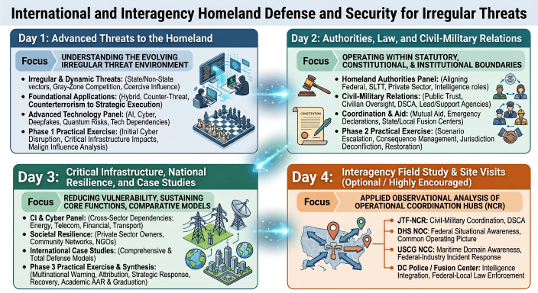
The Homeland Defense and Security – National Security Course (HDS-NSC) is an advanced 4 day long resident seminar subtitled International and Interagency Homeland Defense and Security for Irregular Threats or I2HDS. This course builds directly upon the foundational principles established in the IWC’s online prerequisite course, Irregular Warfare 110 (IW-110) Irregular Warfare approaches for Homeland Security (HS) and Homeland Defense (HD). HDS-NSC / I2HDS advances conceptual awareness into practical, operational, and strategic application. Through expert interagency dialogue, applied analysis, seminar case studies, facilitated exercises, and site visits across the National Capital Region, participants will examine complex homeland defense and security dilemmas characterized by persistent competition, ambiguous threat vectors, overlapping statutory authorities, and contested information environments. The program emphasizes integrated, whole-of-government and whole-of-society solutions to threats operating below the threshold of traditional armed conflict.
Course Learning Objectives
By the conclusion of the HDS-NSC course, participants will be able to:
- • Analyze Advanced Irregular Threats: Evaluate complex irregular, hybrid, technological, cyber, and malign influence threats targeting the homeland from state and non-state threat networks.
- • Navigate Legal and Institutional Frameworks: Explain and navigate the authorities, statutory constraints, jurisdictional relationships, intelligence oversight, and civil-military considerations governing domestic security and defense operations.
- • Apply Resilience and Preparedness Principles: Formulate national preparedness and societal resilience solutions to safeguard critical infrastructure, supply chains, and democratic institutions.
- • Evaluate International and Comparative Approaches: Analyze and compare interagency, total defense, and civil protection models from partner nations to identify transferable practices and bilateral interoperability opportunities.
- • Synthesize Integrated Recommendations: Formulate actionable interagency recommendations to improve cross-sector coordination, operational agility, and national resilience in contested environments.
Instructional Approach
The course utilizes an active, adult-learning seminar model combining multi-modal educational approaches:
- • Expert Practitioner Panels: Candid presentations and Q&A sessions featuring senior civilian, military, law enforcement, intelligence, and homeland security experts.
- • Facilitated Case Studies: Analysis of modern domestic and international gray-zone threats and whole-of-society responses.
- • Applied Scenario Exercise: A multi-day practical crisis exercise examining threat indicators, legal authorities, attribution, and response options.
- • Field Study & Site Visits: Applied observational visits to national-level coordination and fusion centers within the Washington, D.C. area to analyze real-time multi-agency coordination.
- • Open Discourse Environment: Conducted at the unclassified level using the Chatham House Rule to promote candid exchange among international, military, and interagency professionals.
Course Focus & Modules
Prerequisites & Target Audience
Prerequisite Coursework
Completion of the online, self-paced course Irregular Warfare 110 (IW-110) is a mandatory prerequisite prior to attending the resident seminar. IW-110 provides the baseline conceptual grounding in irregular threats, counter hybrid threat approaches, and interagency collaboration.
Intended Audience
This course is structured for mid-to-senior level practitioners, planners, and leaders across:
- • Allied and international security partners
- • Department of Homeland Security and federal law enforcement agencies
- • Department of War (Active, Reserve, National Guard, and civilian officials)
- • Intelligence Community officials
- • State, Local, Tribal, and Territorial (SLTT) emergency management and public safety officials
- • Private-sector critical infrastructure owners, operators, and cyber security specialists
Course Details & Pilot Offering
- • Dates: 12–15 January 2027
- Academic Seminar (Days 1–3; Required): 12–14 January 2027
- Interagency Site Visits (Day 4, Highly Encouraged): 15 January 2027
- Location: National Defense University (NDU), College of International Security Affairs (CISA), Fort Lesley J. McNair, Washington, D.C.
- Classification Level: Unclassified // Chatham House Rule applies
- Class Capacity: Typically 24–32 participants to preserve an optimal seminar and small-group exercise environment.
Course Enrollment
To request attendance at the upcoming pilot session of the Homeland Defense and Security – National Security Course (HDS-NSC / I2HDS), from 12-15 January 2027, contact the Homeland Defense Fellowship Director at NDU/CISA: Professor Antonio “T” Scurlock at: antonio.j.scurlock.civ@ndu.edu