
Raise the Cost for the PRC in Burma
Elizabeth Turnage (IWC INDOPACOM Analyst, CTR)
Dr. Joshua Hastey (IWC Deputy Regional Advisor for the Indo-Pacific, CTR)
The ongoing civil war in Burma (also known as Myanmar) presents a critical challenge to regional stability and an opportunity to counter the growing influence of the People’s Republic of China (PRC). While the conflict between the ruling junta and the resistance forces continues, the PRC is actively maneuvering to safeguard its economic and strategic interests. Despite claims of neutrality, Beijing’s actions reveal a clear bias toward the junta, providing crucial support while exploiting Burmese resources. This intervention has not been entirely successful for Beijing and has revealed potentially exploitable gaps in the PRC’s periphery. By strategically exploiting its economic and political interests, the United States can work with partners and allies to push back against Beijing’s attempts to shape the region for its own benefit.
The Stalled Situation in Burma
Four years after the military coup d’etat in February 2021, Burma remains embroiled in a civil war between the ruling military junta, made up of the majority Burma ethnic Tatmadaw military forces, and a loose coalition of resistance of the People’s Defense Force (PDF) and National Unity Government (NUG). Reflective of the diverse makeup of Burma – with 135 ethnic groups recognized by the state – the resistance coalition is made of over 25 pro-democracy militias and ethnic armed organizations (EAOs) which have existed since the country’s colonial times.
Though the resistance is not a cohesive unit, it has successfully denied the Tatmadaw complete territorial control of Burma. Indeed, the resistance successfully gained territory throughout 2023, capturing over 180 military outposts in the PRC-bordering Shan state alone. By the end of 2024, estimates held that the Tatmadaw Junta controlled only 21% of Burma, with the majority of their holdings being in urban areas – the lowest amount of territorial control by the military since the establishment of the state in 1962. Conversely, the resistance controls 42% of state territory – mostly in rural areas – with the remaining 29% contested between the two sides.
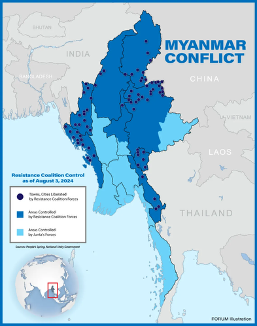
While the resistance has gained vital ground, the civil war in Burma has come to a standoff that favors neither side. The military junta’s forced conscriptions, attacks on civilian settlements, and history of ethnic repression and financial mismanagement have solidified resolve among the resistance. However, the fragmented resistance lacks a unified leadership or vision for a post-junta Burma, limiting the resistance’s ability to topple the regime. Indeed, a November 2024 report indicated that “neither the regime nor the key opposition actors appear willing to seriously negotiate” and that Burma will likely experience “continuing instability and a weakened government more willing to use violence.” Analysts predict the Junta’s latest effort to weaken the resistance and increase legitimacy – a general election in December 2025 – will likely increase tensions, with many opposition voices already claiming the election to be a sham.
The PRC: The Third Party in Burma’s Civil War
As Burma’s northern neighbor, the PRC has both economic and geopolitical stakes within the country. As such, the PRC has arguably become the leading actor in Burma, with their actions defining much of the civil war. Though the prevailing view is that the PRC is hedging its bets through split support to both the Junta and the resistance, the PRC’s actions demonstrate clear favor to the Junta. Indeed, evidence often cited to illustrate PRC support to the resistance should instead be considered self-serving actions for the PRC’s economic and strategic gain.
PRC Interests in Burma
- PRC Economic Interests
The PRC’s economic interests in Burma are driven by resource extraction and strategic infrastructure.
Burma is a key actor in the race for rare earth element (REE) dominance. Burma contains key deposits of the rare earth elements (REEs) terbium and dysprosium, which are components of sensors, semiconductors, and nuclear reactors with a variety of dual use applications. These deposits represent a significant percentage of the world’s REEs. Burma produced 11% of global REE supply in 2023, which ties Burma for second with the United States’ 11% and only follows the PRC’s 68%.
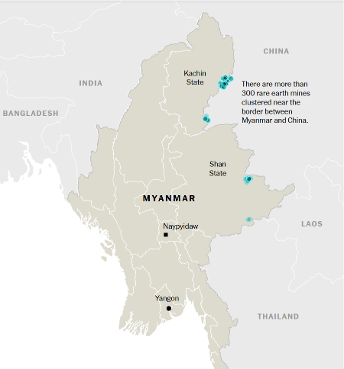
This REE production is inherently tied to the PRC. Burma’s REE mines are concentrated in the country’s northern Kachin and Shan regions along its border with the PRC. The labor at these unlicensed mines is estimated to be comprised of 30% PRC workers. These PRC citizens conduct the skilled labor of the mines, and the vast majority of the product being exported to PRC state-owned enterprises (SOEs) such as the China Rare Earth Group. As such, Burma was estimated to account for 57% of the PRC’s REE imports in 2024.
The PRC’s infrastructure interests in Burma center along the numerous Belt and Road Initiative (BRI) projects in the China-Myanmar Economic Corridor (CMEC). The CMEC is comprised of a series of deep-sea ports, transportation infrastructure, energy infrastructure, and industrial parks that strategically serve to provide the PRC direct access to the Indian Ocean. These projects are being completed via a number of Chinese SOEs such as the China Harbour Engineering Company, giving the PRC significant financial stake in CMEC completion. In addition to immediate finances, CMEC has strategic economic impact for the PRC. Once completed, these projects will allow the PRC to bypass the Strait of Malacca, a major shipping channel in the South China Sea that would serve as a chokepoint for the PRC economy in the event of conflict. Thus, PRC courting of both sides of the conflict should be perceived as efforts to ensure that CMEC projects in Junta-controlled, resistance-controlled, and disputed territory in Burma continue.
- Securing Regional Dominance
The PRC’s second major goal in Burma is to ensure the state retains dominance and control in the states in its periphery. This includes control of both state and non-state actors.
In terms of state actors, the PRC has an interest of mitigating the influence of western countries from the region. In Burma, the resistance has become softly affiliated with a number of western nations. In the name of supporting democracies, The United States has supported the resistance through non-lethal aid, humanitarian assistance, and political and diplomatic pressure against the Junta, including a number of sanctions against the Junta and its affiliates from 2021 to 2024. Likewise, the United Kingdom, European Union, and Canada have all imposed sanctions against the Burmese regime in 2023 and 2024. The PRC is incentivized to have the Junta consolidate power to rebuff a pro-western regime along its border.
This interest to counter western influence in Burma was highlighted in March 2025, when the PRC launched an influence campaign following Burma’s devastating earthquake. The PRC sent significant humanitarian aid to the country, accompanied by widespread videos of Chinese rescue officials searching through rubble. This timing came in tandem with a relative decrease in U.S. international aid – despite the United States pledging $2 million in aid for emergency – with the PRC capitalizing on filling voids in the international aid arena to sway the Burma population to become increasingly pro-PRC.
In addition to state actors, the PRC also has an interest in mitigating the power of transnational criminal organizations (TCOs) currently operating in Burma. Amidst the instability of a civil war, Burma has become a hotspot for TCO run scam centers, many of which are affiliated with Chinese criminal organizations. These scam centers traffic thousands of victims across Asia, including Chinese citizens. As such, these scam centers are manifestations of the limits of the PRC to control its own citizens, and the PRC state has an interest in removing them. This interest was heightened in January 2025, when the abduction of a prominent Chinese actor exacerbated public pressure for the state to act as a mass response by netizens spread on social media.
The PRC’s Faux Double Game
Defense thought leaders on the conflict frequently frame the PRC as playing a double game in Myanmar by providing support to both the Junta and the resistance. Citing diplomatic engagements and military support, analysts claim that the PRC hedges its bets on Myanmar so that it can maintain relations with whichever side emerges victorious from the conflict, or that the PRC stokes the conflict so that it can maintain strategic dominance over the country.
However, a closer examination of PRC support produces a different conclusion: Rather than hedging bets in Myanmar, the PRC has consistently worked to help the Junta consolidate control of the country. While the PRC has allowed tacit cooperation with the resistance for economic gain, it has made decisive action to structurally support the Junta’s consolidation. Beijing’s favor is illustrated by the differences in support between the two groups.
Though initially cautious in supporting the regime, a wealth of reporting illustrates that the PRC has provided significant diplomatic and military support to the Junta since the coup. This support has consistently positioned the Junta ahead of the resistance. For example, the PRC made significant arms sales to the Junta while withholding military aid to the resistance. The UN Office of Human Rights found that at least 41 PRC companies provided approximately $267 million in weaponry between the 2021 coup and May 2023. In addition, the PRC has provided two batches of FTC-2000G jets, Chinese-made aerial bombs, a number of unmanned aerial vehicles (UAVs), allowing the junta to conduct reconnaissance enact an average of 250 air attacks per month in 2024. Accompanying the sale of UAVs by PRC companies to the junta, the PRC also passed an export control regulation in December 2024 banning UAV exports to resistance movements, ensuring that the Resistance cannot gain access to the same weaponry. Most recently, the PRC maneuvered to increase the Junta’s legitimacy through the December 2025 elections. Indeed, the PRC not only pressured the Junta into holding Burma’s December 2025 election – the first in the country since the coup in 2021 – but also pledged technical and financial support to hold the election.
In comparison to this robust support, PRC interactions with the resistance are limited to cooperation in order to advance immediate PRC aims while positioning the Junta for success. For example, proponents of a PRC hedging strategy often highlight that the PRC has consistently cooperated with the resistance to operate REE mines and undermine scam centers in resistance-occupied Burma. However, this support has come hand in hand with clear PRC acts against the resistance. For example, following the resistance’s success in taking the city of Lashio in 2024, the PRC was reported to have captured resistance Chief of Burma National Democratic Alliance Army (MNDAA) Peng Daxun, to pressure the resistance into a ceasefire. In addition, the PRC has opened and closed trade gates between resistance-occupied Burma and the PRC to pressure the resistance on ceasefires. Even when these gates are open, the PRC has notably blocked the export of any military supplies to weaken the resistance. As such, the PRC’s engagements with the resistance are practical decisions to continue economic and geopolitical interests while ensuring the movement remains weak enough to be overtaken by the Junta.
The PRC’s Exploitable Blunder
The PRC’s involvement in Burma has not come without cost. From a financial standpoint, the PRC has billions invested between CMEC projects and different holdings within the country: Following the coup, the PRC was the number one foreign direct investment (FDI) contributor in Burma. Even so, estimates don’t include the cost of military support or PRC SOEs operating within Burma.
Beyond spending treasure, the PRC has incurred significant political cost in Burma. The PRC’s involvement in Burma has increased anti-Chinese sentiment in the country. Though Burma has historically distrusted the PRC for its involvement in their country, anti-PRC sentiment rose following the Junta coup as the Burmese public came to associate the PRC with the Junta. Just days following the coup, protesters gathered outside the Chinese embassy in Yangon, boasting signs with sayings like “Myanmar Military dictatorship is ‘Made in China.’” These protests escalated to attacks against PRC-owned factories, infrastructure, and citizens working in the country that have continued into 2025, along with growing online rhetoric against PRC interests and citizens in Burma. In addition to the PRC’s support to the Junta, public disdain has grown from the negative environmental impacts of PRC businesses and REE mines.
These costs can be exploited by the U.S. Government (USG). First, the USG could work to impose reputational costs on the PRC for its actions in Burma. By advertising the adverse effects of PRC investment – like environmental and public health impacts of the REE mines – the United States could stoke the flames of anti-PRC sentiment within Burma. Likewise, the United States could work to impose reputational costs of “playing both sides” of the conflict to the benefit of the Junta. Given that the resistance still controls key trade routes for REE exports in the north, the resistance could opt to stop REE exports in response to the PRC’s increasingly blatant favoritism to the Junta.
Further, the United States could provide alternative narratives to the PRC within Burma. A myriad of countries and the United Nations sent aid or rescue teams in response to the March 2025 earthquake. However, the PRC was able to make it appear like the PRC was the primary aid provider because the other countries did not stage their own publicity stunts to flaunt their aid, gifting the PRC the ability to control the narrative. As such, the United States could work with our allies and partners to amplify existing aid, trade, and diplomatic efforts in country to deny the PRC control of the narrative space. This in turn would not only allow the Burmese public with a better understanding of the truth but also force the PRC to expend additional resources to counteract this messaging.
Elevating the reputational costs for the PRC and contesting its narrative hegemony could yield several strategic advantages for the United States as these lines of effort offer a low-cost method to impose relatively high costs against the PRC. By compelling the PRC to expend resources mitigating challenges to key economic and geostrategic interests along its periphery, we can effectively dilute its capacity to engage offensively against U.S. interests in the broader region. In addition to imposing costs on the PRC, these lines of efforts also stand to increase partner and ally capacity to assume burden sharing. Amplifying existing partner efforts within Burma empowers regional actors to actively counter PRC expansionism. This facilitates a redistribution of the associated costs and risks of countering the PRC, transitioning from a unilateral burden to a shared responsibility amongst allies and partners. Further, building up partner and ally capacity then fosters a decentralized network of resilience against malign foreign influence, effectively hardening the region against further PRC encroachment. As such, this multilateral approach enhances U.S. interests in countering the PRC’s expanding influence without undue costs to the United States.