
Clash or Convergence of Equities?: Exploring Overlap Between Russia and China in Africa
Across history, great power contestation has occurred in Africa, often with little regard for the impact on local governance, populations, or regional security. Today, both the People’s Republic of China (PRC) and Russia have extensive interests across the continent. Two recent incidents in the Central African Republic (CAR) bring the possibility of PRC and Russian direct competition or cooperation into stark relief. In March 2023, gunmen, allegedly affiliated with Wagner Group, according to local rebel fighters, killed nine Chinese nationals at a gold mine. Months later, Wagner Group members claimed to rescue kidnapped Chinese miners in CAR. Gold mining in CAR was a primary method for funding Wanger Group activities, making new gold exploration concessions to PRC a potential threat to the Russian private mercenary company (PMC). The two incidents in 2023 present two possible paths for increasingly overlapping Chinese and Russian interests in Africa – cooperation or potentially violent competition.
Following Wagner Corps’ initial deployments to the CAR and Libya in 2017, much has been made in the Western press about the group’s role in propping up authoritarian governments, extracting resources, and abusing human rights. Separately, the PRC’s use of aid, loans, and economic partnerships to secure soft power influence in economically or strategically significant countries has generated concern across western capitals. Less examined is the role that these two efforts, one rooted in providing hard power for a price and one rooted in economic ties, overlap. Additionally, while the PRC-based private security or private military companies (PSC/PMC) do not offer directly analogous services as Russian PMCs, their growing presence across the continent creates novel opportunities for Russian or PRC equities to either overlap or clash.
State of Play in 2025
Russian Presence in Africa
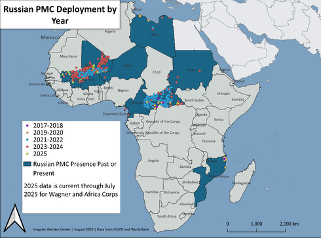
In order to accurately predict where competition or cooperation is likely to occur, it is vital to understand the current PRC and Russian presence. While the fallout from the 2023 Wagner Group mutiny has changed the composition of the Russian presence on the continent, a Russian PMC presence is continuing across most partner countries under tighter control by the Russian Ministry of Defence (MoD). As of mid-2025, Russian PMCs are present in the CAR and in the Sahel states. Additionally, supply lines and front companies in Cameroon provide Russia force access into the CAR. In West Africa, the most active recent Russian PMC presence is in Mali and Burkina Faso, alongside limited activity in Niger and Equatorial Guinea. In both Mali and the CAR, the PMCs are supporting the government’s battle against insurgents. Additionally, Russian operations in the information environment (OIE) target multiple regions of the continent, especially across West Africa broadly in support of anti-Western military rulers with a particular focus on increasing the popular perception of the Burkinabe military junta leader Captain Ibrahim Traoré in the region.
Chinese Economic Overlap with Russian PMC Presence
Based on a review comparing available datasets on Chinese foreign direct investment (FDI), aid, and loans against the geographic distribution of Wagner/Africa Corps deployment, Chinese financial investment and Russian PMC security presence have limited overlap in Africa from 2018-2024. This indicates that there are currently limited opportunities for Africa Corps and PRC investment to be in direct competition or conflict unless one or the other expands its geographic scope on the continent.
The lack of Russia/China equity overlap is likely at least partially a selection effect. Russian mercenaries under both Wagner Group and Africa corps have mostly deployed to insurgent beleaguered countries (such as Mozambique, Libya, and the CAR), many of which have recently experienced authoritarian takeover (Mali, Burkina Faso, Niger, and Sudan). Contracting with a Russian PMC is often an option of last resort for governments that are actively being ostracized by regional and international blocks such as the Economic Community of West African States (ECOWAS) or Western aligned countries. These same characteristics make economic investment less desirable for the PRC. Even debt trap diplomacy, where loans are motivated by geopolitical interests rather than prospect for repayment, is riskier if the target government is unstable. The one contradictory selection effect in Africa that, on its own, would point to greater overlap is Russian PMC’s proclivity to target partner countries that have resource extraction opportunities. Examples include mines in Mali or Central African Republic which generate revenue for the mercenaries. While this could lead to potential competition with PRC state-owned enterprises (SOEs), it may be partially offset by Russian PMC’s target resources being precious or semi-precious metals rather than rare earth resources.[1]
There has been modest geographic overlap of PRC aid and Russian PMC activity. As identified in AidData’s Chinese Development Finance Dataset, PRC aid overlapped with Russian PMC presence in Mali, Mozambique, and Central African Republic. Overlap in Mali includes PRC humanitarian aid and participation in a UN deployment, while in Mozambique, the PRC provided food aid. Additionally, the PRC provided $2 million for a World Food Program anti-malaria campaign in the CAR.
Chinese PMC or Private Security Company (PSC) Overlap with Russian PMCs
Private security isn’t a Russian monopoly; multiple PRC companies work on security contracts in Africa. Most of the PRC companies prefer the term Private Security Company (PSC). Despite lower quality data on where Chinese PSCs are active within countries compared to Russian PMCs, we have identified at least 19 African nations in addition to the de-facto independent Somaliland where Chinese PSCs are currently active have had a presence in the near past. We reached this number by building on work from RAND Corporation and the Africa Center for Strategic Studies (ACSS). Identified geographic overlap between PRC PSCs with Russian PMC occurred in Mozambique, Sudan, Central African Republic, Libya, and Mali. In addition to the PSC presence mapped below, People’s Liberation Army (PLA) troops are stationed in Djibouti, and PLA troops have been part of UN peacekeeping missions in the DRC (MONUSCO), South Sudan (UNMISS), Sudan (UNISFA), Mali (MINUSMA), and Morrocco (MINURSO).
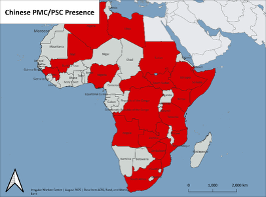
Despite operating in some of the same areas, PRC PSCs have key differences that prevent them from directly competing with Russian PMCs. While Wagner Group or Africa Corps often join government forces in firefights with insurgents, PRC PSC deployments are lower profile and generally avoid direct involvement in conflict. Many of the PRC PSC firms are contracted to embassies or PRC SOEs to guard infrastructure in-country, making them more likely to fly under the radar. PRC law bans security contractors from carrying weapons anywhere in the world, though this prohibition is not universally enforced. Like Russian PMCs, PRC PSCs aren’t immune to controversy, such as when PRC PSC members employed by a gold mine were imprisoned for shooting a parliamentarian’s son in Zimbabwe. The law does make PSC groups more likely to contract with armed locals wherever they are deployed. Thus, despite the overlap, Chinese PSCs present only a modest business threat to Russian PMCs since they target a different clientele and face restrictions on carrying weapons.
Potential Overlap in the Near to Medium Term
Despite limited current economic or military overlap between Russian PMCs and Chinese interests, equity overlap is likely to increase in the near to medium term. While in parts of the continent the two forces may continue to not engage in direct competition, two types of expansion could bring Russian PMCs and Chinese interests into direct competition. First, a Russian PMC expansion into security in the DRC, especially following the failure of Western mercenaries, could threaten PRC interests in the region. Separately, an expansion of PRC economic investment in CAR, especially in resource extraction could threaten a key financing mechanism for Russian PMCs.
Democratic Republic of the Congo
China has an extensive economic involvement in the DRC through SOEs operating rare earth resource extraction or serving as middlemen for export. Additionally, regardless of how the extraction occurs, a majority of rare earth resources are refined in China. On security, the PRC linked Frontier Services Group has provided security training for Chinese firms in North, South Kivu, and Ituri province. Unlike other incidents of Chinese PMC/PSC, Frontier has acted like Wagner, with associated businesses reportedly involved in gold smuggling.
Conversely, Russia has few direct current interests in the country. There have been unreliable reports of Wagner in DRC, though these rumors may stem from mistaken sightings of western mercenaries. However, Russia may have expansion aims into the DRC for the near future. In March 2024, Russia signed a defense cooperation agreement with the DRC. In 2025, the semi-official TASS news agency reported that the head of the Officers Union for International Security, which the U.S. Treasury claims is a front company for Wagner, “wished that the DRC ‘will just as successfully overcome all difficulties [as the Central African Republic did with Russian help] and [that the DRC will] enter a path to long-term development as soon as possible.’” Russia also has limited involvement with Rwanda, which supports M23 rebels in the east of the DRC, though President Kagame has been careful to praise President Putin and not criticize Russia’s invasion of Ukraine.
In addition to expressed Russian interests, the DRC has a recent history of hiring mercenaries and offering resource concessions in exchange for support, which may make it ripe for Wanger Group-style involvement. The country’s limited air force has depended on Georgian pilots and both Bulgarian and Romanian companies have offered “training” or served as mercenaries in the country’s east.[2] The support from these companies wasn’t sufficient to stop M23’s advance or capture of Goma. Following the January 2025 battle of Goma, around 280 Romanian fighters hired by the DRC exited through Rwanda after the UN negotiated their safe passage. Following the M23 offensive and PRC playing both sides of the conflict, DRC President Felix offered the U.S. mineral concessions for support.
All of these factors, Russian willingness to engage in the DRC, the DRC’s willingness to hire mercenaries, and DRC administration’s willingness to trade mineral access for support, makes the DRC a key expansion opportunity for Russian PMCs. Russian PMC expansion is especially likely if conflict in Ukraine diminishes, freeing up resources and creating a newly available cohort of trained fighters for Africa Corps or other Russian PMCs to recruit and deploy. Given the PRC’s extensive economic interest in the DRC, combined with its modest PSC presence at PRC SOE-linked sites, any major Russian PMC deployment to eastern DRC would bring the Russian PMC into closer proximity to major PRC interests than any previous deployment on the continent. Unlike in other areas of Russia-PRC equity overlap, in the DRC, any mercenary deployment funded through resource extraction would bring Russian mercenaries into competition with Chinese-backed companies. While this could lead to broader conflict, the most likely outcome would be Russian PMC integration into PRC mineral supply chains due to PRC near-monopolization of mineral refinement, including lithium and cobalt. While options exist outside of the PRC, such as in Estonia, this would likely be out of reach for Russian businesses due to Western sanctions, forcing closer relations with PRC-linked companies.
Central African Republic
The CAR presents nearly the opposite situation as the DRC: a significant Russian PMC presence and a modest amount of PRC investment. However, if PRC economic presence in CAR expands, it is possible that its investments would bring PRC SOEs in direct competition with Russian PMCs.
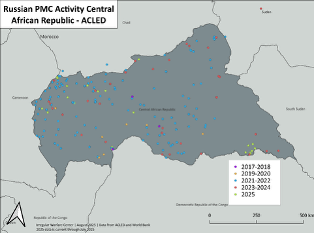
Wagner group first deployed to the country in 2018 as “instructors” amid CAR’s civil war. Wagner groups presence, which includes multiple front organizations, was financed through gold and diamond concessions. Despite lucrative mines, early media reports indicate that the Russian government’s attempt to force a transition from Wagner Group to Africa Corps has generated tension. Reportedly, Africa Corps has demanded direct payments rather than the Wagner model of resource concessions.
The PRC, on the other hand, has a modest amount of investment and aid in the CAR, according to multiple datasets tracking PRC overseas activity. The PRC has led an anti-malaria campaign and contributed around $2 million to a World Food Programme project. Additionally, in 2018, the PRC invested approximately $46 million in foreign direct investment, representing less than 1% of the PRC’s FDI flow to Africa in 2018. Following the 2018 investment and the increase in both Wagner Group activity alongside fighting in the civil war, the number decreased to less than a million a year in preceding years, according to Johns Hopkins University’s China Africa Research Initiative dataset. Other than a 2019 $29 million loan to the government for a solar power project to power the capital that emerged out of the 2018 China-Africa summit, there has been limited PRC loans to the country. While the solar project has represented sustained PRC state-sponsored activity in and around Bangui, the project was completed in 2023, and a review of Boston University’s Chinese Loans to Africa Database does not reveal any additional loans from 2018-2023
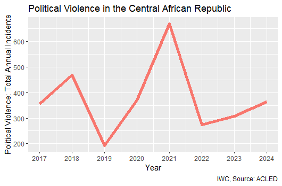
While CAR continues to face political violence and insurgency, political violence (including both insurgent attacks and Wagner group-linked abuses) has diminished since recent highs in 2021. If violence continues to abate despite an uptick in political violence in 2024, new avenues for international investment could open in CAR. If PRC economic presence in CAR expands, it is possible that these investments would bring PRC SOEs into direct competition with Russian PMCs. The Wagner group has a history of violently defending their economic presence in the CAR, potentially indicating a potential conflict with any new economic competition from PMC-linked businesses. While it is possible that an increased PRC economic presence in CAR could lead to direct conflict between a Russian PMC and Chinese workers, two factors make such an outcome less likely: the transition of Russian PMCs directly under the Russian MoD and the Russian interest in transitioning to a direct payment model over resource concessions.
As the Russian MoD takes direct control of Russian PMCs, the government is shifting to a direct command relationship with mercenaries rather than the opaque relationship between the Russian government and Wagner group subsidiaries. This direct relationship both removes an element of plausible deniability and makes Russian PMC activity more accountable to broader Russian foreign policy. As the PRC and Russia grow closer together diplomatically and economically due to sanctions on Russia over the Ukraine war, it is unlikely that Russia would sacrifice that economic lifeline for fighting over narrow economic interests in what remains a strategic backwater for Russia. Additionally, if the trend of the Russian government pressuring its African partners to switch from funding Wagner mercenaries with recourse concessions to funding Africa Corps mercenaries with direct payments continues, there will actually be an expanded opening for PRC economic activity, potentially protected by Russian PMCs.
Conclusion – Opportunities for Irregular Contestation and Irregular Cooperation
Both the Russian Federation and the PRC are active across the continent, though there is limited direct overlap of their equities. While some of this Russian and PRC activity is open, normal investment through both SOEs and, at least nominally, non-state investment firms, a significant subset of both countries’ presence falls under the umbrella of irregular activities. For Russia, this involves proxy forces and security assistance for hire. On the PRC side, as explored in this article, the presence partially involves private security services but primarily focuses on economic involvement. While both the PRC and Russian presence in Africa use irregular tactics, including proxy forces and economic coercion, to achieve strategic goals, the two sides are unlikely to directly compete. As discussed in this article, there is limited current overlap between PRC and Russian equities in Africa. While two potential pathways could increase the likelihood of direct competition – Russian expansion into the DRC or PRC expansion into the CAR, both have factors that would limit the potential competition. The DRC pathway is the most plausible in the near to medium term due to Russia’s expressed desire to engage, the DRC’s willingness to hire mercenaries, and the DRC administration’s willingness to trade mineral access for support. However, the PRC’s near monopolization of rare earth resource export and refinement, coupled with the PRC’s minimal involvement in security in the DRC, limits the potential likelihood that a Russian expansion into DRC would lead to significant conflict. Still, if an expanded Russian PMC presence further destabilized eastern DRC, the broader instability would threaten PRC SOE investment regardless of whether the Russian PMC was in direct competition or conflict with PRC interests. Separately, an expansion of PRC involvement in the CAR is possible given the limited current presence, combined with underexplored natural resources and the potential moderation of violence in the country. However, this expansion would not inherently prompt Sino-Russian competition. As the two 2023 examples at the beginning of this article demonstrate, a PRC expansion in CAR could lead to either conflict or increased cooperation. While Chinese resource extraction would bring it into competition with Wagner affiliates, Africa Corps demands to be paid directly by the government rather than through resource concessions could diminish the long-term potential for competition if Russia is successful in forcing Bangui to switch how it contracts mercenaries.
[1] While it is too early to tell, Africa Corps may prefer direct payments to the Russian government over resource concessions. According to media reports in August 2025, the Central African Republic was resisting Russian demands to switch to Africa Corps’ model of security assistance from Wagner Group, preferring Wagner Group because it allowed its fees to be paid by resource concessions.
[2] Note: Under European Union law, it is illegal to be a mercenary. These companies often publicly claim to be consultants, trainers, or providing defensive security. The Romanian mercenaries exited through Rwanda after the fall of Goma to the Rwandan backed M23.