
Irregular Warfare 301/401 (IW-301/401 MTT)

Course Details

Course Format:
 5-Day In-Person Intensive (Mobile Training Team)

PME & Interagency Level:
Senior Operational & Strategic Leaders (O-4 to O-6, CW4–CW5, E-8 to E-9, GS-13 to GS-15 / Interagency Equivalents)

Credential:

IWC Resident Certificate in Advanced IW Campaign Design & 40 Continuous Learning Points (CLPs)

IW-301/401 MTT: Campaigning in Competition Course

Course Purpose & Overview

The Irregular Warfare 301/401: Campaigning in Competition Course is an intensive, five-day executive course designed to equip joint force command staffs, interagency partners, and allied leaders with the intellectual tools and operational disciplines necessary to protect and advance U.S. national security interests in enduring competition below the threshold of armed conflict.

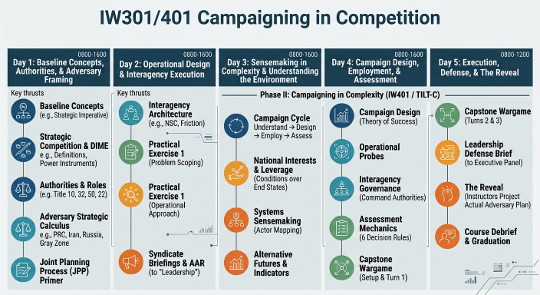
Traditional military education bifurcates deliberate doctrinal planning and irregular warfare campaigning. IW301/401 joins the two via modular courses that connect to form one continuous argument. The in-person course compresses the foundational principles of Irregular Warfare 301 (Doctrinal Operational Design and JPP) into an accelerated two-day baseline, and integrates it directly with the advanced executive seminar of Irregular Warfare 401 (Persistent Campaign Design, Systemic Complexity, and Adaptive Probing).

Over five immersive days, cohorts transition from bounded, crisis-driven planning (aimed at a decisive military end state) to unbounded, continuous campaigning (designed to gain and hold the influence, advantage, and leverage that protect and advance national security interests, and to adapt before that position erodes).

Flexible & Modular Scenario Architecture

IW301/401 is scenario-modular and tailorable to the host command, agency, or regional operational focus. Rather than being restricted to a single theater, the course can be delivered utilizing multiple scenario tracks based on the IW301 scenario options focused on countering China, Iran, or defending the homeland from irregular threats.

The Core Discipline: Three Capabilities, One System

IW301/401 approaches modern competition through the synthesis of three mutually dependent disciplines. A student or staff that masters one while neglecting the others plans confidently in the wrong direction:

  1. Operational Design & Doctrinal Discipline (IW301, Days 1–2): Grounding operational problems in national strategy, authority boundaries, joint planning formats, and the synchronization of all instruments of national power (Diplomatic, Informational, Military, Economic, Financial, Intelligence, and Law Enforcement, or DIMEFIL).
  2. Design Thinking in Complexity (IW401, Days 3–4): Starting from the national security interests at stake, moving beyond linear causality to map dynamic systems, define leverage points, identify systemic vulnerabilities, and construct an explicit “Theory of Success.”
  3. Persistent Campaigning & Probing (IW401, Days 4–5): Shifting focus from static “end states” to establishing and holding desired conditions over time by sequencing a portfolio of probes across the interagency, recording what each is expected to achieve, and applying clear decision rules to reinforce, hold, or divest as conditions change.

Course Learning Objectives (CLOs)

Upon successful completion of the course, participants will be able to:

  • CLO 1 – Evaluate Strategic Context: Contrast traditional bounded crisis-planning paradigms against continuous, unbounded campaigning in gray zone competition.
  • CLO 2 – Navigate Legal & Interagency Seams: Explain how departments and agencies apply the instruments of national power under their own authorities (Titles 6, 10, 14, 22, 32, 50, and Lead Federal Agency structures), abroad and in the homeland, and integrate their kinetic and non-kinetic effects.
  • CLO 3 – Ground the Campaign in Interests and Map the Rival: Identify the national security interests a campaign must protect and advance, then model rival systems (PRC, Iran, Russia, or surrogate networks) using sensemaking frameworks (e.g., Cynefin) to find leverage points.
  • CLO 4 – Formulate Theories of Success & Actionable Probes: Build a theory of success and sequence a portfolio of probes, each with a stated logic, indicators of effect, and triggers to reinforce or divest.
  • CLO 5 – Execute Dynamic Assessment & Campaign Reframing: Apply the campaign decision rules (g., Hold, Reinforce, Divest) against simulated intelligence feeds and an evolving adversary counter-campaign.
  • CLO 6 – Defend Strategic Initiatives: Brief and defend interagency campaign decisions each turn, then evaluate them against the rival campaign plan revealed at the close of the exercise.

Target Audience & Class Composition

  • Ideal Cohort Size: 27–36 students (organized into three or four balanced syndicates of 8–12 practitioners).
  • Target Audience:
  • Joint, Service, and Combatant Command operational planners (J3, J5, J39, J2).
  • Interagency security professionals (DOS, DOJ/FBI, DHS/CISA, Treasury, ODNI/CIA).
  • National Guard and Reserve leaders navigating Title 10/32 interfaces.
  • Allied and coalition military and security planners operating in contested theaters.
  • Prerequisites: Completion of Irregular Warfare 101 or foundational PME/operational experience is strongly recommended.
  •  

Requesting an IW301/401 Campaigning in Competition Course

The Irregular Warfare Center conducts IW301/401 courses at resident education centers and as mobile training teams (MTTs) deployed directly to Combatant Commands, regional hubs, and interagency organizations worldwide. Commands or organizations desiring to sponsor a tailored iteration (including classified delivery options or specific regional adversary scenarios) should submit an official Request for Support (RFS). IWC Education Request for Support
Email: info@irregularwarfarecenter.org
