
China’s Way of Occupation: Implications for Taiwan
By Jan K. Gleiman
With Jocelyn Garcia, Troy Acevedo, Lee Thurman
This research is funded by the Irregular Warfare Center, U.S. Department of Defense under Contract HQ0034-24-C-0108
Table of Contents
Abstract

This report examines the People’s Republic of China’s (PRC) enduring habits and approaches to occupation to develop a PRC “way of occupation” and considers how the PRC might occupy, pacify, and integrate Taiwan after seizing the island—an area largely neglected in wargames and policy analyses that end with invasion. Through structured comparison of Tibet, Xinjiang, and Hong Kong, the study identifies recurring logics of PRC control: occupation begins before invasion; coercion is framed as lawful governance; identity becomes the long-term battleground; surveillance is structural; political opportunity space is manipulated; resistance is fragmented; and time is treated as a strategic asset.
These patterns are reinforced by contemporary reforms under Xi Jinping, including the expansion of the People’s Armed Police, creation of the Information Support Force, and new laws enabling surveillance and repression under claims of legality. Together, they constitute a coherent “way of occupation” that blends coercion, lawfare, and identity transformation.
Taiwan’s distinct context—democratic legitimacy, advanced economy, strong civic identity, and global integration—complicates Beijing’s model. The decisive variable will be the mode of seizure: capitulation under coercion may allow for legalistic integration, while military conquest would fuel enduring resistance resembling counterinsurgency. The study concludes that any PRC occupation would trigger a protracted contest over legitimacy and identity, underscoring the need for Taiwan and partners to invest now in resilience and resistance planning.
Author Bios
Professor Jan K. Gleiman (Ken) is the Senior Research Professor for the DoW Irregular Warfare Center (contractor). He is a Professor of Practice at Arizona State University’s Future Security Initiative and the Editor-in-Chief of Small Wars Journal.
Troy Acevedo is veteran and a graduate student in the Master of Arts in Global Security (MAGS) program at ASU.
Jocelyn Garcia is a graduate student in the MAGS program at ASU and the Director of Communications for Small Wars Journal.
Lee Thurman is a graduate of the MAGS program at ASU and currently serving as a research specialist (contractor) for the DoW Irregular Warfare Center
List of Acronyms
| Acronym | Definition |
| BLDC | Basic Law Drafting Committee |
| CCP | Chinese Communist Party |
| CEPA | Closer Economic Partnership Arrangement |
| CIA | Central Intelligence Agency |
| CMC | Central Military Commission |
| DoW | Department of War |
| HKSAR | Hong Kong Special Administrative Region |
| IJOP | Integrated Joint Operations Platform |
| ISF | Information Support Force |
| KMT | Kuomintang Party |
| NPC | National People’s Congress |
| NPCSC | National People’s Congress Standing Committee |
| NSL | National Security Law |
| OSNS | Office for Safeguarding National Security |
| PAP | People’s Armed Police |
| PCART | Preparatory Committee for the Autonomous Region of Tibet |
| PLAN | People’s Liberation Army Navy |
| PLA | People’s Liberation Army |
| PRC | People’s Republic of China |
| ROC (Resistance Operating Concept) | Resistance Operating Concept |
| ROC (Republic of China) | Republic of China |
| SMS | Science of Military Strategy |
| TAR | Tibet Autonomous Region |
| UFWD | United Front Work Department |
| UARX | Uyghur Autonomous Region of Xinjiang |
| UN | United Nations |
| XPCC | Xinjiang Production and Construction Corps |
Executive Summary[1]
The debate over Taiwan’s future often focuses narrowly on invasion scenarios and the opening phases of conflict. Wargames and policy simulations generally stop after a few days or weeks, treating the People’s Liberation Army’s (PLA) landing or a blockade as the natural endpoint. This study begins where those simulations end. It asks a different and equally strategic question: if the People’s Republic of China (PRC) seizes Taiwan, how would it occupy, pacify, and integrate the island into the PRC system?
The answer matters. History shows that China’s struggles do not conclude with military success. They extend into long arcs of political transformation, where the real contest lies not only in holding territory but in reshaping populations. Tibet, Xinjiang, and Hong Kong demonstrate that the Chinese Communist Party (CCP) possesses a tested repertoire for converting conquest or coercion into political control. Under Xi Jinping, doctrine and institutions have further consolidated these tools. Taiwan, however, differs from earlier cases in decisive ways, and these differences will shape both occupation and resistance.
Historical Cases: A Way of Occupation
Though its officials would never use the term, the CCP has achieved what it considers unbroken success in its prior ‘occupations’. Tibet was incorporated through military coercion masked as “liberation,” elite co-optation, and eventual repression after the 1959 uprising. Xinjiang, transferred with Soviet acquiescence, became a laboratory for demographic engineering, securitization, and digital authoritarianism. Hong Kong, handed over through treaty and despite rhetoric of “One Country – Two Systems”, was absorbed through lawfare, institutional capture, and narrative control, culminating in the 2020 National Security Law.
Despite differences in geography, demographics, and timing, these cases reveal recurring logics of control. The CCP begins occupation long before overt military action, using law, narrative, and influence operations to weaken opposition. It formalizes coercion through legality, reframing repression as orderly governance. It wages a generational struggle over identity through education, cultural erasure, and demographic change. It embeds surveillance structurally, ensuring that both digital and human monitoring suffocate dissent. It manipulates political opportunity space by granting limited freedoms when useful and closing them abruptly when threatened. It fragments resistance by rewarding moderates and criminalizing radicals. Finally, it treats time as its greatest asset, accepting reputational costs in the short term to achieve normalization in the long term.
This model is not accidental. It reflects a strategic culture that prizes endurance, patience, and adaptation. In Tibet, decades of international advocacy faded while Beijing consolidated control. In Xinjiang, global outrage over mass internment did not alter Party policy. In Hong Kong, international condemnation of the National Security Law subsided as Beijing entrenched its control. The CCP has shown that it will wait out both internal resistance and external criticism, confident that fatigue and normalization work in its favor.
Policy and Institutional Reforms under Xi
The CCP’s repertoire of occupation has been reinforced by doctrinal and organizational reforms under Xi Jinping.
Xi Jinping Thought establishes the ideological logic of fused authoritarianism, in which all institutions including legal, social, economic, serve the Party center. Updating and clarifying ideas with their roots is Leninism and Maoism, it explicitly subordinates the rule of law to Party leadership and frames civil society, press freedom, and independent courts as threats. For populations under occupation, this means rapid elimination of alternative authorities and absorption of all institutional life into the Party’s orbit.
The Science of Military Strategy provides operational guidance. It emphasizes non-war military operations, grid governance, political commissar oversight, and the “Three Warfares” (legal, psychological, public opinion). The doctrine of “fighting while talking” illustrates how the PLA pairs coercion with negotiation, using dialogue to fracture resistance even as it represses it.
Organizational reforms have produced the capacity to implement these doctrines at scale. The People’s Armed Police (PAP) has become the PRC’s principal tool for internal coercion, trained and organized for riot suppression, stability operations, and population control. The Information Support Force (ISF), created in 2024, unifies cyber, electronic, and information dominance. The ISF combined with efforts at civil-military fusion gives Beijing the technical muscle and capacity to seize Taiwan’s digital networks, impose censorship, and weaponize data.
Legal reforms provide the framework for criminalizing dissent. The Counter-Espionage Law, State Secrets Law, and Personal Information Protection Law expand the Party’s authority to classify, surveil, and punish. These laws cloak repression in legality, allowing Beijing to claim sovereignty and order and rule of law as it dismantles freedom and makes dissent punishable and limits options to resistance movements.
Together, these reforms indicate that the PRC is not only more capable of seizing Taiwan but is institutionally prepared to govern it under occupation despite the Taiwanese people’s history of resistance.
Taiwan’s Distinct Context
The structured comparison highlights Taiwan’s differences from Tibet, Xinjiang, and Hong Kong.
Politically, Taiwan is a consolidated democracy with high legitimacy, competitive elections, and vibrant civil society. This makes it far more resistant to lawfare and elite co-optation. Where Tibet and Xinjiang were weakly institutionalized, and Hong Kong lacked sovereignty, Taiwan commands genuine democratic legitimacy.
Militarily, Taiwan fields a modernizing armed force, backed by recently re-energized whole-of-society defense initiatives. Even if the PLA achieves battlefield dominance, the destruction caused by invasion would create conditions for resistance. Civil defense networks, stockpiled resources, and decentralized planning raise the likelihood of prolonged disruption after defeat and occupation.
Economically, Taiwan sustains an advanced, globally integrated economy, anchored in semiconductors and high-tech manufacturing. Unlike in Tibet and Xinjiang, but more like in Hong Kong, the CCP cannot credibly present itself as a modernizer for Taiwan. Instead, the CCP would face the dilemma of preserving Taiwan’s semiconductor and other sectors to retain global relevance or dismantling it (at great risk to itself) to reduce Taiwan’s leverage.
Socially, Taiwan’s identity diverges sharply from the PRC. A majority of Taiwanese citizens now identify as Taiwanese, with younger generations overwhelmingly rejecting integration. This identity, rooted in democracy and its traditions, makes occupation appear as foreign conquest rather than national reunification despite the concerted efforts of the CCP’s United Front.
Informationally, Taiwan has one of the freest and most connected media environments in Asia. Years of exposure to PRC disinformation have fostered high civic awareness, making narrative domination more difficult than in earlier cases.
Geographically, Taiwan’s island status makes it unique. Unlike Tibet or Xinjiang, it has no porous land borders for material support to resistance. Unlike Hong Kong, it commands sovereign territory and maritime space. Occupation would therefore require a massive political capitulation or invasion that included a joint land, air, and naval campaign, with a flexible blockade or quarantine system becoming permanent features of governance. Taiwan’s geography makes both invasion and occupation a significantly different endeavor than previous cases. Geography makes invasion challenging for the PRC, but perhaps geography gives the PRC an advantage in occupation as maritime boarders might be easier to secure than land boarders thus cutting of vital external support to resistance.
Temporally, Taiwan’s trajectory moves against Beijing. Each year identity divergence deepens, making peaceful or even a coerced unification less plausible. Meanwhile, the PLA prepares for compellence by 2027, within the so-called “Davidson Window.” Xi Jinping’s advancing age and legacy goals add urgency. This creates a paradox: Beijing views time as an ally, but in Taiwan, time also erodes Beijing’s domestic legitimacy despite its well-orchestrated efforts to enhance the international legitimacy of Beijing’s claims.
Key Themes for a Taiwan Occupation
Synthesizing history, doctrine, and context, the report identifies seven themes that would shape a PRC occupation of Taiwan:
- Occupation begins before invasion: Pre-occupation activities are a critical part of the approach. Much of these efforts are designed to ensure non-interference by international actors that might consider supporting resistance to invasion or resistance to occupation. Taiwan already faces shaping operations through disinformation, elite co-optation, and legal narratives.
- Coercion wrapped in legality: Beijing would present repression as lawful governance, criminalizing dissent as separatism or terrorism.
- Identity as the long-term battleground: Taiwan’s civic identity is the most resilient obstacle; Beijing would attempt to reshape it through education, culture, and selective privileges.
- Surveillance as structure: Taiwan’s digital infrastructure would be seized and repurposed or wholly replaced by PRC networks to enable anticipatory control even though this task may be incredibly difficult. Combined with theme one, it is hard to imagine an unprepared occupation force. The resistance may be identified before it is formed.
- Manipulation of political opportunity space: Beijing would alternate between selective tolerance and abrupt closure of political opportunity space to fragment resistance and opposition. This is just one part of the PRC’s adaptive strategy.
- Resistance fragmented by design: Taiwan’s partisan divides, generational differences, and geographic disparities would be exploited to prevent unity.
- Time as a weapon: The CCP would aim to outlast international outrage and domestic resistance, counting on fatigue to normalize control. Yet, time may be on the side of the Taiwanese people as their sense of an independent identity is growing.
The Decisive Variable: Mode of Seizure
A central conclusion of this study is that the PRC’s way of occupation is coherent and adaptable, but Taiwan’s context complicates it. The decisive variable could be the method of seizure.
- Coercion, subversion, and capitulation: If Taiwan yields under blockade or elite bargains, infrastructure and institutions may remain intact. Occupation would emphasize legal integration, surveillance, and co-optation. Resistance would likely remain civic, digital, and international.
- Compellence through invasion: If the PLA conquers Taiwan militarily, the destruction and trauma would fuel violent and non-violent resistance. Occupation would resemble counterinsurgency more than assimilation, with prolonged pacification and international sympathy for resistance.
In both cases, Taiwan’s democracy, identity, and global connections make occupation far more difficult than any of the PRC’s earlier efforts.
Implications
For Taiwan and its partners, the lesson is clear: the battle over occupation begins before any invasion, or takeover through coercion or subversion. Resilience must be built now—through civic preparedness, digital security, and international partnerships. Resistance planning and preparation cannot wait for the PLA to land or be ignored because of uncomfortable political concerns. Many studies have demonstrated that the establishment of legal frameworks for resistance should be established well in advance of invasion. In this way, countries like Taiwan that are likely to face occupation can be prepared to resist effectively with external support and both international and domestic legitimacy. Emergent networks of resistance are likely already under PRC surveillance. For Beijing, the lesson is equally stark: Taiwan is not Tibet, Xinjiang, or Hong Kong. The costs of occupation will be higher, the resistance more resilient, and the international stakes far greater.
The PRC has a way of occupation that is coherent, adaptive, and patient. Taiwan has differences that complicate but do not negate this model. Whether the future holds coercion, subversion, or compellence, the outcome will not be decided in days but in years. Occupation would trigger a generational struggle over identity, legitimacy, and endurance. Time remains Beijing’s greatest asset, but in Taiwan it may also be its greatest vulnerability.
Introduction
Sometime in the not-so-distant future, the streets of Taipei are quiet in a new and unfamiliar way. Armed units of the People’s Liberation Army (PLA) sit in cantonment areas while members of the Peoples Armed Police (PAP) patrol key intersections as “advisors,” their uniforms freshly pressed and their posture relaxed but unyielding. Side by side with them are “volunteers” wearing the uniforms of Taiwan’s National Police Agency. Outside the Legislative Yuan, loudspeakers broadcast soothing invocations of “harmony” and “reconciliation” in traditional Mandarin. The Taiwanese flag still hangs above government buildings, but alongside it now flies the red banner of the People’s Republic of China. The words “Special Administrative Region of Taiwan” have replaced “Republic of China” on official signage. In a televised ceremony, a group of Kuomintang Party (KMT) officials, their faces tight and solemn, formally endorse the new “peace and stability framework” negotiated with Beijing—what others bluntly call surrender.
The transition, though militarized and intermittently violent, did not resemble the storming of an opposed beach. There were two unopposed amphibious assaults as demonstrations, but no Battle of Taiwan akin to Normandy in 1944 or Okinawa in 1945 with opposed beach landings. Nothing like the numerous wargames played out every year in Washington, D.C. think-tanks. Instead, a hybrid campaign of military coercion, cyber disruption, economic embargoes, political subversion, and precision strikes dismantled Taiwan’s military and information infrastructure within days. Frustrated by the PLA Navy (PLAN) blockade, Taiwan’s forces shot first and the PRC’s United Front spun the constrained war of attrition in the international press while PRC diplomats executed carefully coordinated engagement leading to the expanded isolation of Taiwan. PLA airborne and naval infantry units secured critical airfields and ports before conventional forces even set foot on the island. A measured but steady consolidation followed. A new “Governor” appointed by the Central Committee’s Taiwan Affairs Office now oversees a provisional authority with KMT officials as symbolic “co’-chairs”. The Governor works closely with United Front cadres and trusted elements of Taiwan’s existing bureaucracy, all of whom undergo intensive vetting.
International condemnation was minimal, fractured, and incoherent. Sanctions were imposed but limited. U.S. forces in the region initiated parts of their plans to defend Taiwan, but political leaders in the United States were deterred from full-scale intervention due to divisive politics and national emergencies at home. The small U.S. advisory presence on the island became a critical bargaining chip for the numerous cease fires and concessions during the years-long period of what was originally called the “Seventh Taiwan Straits Crisis.” The “war,” although few have ever referred to it in this way, is now over. The occupation has begun.
This paper does not ask how we got here. Instead, it asks, “What happens next?”
This will happen
The community of national security professionals in the United States is focused on Taiwan. Over the past decade, the question of a PRC move against Taiwan has evolved from speculative analysis to near-certainty among national security professionals. The Department of War’s (DoW), major U.S. think-tanks, and numerous academic institutions have run scores of wargames simulating potential Chinese military campaigns against Taiwan.[2] These exercises vary in outcome but converge in an assumption so well supported by evidence that it is considered a fact: the Chinese Communist Party (CCP) seeks (re)unification, and it is willing to use force to achieve it.[3]
This is not a speculative assessment. It is declared intent combined with deliberate capability building. Xi Jinping has stated unambiguously that “complete reunification” is a requirement for China’s “national rejuvenation,” a milestone the Party hopes to reach by 2049. More concretely, in 2021 Xi directed the PLA to achieve full operational readiness for a Taiwan contingency by 2027. This date, known in Washington policy circles as the “Davidson Window,” derives from the 2021 congressional testimony of Admiral Philip Davidson, then-Commander of U.S. Indo-Pacific Command, who warned that the PLA could be ready to invade Taiwan within six years. His successor, Admiral John Aquilino, reaffirmed the urgency of that assessment, stating that the threat is not only imminent but accelerating.[4]
This is the most robust strategic intelligence consensus of our time: the question is not if the PRC will attempt to assert sovereignty over Taiwan, but when and how. In terms of stated intent, observed military posture, political signaling, and strategic culture, there is no comparable issue with such alignment across open-source intelligence, classified assessments, and scholarly consensus. Barring highly improbable shocks, such as an internal collapse in China, a black swan regional conflict, or a breakthrough in cross-Strait diplomacy…this will happen.
The ongoing debate centers not on inevitability, but on sequencing, methods, and approaches. Analysts diverge on whether the PRC will attempt a full-scale amphibious invasion, a graduated campaign of coercive pressure, or a hybrid model combining blockade, decapitation strikes, and disinformation. The 2024 U.S. DoW Annual Report on Chinese Military Power identifies five potential avenues of action: (1) an air and maritime blockade; (2) limited coercive or non-military measures; (3) joint firepower strikes; (4) full amphibious invasion; and (5) seizure of outlying islands. These are not mutually exclusive, and recent PLA modernization efforts suggest growing capabilities in all five areas.[5]
However, even this growing body of scholarship and analysis remains largely preoccupied with the opening moves of conflict. Most simulations and studies end after a few weeks or months, treating a hypothetical stalemate or PRC victory as the natural terminal point.[6] Few ask what comes after. Yet history offers a clear pattern: China’s strategy does not end (nor begin) with battlefield success. It seeks to politically transform the territory it controls. The experience of Tibet, East Turkistan (Xinjiang), and post-2019 Hong Kong shows that PRC strategic culture views pacification and integration as integral to victory.
This paper addresses the gap in our understanding of that long arc—from seizure to sovereignty, from kinetic to cognitive control, from the exercise of power and influence to the effective establishment of legitimacy in the minds of relevant populations.[7] It investigates the central research question: How might the PRC occupy, pacify, and integrate the territory and population of Taiwan after seizing it? Only by studying the tools of post-conflict governance can Taiwan and its partners prepare for the equally strategic battle that begins after the war, or non-war capitulation, ends.
Methodology: A Framework for Contingent Occupation Analysis
To answer this question, this study draws upon an interdisciplinary methodological framework designed to surface historical patterns and apply them to a plausible, but not predictive, future scenario. The core approach combines elements of grounded theory, historically structured comparison, and military doctrinal analysis logic. The objective is not to forecast precise outcomes, but to offer foresight grounded in empirical precedent and tailored to Taiwan’s unique socio-political terrain.
The paper relies on three methodological pillars. The first methodological pillar is a structured-focused comparison of three prior PRC occupation efforts: Tibet, East Turkistan (Xinjiang), and Hong Kong.[8] Each case is interrogated through a common set of analytical questions: How did the PRC suppress dissent? What administrative and legal mechanisms were deployed to integrate the population? How was ideological conformity encouraged or enforced? What considerations or measures did the PRC take with respect to international legitimacy and involvement? Additionally, this paper takes the time to examine recent structural changes and authoritative sources that illustrate reforms within the PRC that could affect methods of occupation. For this, this study poses the research sub-question, “What do recent reforms within the PRC indicate about its capacity, capability, and propensity toward approaches to a future occupation of Taiwan?” This method of comparison identifies recurring logics of control and abstracts them into a “doctrinal template.”[9]
The second pillar borrows from the military intelligence method of joint intelligence preparation of the operational environment (JIPOE), particularly the concept of a “situational template.” In military contexts, situational templates help anticipate adversary behavior by combining doctrinal patterns with the specific conditions of the environment.[10] This study adapts the logic of JIPOE to strategic occupation planning. The doctrinal template, developed from the structured comparison that identifies continuities and separates them from contextual contingencies, is then mapped onto the distinct “terrain” of Taiwan: its geography, population, political identity, economy, and international linkages.
The third pillar is an adapted form of grounded theory and strategic foresight. This technique does not claim to inductively derive theory from open-ended field data, as in traditional grounded theory. Instead, it extracts actionable insights from historical cases and recontextualizes them to generate plausible occupation themes for understanding the future.[11]
This paper’s methodological logic is anchored in the foundational insights of strategic culture and “ways of war” literature. As Colin Gray asserts, strategy is conducted within a cultural context that shapes the interpretation and application of force.[12] Likewise, as Russell Weigley demonstrates in his study of American military preferences, national histories and institutional experiences generate persistent patterns in how societies and regimes approach strategic problems.[13] This research adopts the premise that the PRC, like other states, exhibits distinctive historical and cultural tendencies in its approach to war, coercion, and in this case – occupation.
Importantly, this approach acknowledges its many limitations. It does not offer probabilistic forecasts or point estimates. It is not predictive in any statistical sense. As Lawrence Freedman cautions, the concept of strategic culture certainly influences strategic preferences as it shapes the language, assumptions, and traditions through which strategy is understood and practiced, but it cannot predict behavior in any mechanistic or fixed way.[14] This entire approach is therefore also limited in its ability to determine intentionality and must rely mostly on secondary sources. Rather, it is a form of structured imagination that is anchored in empirical history and disciplined analysis. It is intended to inform policy discussions on resistance, resilience, and recovery in the face of occupation. It asks: If this happens, what might it look like? And it challenges other scholars to refute or add to its thematic conclusions. As a second order effect, this paper hopes that more subject matter experts will pose the subsequent question: Given what we know, what must be done now to prepare for that possibility?
Definitions and Considerations
This study uses several terms and phrases that may be controversial in international relations and irregular warfare literature. It is necessary to spend some time clarifying the choices of terms and explaining both conceptual and operational definitions. Six terms or phrases require clarification up front. The first two are occupation and resistance, which have significance as occupation is in the title of the study and for the implications both terms lend to the point of view and some inherent and acknowledged biases. Additional terms of relevance are closely related to each other but necessarily distinguished in this study. Power, influence, and legitimacy are common words used in the discourse of irregular warfare and international relations but require some specific clarity for their use in this study. Finally, there is the phrase political opportunity space, which is critical for describing conditions under occupation that may be part of the strategic and operational approaches and may help define resistance approaches.
Occupation is defined under international humanitarian law (IHL) as a situation where a state exercises an unconsented-to effective control over a territory to which it has no sovereign title. This definition is rooted in Article 42 of The Hague Regulations which explains that “…a territory is considered occupied when it is actually placed under the authority of a hostile army. The occupation extends only to the territory where such authority has been established and can be exercised.”[15] Given the legal foundations of the term occupation, it must be stated that the case studies explored as PRC occupations may not align with various legal opinions and rulings in international law. As the studies will show, PRC authorities would reject the characterization of any of the activities in any of the areas discussed as occupations because of the Chinese Communist Party’s (CCP) deeply ingrained and hard-fought claims to sovereignty (or suzerainty) over the territories discussed. Yet, in every case, there was significant resistance to such claims from the indigenous populations of the territory and from several members of the international community. One can now anticipate and observe that the same holds true for Taiwan as most countries do not officially recognize Taiwan as an independent state and the CCP goes to great lengths to ensure that the number of countries affording recognition of Taiwan continues to decline. This study, therefore, defines occupation as the situation where the PRC and its institutions are attempting to establish the conditions of effective control and legitimate sovereignty over a territory where significant elements of the population or the international community contest the claim.
The term resistance is defined in the Resistance Operating Concept (ROC) as, “a nation’s organized, whole of society effort to restore national sovereignty, encompassing a range of activities, from non-violent to violent, led by a legally established government, potentially exiled, displaced, or a shadow government.”[16] This definition puts a high inter-subjective threshold for a effort to be characterized as a resistance insisting that the efforts come from a “nation”, be “whole-of-society”, led by a “legally established government” etc. This study uses a broader conceptual definition and considers resistance as all efforts to oppose the PRC approaches to occupation and in some cases uses the word resistance to refer to the organizations collectively working towards that effort. Related terms and concepts may also apply from the academic literature. These might include counterinsurgency (as the efforts of occupation) or counterterrorism (specific activities against people involved in resistance) and insurgency or terrorism. As the next set of terms explain, the very use of these terms is part of the effort to either gain effective control of territory and populations or to counter that control. Indeed, the PRC authorities rejected the usage of English (and Mandarin equivalents) to occupation and resistance to characterize their efforts and those of the opposition and preferred to characterize their efforts to establish control as counterinsurgency and their adversaries as, bandits, rightist, counterrevolutionaries.[17]
There is a long-standing debate over the definition of the term irregular warfare.[18] This study uses a definition of irregular warfare that comes from previous U.S. Department of Defense publications and from Patterson et al.[19] Irregular warfare is therefore efforts short of conventional or nuclear warfare to gain power, influence, and legitimacy in the minds of relevant populations. The activities and approaches that take place under conditions characterized here as occupations are therefore one subset of irregular warfare. The forces and institutions of the occupier are competing with the forces and organizations of the resistance for power, influence, and legitimacy over relevant populations which allows them to establish and maintain sovereignty over the territory. Though sometimes overlapping and used interchangeably, this study takes care to distinguish between power, influence, and legitimacy and use definitions from Patterson et al.[20]
Power is this study is the ability to coerce through threat (or incentive) or to compel by force. This conceptual definition is based on what Joseph Nye termed ‘hard power’, often associated with military or physical force or economic incentives and disincentives.[21] Influence is simply defined as the ability to convince. It is roughly equivalent to Nye’s conception of “soft power”, but influence is the ability to change minds and the inter-subjective beliefs of populations so that they agree with the influencer on the way things ought to be. Power and influence are often used interchangeably in international relations literature but in this study, it is important to distinguish between the two. As the case studies will show, The PRC has often used its power to compel individuals and groups to attend and participate in massive reeducation efforts designed to convince people of their new identities and loyalties. In studying irregular warfare and the occupation/resistance cases in this study it will be important to note that when power (coercion, compellence, threat) is removed, do populations continue to behave in a certain way? If they do, then influence has been exercised and built; if not, then it was only power.
Legitimacy requires both a conceptual definition and needs to be further specified based on concepts in the study. Legitimacy, in its broadest political science conceptual definition is the belief that a rule, action, institution, or leader has the right to govern.[22] Like any other inter-subjective reality, the degree of legitimacy may vary in the minds of different individuals or collectively within the minds of relevant populations. In all the cases discussed in this paper, leaders of the PRC competed for the legitimacy of their claims within the minds of relevant populations. Legitimacy also has a strong connection to legal institutions as law is an important inter-subjective construct (social construction) in all human societies and identity groups.[23]
When using the term legitimacy in this paper, it often becomes necessary to distinguish the relevant population among whom legitimacy is gained. This paper therefore uses the modifiers international, domestic, and internal legitimacy where appropriate. International legitimacy refers to legitimacy in the minds and policy positions of members of the international community and institutions. In its most basic form, international legitimacy can be measured by the number of states whose leaders have officially “recognized” the PRC as the sovereign of a particular area and over a population. This official recognition was often the explicit goal of PRC’s foreign representatives. International legitimacy can also be contested when PRC actions within the territory are contested as specifically illegitimate. Domestic legitimacy refers to the beliefs of the population of the territory under occupation as to who has the right to rule. In some cases, this study may refer to the domestic legitimacy of the CCP in greater China or specific regions of China. Finally, there is internal legitimacy which is importantly distinguished from domestic legitimacy as it usually indicates legitimacy of a leader or collective leadership in the minds of the members of an organization or institution. The PRC frequently used the instruments of its power and influence to erode or attack the internal legitimacy of resistance leaders, while there were times when the actions of key leaders of the CCP caused party members to question whether they should continue to lead the party, thus characterizing an erosion or weakening of the party’s internal legitimacy.
The final term that merits explanation is political opportunity space (or political opportunity structure). Political opportunity space is a catchall term in sociology and political science that refers to the environment within which all political and social movements (including resistance) operate and how it affects their ability to use power and influence, promote legitimacy, and mobilize resources.[24] Political opportunity space can be characterized on one extreme as brutal repression and totalitarian control measures and open societies with press freedom and civil liberties on the other. As the study will show, the PRC authorities had to make critical decisions about the degree to which they tighten, closed, or restricted the political opportunity space to counter resistance activities and balance that with its potential effects on domestic and international legitimacy.
Structure of the Paper
The body of the paper unfolds in four analytic sections; each designed to construct and test a strategic understanding of PRC occupation in the context of Taiwan.
The first section builds a thematic doctrinal template of Chinese occupation by examining the PRC’s approach to governing, integrating, and quelling resistance in Tibet, East Turkistan (Xinjiang), and Hong Kong. These cases span different periods and modalities of control—from military conquest and colonial administration to legal subversion and technocratic authoritarianism. By examining how dissent was suppressed, how identity was engineered, and how administrative systems were restructured, the paper distills key continuities in Chinese statecraft.
The second section attempts to update that doctrinal template and, through secondary sources, examines recent evolutions in Chinese military and political capacity. It examines institutional reforms, including broad reforms at the highest level such as the policy and doctrinal power of Xi Jinping Thought, and narrower reforms relevant to future occupation activities such as the modernization of the People’s Armed Police (PAP), the expansion of civil-military fusion programs, and the integration of digital surveillance infrastructure into Party control mechanisms. These tools are not limited to domestic use; they are central to the CCP’s external coercive strategy and especially relevant to stated objectives to “reunify” Taiwan with the PRC. The analysis considers how these mechanisms might be deployed in context following a military seizure or coerced transition of control in Taiwan.
The third section engages the specific context of Taiwan. It applies a method of difference, contrasting Taiwan’s context with Tibet, Xinjiang, and Hong Kong through the PMESII-PT lens to assess how those differences might shape a PRC occupation strategy.[25] This analysis underscores the distinct challenges the PRC would face in attempting to govern a population with high levels of political mobilization, strong civic identity, and deep links to international media, commerce, and information ecosystems.
The final section synthesizes the doctrinal template and contextual analysis to develop themes of occupation. These themes characterize plausible PRC approaches and assess points of friction where resistance may be effective. The section concludes by offering policy recommendations for governments, civil society, and defense planners to begin shaping conditions for long-term resilience and counter-occupation (resistance) planning before the moment of crisis and conflict arrive or before a coerced fait-accompli can be achieved.
1 – Unbroken Success: Case Studies of PRC Occupation
From its founding in 1949, the People’s Republic of China (PRC) and the Chinese Communist Party (CCP) have maintained an unwavering belief in the indivisibility of what they call Zhongguo daxiyi or the Greater Chinese Unity.[26] Borrowed from the defeated Chinese nationalists and the legacy of Qing dynasty emperors before them, the great unity concept helped CCP establish the intellectual framework for the ‘unity of the five races’ and in 1949 a common program for the liberation of territories and the incorporation of national minorities (non-Han Chinese –minzu).[27] The evolving vision encompasses not only geographic borders but also the cultural and political assimilation of recognized ethnic minorities that the Party has long considered part of a singular Chinese nation.[28] The assertion that Tibet, Xinjiang, Hong Kong—and Taiwan—are integral components of China is not a rhetorical invention of Xi Jinping’s era. It is an ideological constant, foundational to CCP identity and both domestic and internal legitimacy. Though the party has, throughout its history, debated the best approaches to building and maintaining this national identity construction, across decades, leadership transitions, and geopolitical shifts, the CCP has pursued the same goal: to convert territorial claims into lived political realities through instruments of effective control, using adaptive blends of power, influence, legitimacy.
This is not simply a matter of ideology and academic debate, but it is reinforced through demonstrated capability and success. By the early 1950s, the CCP had amassed practical experience in occupation through its campaigns during the Chinese Civil War. In the immediate aftermath of Japan’s surrender, the Party swiftly moved to fill power vacuums, consolidate control over rural and urban zones alike, making deals with elite warlords as necessary while reengineering political life across vast, diverse regions. Mobilizing resources, aligning local elites, and orchestrating population compliance were not theoretical exercises, they were operational necessities. These formative experiences, including the PLA’s bloodless capture of Beijing through subversion during the Pingjin campaign, became the basis of what we now recognize as the Chinese model of occupation: a fusion of coercion, subversion, adaptation, and legitimacy-seeking behaviors aimed at long-term integration.[29]
This section examines three cases; (1) Tibet, (2) East Turkestan (Xinjiang), and (3) Hong Kong (1997-2021). Together they represent an “unbroken success” in the Party’s occupation playbook. Each case is distinct in context, yet all reflect recurring logics of control. The paper does not assess whether occupation was just or moral, but whether, and more importantly how, it worked. Here, we introduce the structured-focused comparison used throughout: (1) How did the PRC suppress or overcome dissent? (2) What administrative and legal mechanisms were used to integrate the population? (3) How was ideological conformity enforced? (4) How did China manage international legitimacy? These questions allow us to trace patterns across space and time and assess whether a coherent occupation doctrine can be abstracted from disparate cases.
Yet the question of success requires qualification. Occupation is not a binary condition. It exists on a spectrum, and its permanence is rarely self-evident. In fact, one might argue that the only way to know an occupation has succeeded is when it is no longer widely perceived as an occupation. That is, when its legitimacy is no longer seriously questioned. In other words, the international community, the occupied population, and even internal dissenters begin to speak in the language of governance rather than resistance. The occupation is a success when protests, if they are allowed within the political opportunity space, are no longer about sovereignty but about budget allocations and education policy and when world leaders refer to the territory and its people as Chinese. It is in effect when the occupier has become the state. This is the long arc the PRC seeks for Taiwan. Whether it can replicate the successes of Tibet, East Turkestan (Xinjiang), and Hong Kong remains an open question. But to answer it, one must first understand how it succeeded before.
To ensure analytic consistency across distinct cases, each study follows a common three-part structure designed to support both cross-case comparison and case-specific insight. The first section, Roots of the Conflict, introduces the historical and ideological foundations of the PRC’s claim to the territory, alongside the opposing claims made by resistance movements or alternative authorities. This framing is not intended to offer exhaustive historiography, but rather to supply the reader with essential context to interpret subsequent developments. The second section, Phases of the Occupation, offers a longitudinal overview of how the occupation unfolded over time, with attention to evolving strategies and shifting dynamics. Recognizing that occupation is neither static nor monolithic, this section emphasizes how both the occupier and opposition adapted their strategic approaches to political, social, and technological change. While informed by structured-focused questions, the section privileges narrative coherence over rigid thematic segmentation. Temporal boundaries for this section are set to encapsulate key strategic shifts and turning points while acknowledging that in each case, some form of resistance persists to the present day, but often in forms that no longer influence the strategic arc of the occupation. The third section, Themes of Occupation, draws out cross-cutting patterns and insights from the preceding narrative to generate themes. Rather than serve as a summary, it acts as a synthesis, identifying enduring logics of PRC occupation that may hold explanatory value beyond the cases examined. This structured approach enables both within-case depth and cross-case comparison, facilitating the larger analytical purpose of the paper: to understand not only whether PRC occupations succeeded, but how.
1.1 Tibet
Roots of the Conflict – Tibet
The roots of the Tibet conflict are embedded in centuries of contested sovereignty, imperial entanglements, competing narratives of nationhood, and levels of collective identity. Tibet is a vast, sparsely populated plateau in the Himalayan highlands, historically situated between powerful empires. While its geographical remoteness conferred a degree of isolation, it did not shield Tibet from imperial ambitions or claims of degrees of suzerainty or sovereignty.[30]
The region’s early political identity coalesced during the Tibetan Empire (ca. 618–848 CE), a period of relative autonomy and military strength. It was during this period when Buddhism became the predominant, and later the official, faith of the Tibetan people. Buddhism grew to be central to the Tibetan identity and to the organization of Tibetan society. After the fragmentation of the Tibetan empire, Tibet became increasingly shaped by external forces, notably the Mongol conquest in the 13th century. The Mongol-led Yuan Dynasty of China (1271–1368) established a formal relationship with Tibetan religious authorities, commonly described as a patron-priest relationship.[31] While the Yuan incorporated Tibet into its imperial domain, many historians argue that this relationship reflected symbolic authority more than direct governance, in other words, more like suzerainty and less like sovereignty. Suzerainty implies symbolic submission without direct administrative or legal integration—a distinction later blurred in PRC historical narratives.[32] This precedent would later be selectively interpreted by Chinese regimes as evidence of historical sovereignty.[33]
The Qing Dynasty of China (1644–1911) reasserted imperial claims by intervening militarily in 1720 to expel the Dzungar Khanate and by stationing “ambans”—imperial residents—in Lhasa. However, Qing control remained intermittent and largely ceremonial. Throughout the 18th and 19th centuries, Tibet exercised real governance was exercised by the Kashag (an elite council) and the Dalai Lama, who served as both temporal ruler and spiritual leader. Notably, many scholars describe the Qing-Tibetan relationship as one of suzerainty rather than sovereignty.[34]
With the collapse of the Qing in 1911, Tibetan leaders moved quickly to assert de facto independence. The 13th Dalai Lama expelled Qing officials, fielded a Tibetan military force, and rejected the limited sovereignty offered by the nascent Republic of China.[35] Efforts to gain international recognition for the whole of Tibet at the 1913–1914 Simla Convention failed.[36] The Simla convention had a few outcomes that would be significant for the coming PRC occupation of Tibet. First, the conference established the McMahon line which demarcated the line between British India and Tibet. Second, it attempted to appease a weak Chinese nationalist regime by dividing Tibet into inner and outer Tibet. Inner Tibet, including Amdo and western Kham would be under the jurisdiction of China, while Outer Tibet would be run by the Dalai Lama’s government and the Kashag from the Tibetan capital of Lhasa. The Simla Convention acknowledged Chinese suzerainty (but not sovereignty) over Tibet to appease the Nationalists. In the end, the Nationalist government refused to sign the Simla convention but Britain and Tibet did.[37]
Tibet functioned autonomously in practice for the next several decades. Western powers often treated Tibet as independent in their dealings, though few formally recognized its complete sovereignty. This created a precarious gray zone: international ambivalence, diplomatic isolation, and internal underdevelopment rendered Tibet vulnerable.[38]
By the 1940s, despite its autonomy, Tibet had not modernized its institutions or built meaningful external alliances. In contrast to Mongolia, which secured independence with Soviet backing, Tibet entered the postwar period militarily weak, diplomatically marginalized, and unprepared for the geopolitical assertiveness of the People’s Republic of China (PRC).[39]
Founded in 1949 after the People’s Liberation Army (PLA) defeated Nationalist forces of Chiang-Kai Shek, the PRC swiftly identified the integration of Tibet as a strategic and ideological imperative. For Mao Zedong, Tibet represented a “missing piece” in the project of national reunification. In his speech “The Chinese People Have Stood Up,” Mao asserted the need to consolidate the people’s democratic dictatorship and restore territorial integrity.[40] Within CCP strategic culture, the integration of Tibet was framed not as conquest, but as liberation—from imperialist manipulation and “feudal theocracy.”[41]
From the outset, the CCP signaled that Tibet would be subjected to what Mao called a “protracted struggle” against reactionary forces. These rhetorical framings included anti-feudalism, anti-imperialism, and national unity. These narrative frames would justify the PLA’s eventual entry into Tibet in 1950 and shape the logics of control that followed. The ideological groundwork for occupation was thus laid well before any military campaign, revealing the CCP’s intent to transform, rather than simply seize the territory.
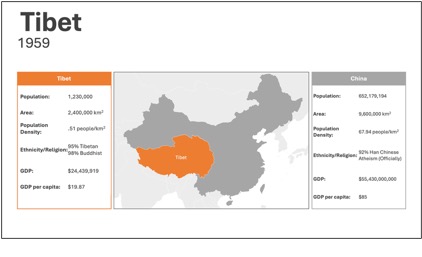
FIGURE 1. TIBET / PRC COMPARISON [42]
Phases of the Occupation -Tibet
Historians may disagree as to the major phases of the PRC occupation of Tibet, however, from the point of view of studying the PRC way of occupation and understanding the PRC’s strategic approaches, it is useful to view the occupation in four phases. The first is the initial Coercive Incorporation (1950-1959), second is Rebellion and Consolidation (1959-1965), third is Cultural Revolution and Repression (1966-1976) and finally the Post-Cultural Revolution Era (1976 – 1995).[43] Each phase is characterized by a notable shift in the PRC strategic approach. These shifts were often predicated by changes in conditions either on the ground in Tibet, changes internationally, or changes in the internal politics of Beijing and the CCP. As the next section demonstrates, the shifts in the PRC approach can be largely characterized by the relative opening vs restricting of the political opportunity space.
Coercive Incorporation (1950-1959)
From the outset, the PRC approached Tibet not as a conventional military conquest but as a complex political project that required ideological framing, elite co-optation, legal maneuvering, and tightly managed narratives. The incorporation of Tibet between 1950 and 1959 unfolded as a synchronized campaign of coercion masked as a benevolent unification, with each step carefully calibrated to preserve international standing, divide the potential forces of meaningful opposition both domestically and internationally, forestall (or crush) rebellion, and lay the groundwork for long-term assimilation.
Even before the PLA entered Tibetan territory, the CCP had laid a robust foundation for internal, domestic, and international legitimacy. Internally, the Party presented Tibet’s “liberation” as the final chapter in the struggle against feudalism and imperialist fragmentation. This framing was not rhetorical flourish; it served to rally the CCP’s base, align Tibet with the larger anti-imperialist struggle, and justify the coming occupation as a revolutionary duty. Domestically, the PRC’s narrative emphasized China’s historical claim to Tibet, drawing selectively from Yuan and Qing precedents to assert that Tibet had always been an integral part of China. Internationally, Beijing invoked the language of decolonization and national unity, carefully avoiding terms associated with annexation or aggression.[44]
This message discipline extended to all spheres of influence. To the Chinese populace, the mission was to reclaim a wayward province. To Tibetans, the Party spoke in the language of religious respect, promising protections for Buddhist institutions and inviting cooperation from the ruling elite. The CCP was careful to not cast itself as a conqueror, but rather as a benefactor offering modernization, infrastructure, and peace. To the world, it projected moderation, timed its actions to avoid diplomatic backlash, and worked to preclude debate in international forums.[45]
In October 1950, with the Korean War drawing global attention and UN mechanisms consumed by crises in Northeast Asia, the PLA initiated its military campaign by seizing the strategic city of Chamdo in eastern Tibet. The operation was swift and decisive. It cut off Tibetan forces from Lhasa and signaled the overwhelming superiority of Chinese arms without extending into a full-scale occupation of the Tibetan heartland. The PLA’s limited advance was probably less a sign of constraint and far more a calculated maneuver, designed to prevent the over extension and commitment of PLA and party resources, especially as PRC “volunteers” were committed in large numbers to the Korea campaign. By demonstrating military dominance while stopping short of outright conquest, the CCP created the conditions for coerced negotiation.[46]
Shortly thereafter, the Tibetan government dispatched a delegation to Beijing to engage in what was presented as a diplomatic settlement. In reality, the negotiations were tightly controlled by the United Front Work Department, and the resulting 17-Point Agreement had been prepared in advance. The Tibetan envoys, isolated from the Dalai Lama and lacking a clear mandate, signed the agreement under pressure. The document ostensibly guaranteed religious freedom and Tibetan autonomy on paper but granted the PRC full authority over foreign affairs, military affairs, and communications. In other words, it was very much in line with the middle ground historical compromise of Chinese suzerainty (as opposed to sovereignty) over Tibet. These provisions allowed Beijing to assert control while maintaining the illusion of Tibetan self-rule. Even the young 14th Dalai Lama, facing political disarray and with few viable alternatives, ultimately sent a telegram acquiescing to the agreement—an act the CCP would later brandish as proof of voluntary unification.[47]
The occupation strategy did not rely solely on force or legal manipulation. Equally important was the Party’s campaign to divide and absorb Tibet’s ruling elite. Following Mao’s dictum to “win over the middle forces; isolate the die-hards,” the CCP offered high-status Tibetans material incentives and symbolic authority.[48] Nobles were given titles, stipends, and roles in newly established governance bodies, such as the Preparatory Committee for the Autonomous Region of Tibet (PCART). On the surface, these institutions suggested continuity. In reality, substantive power resided with mostly Han Chinese cadres and CCP officers operating under United Front guidance.[49] Real decisions flowed from Beijing, even as Tibetan elites were paraded in ceremonial roles.[50]
The treatment of Ngabo Ngawang Jigme, the captured governor of Chamdo, illustrates this co-optation strategy. Rather than punish or exile him, the CCP treated him respectfully and eventually elevated him to vice-chair of the PCART. Such moves signaled to other elites that cooperation offered personal security and advancement. Meanwhile, the CCP exploited longstanding religious divisions by promoting the Panchen Rinpoche—whose recognition had not been endorsed by the Dalai Lama—as a political and religious counterweight. By elevating the Pachen Lama to unprecedented political prominence, Beijing aimed to weaken the Dalai Lama’s authority and fragment the Gelug hierarchy from within.[51]
With the signing of the Korean Armistice in 1953 and the subsequent easing of external military pressure, the PRC shifted into a new phase of dual-track engagement. Beijing made a public show of openness toward the Dalai Lama, inviting him (always accompanied by the Panchen Rinpoche) to Beijing where he met with Mao Zedong and other senior Party leaders. The Dalai Lama and other prominent Tibetans were granted seats in the National People’s Congress (NPC), a symbolic move designed to display the political integration of Tibet into the socialist state. At the same time, the PLA and CCP quietly expanded infrastructure projects aimed at binding Tibet physically to the Chinese interior, while the institutions of the PCART were incrementally scaled. These projects required the migration of Han cadres, technicians, and laborers, making the Chinese presence increasingly visible even in remote Tibetan settlements. Importantly, in 1953 Tibet’s population was less than 1.3 million compared to an estimated population of 547 million in China under PRC rule. Though Tibet’s territory was vast and mountainous, it’s population was a tiny fraction of its huge neighbor.
In Kham and Amdo, regions administered directly as part of China rather than through the autonomous framework, the Party implemented collectivization policies and began disarming the population. For the Khampas, known for their nomadic traditions and warrior ethos, the forced surrender of firearms and imposition of collective schemes was intolerable. From 1956 to 1959, armed resistance erupted in waves, particularly in eastern Tibet, foreshadowing the broader armed uprising that would follow.[52]
On the international front, the PRC devoted considerable diplomatic resources during the latter half of the decade to securing recognition from India and preempting the emergence of a politically active Tibetan diaspora. It achieved partial success, concluding a trade agreement with India while quietly pressuring New Delhi to constrain émigré activism. Still, the Tibetan exile community—centered in northern India—began to organize politically and militarily. By 1952, the Dalai Lama’s elder brother, Gyalo Thondup, had established contacts with the US Central Intelligence Agency (CIA).[53] By 1956, the United States began covert support for an armed resistance network that would come to be known as the “Four Rivers, Six Ranges.” CIA assistance included both training and materiel and would continue until 1972. Although marginal in conventional military terms, this international backing added a volatile external dimension to what had been, until then, a largely internal process of occupation and assimilation.[54]
What distinguished this phase from later periods was its incrementalism. The CCP avoided triggering mass resistance by allowing religious practices to continue and assuring elites that their traditional roles would be respected. At the same time, the Party expanded its physical footprint—building roads, garrisoning troops, and establishing surveillance networks. In regions like Kham and Amdo, where PLA control was firmer and resistance networks weaker, reforms advanced more aggressively, setting the stage for later campaigns in central Tibet.[55]
Tibet’s political structure, which had always been fragmented, conservative, and slow to modernize, was ill-equipped to resist this kind of calibrated pressure. The Kashag was divided; communications with distant delegations were irregular; and the international community, including India and the United States, remained hesitant to intervene. The CCP took full advantage of these vulnerabilities. Its leaders acted with ideological clarity and strategic foresight, blending legal claims, coercive force, and elite manipulation to establish what they called the “peaceful liberation” of Tibet.[56]
This period of coercive incorporation did not complete the project of occupation, but it laid the essential groundwork. By 1959, Beijing had entrenched itself in the administrative, military, and ideological fabric of Tibet. The façade of Tibetan autonomy remained intact, but the CCP had effectively constructed a parallel governance structure that would eventually displace the old order. The next phase—marked by rebellion, repression, and direct confrontation—would bring the contradictions of this arrangement to a head. But from 1950 to 1959, the PRC succeeded in transforming a military fait accompli into a claim of legitimate sovereignty, not through brute force alone, but through the strategic orchestration of coercion, patience, and political theater.
The Party’s approach to governance in this period reflected strategic patience. Mao instructed, that radical reforms, including land redistribution or collectivization, should be delayed in central Tibet. These would come later, once Chinese control had been consolidated. In the early years, particularly in Lhasa and surrounding areas, the PLA and CCP cadres focused on embedding themselves in the administrative and symbolic infrastructure of Tibetan governance. Political study sessions, bilingual education programs, and infrastructure development all served to normalize Chinese presence and build pathways for future integration.[57]
Rebellion and Consolidation (1959-1965)
The uprising of 1959 marked a decisive rupture in the PRC’s occupation strategy in Tibet. What began as an attempt to integrate Tibet through a gradualist, suzerainty-like approach collapsed under the weight of mounting rebellion, elite defection, and geopolitical friction. In the eyes of CCP leadership, the events of 1959 confirmed the limits of strategic patience and forced a shift toward direct consolidation and coercive assimilation.
By the late 1950s, the CCP’s efforts at calibrated control had produced mixed results. While the Dalai Lama remained within the system and Tibetan elites participated in ceremonial governance structures such as the NPC, the situation in eastern Tibet had begun to unravel. The imposition of collectivization, disarmament campaigns, and the growing Han presence across Kham and Amdo triggered widespread unrest. Unlike the symbolic integration seen in Lhasa, these eastern regions, which were governed directly as Chinese provinces rather than as part of the TAR, were subject to the full force of socialist transformation and Mao’s “Great Leap Forward.” Resistance fighters, many from the Khampa warrior class, took up arms in defiance of state intrusion, initiating a series of revolts between 1956 and 1959 that exposed the underlying fragility of PRC control.[58]
The CCP leadership perceived these uprisings not merely as localized disturbances but as part of a broader counterrevolutionary threat. Intelligence assessments increasingly emphasized foreign influence, especially the activities of the Tibetan diaspora in India, connections to the exiled Nationalist government in Taiwan, and growing American interest in the region.[59] The Party was aware of U.S. efforts to support Tibetan resistance, including covert CIA links to the Dalai Lama’s family. Though such claims were sometimes exaggerated for political effect, they provided a ready justification for hardening the Party’s line. With the PLA already embroiled in counterinsurgency in the eastern provinces, suspicion naturally turned westward to Lhasa.[60]
Despite outward compliance, CCP leaders suspected that members of the TAR’s religious and aristocratic elite were sympathetic to the rebellion, if not covertly supportive. Party officials placed increasing pressure on the Dalai Lama and the Kashag to denounce the uprisings and assist in their suppression. This campaign of political coercion destabilized the already tenuous working relationship between Beijing and Tibet’s traditional leadership. By early 1959, rumors began to spread through Lhasa that the Dalai Lama would be abducted or assassinated by Chinese authorities. While some historians believe the rumors were likely untrue, the rumors triggered panic among the population. On March 10, 1959, thousands of Tibetans gathered in front of the Norbulingka Palace in a spontaneous mass protest. Over the following days, these demonstrations escalated into a full-scale popular uprising.[61]
The Chinese military responded with overwhelming force. The PLA shelled parts of Lhasa, conducted house-to-house sweeps, and executed suspected rebels. The bloodshed in the capital not only decimated Tibetan resistance but also obliterated the last vestiges of political trust between the CCP and the religious establishment. In the chaos, the Dalai Lama fled to India with the assistance of CIA-trained escorts.[62] His arrival in India—where he established a government-in-exile—was a profound strategic and symbolic loss for Beijing. The CCP no longer had a cooperative figurehead through which to channel its legitimacy narrative.
From 1959 to 1965, Tibet existed under a regime of de facto martial law. The PLA exercised direct control over all major institutions, and CCP officials moved to dismantle the religious, aristocratic, and administrative structures that had previously mediated occupation. Thousands of monks were arrested or forced into labor. In some cases, monasteries were shuttered. In all cases, the party placed limits on the numbers of monks and insisted that monks be involved in productive work activities. The Party’s new approach sought to transform Tibetan identity rather than seek coexistence with it.[63]
The ideological framework for this period was shaped by the intensification of Maoist campaigns throughout China, especially the Great Leap Forward. These radical reforms, often disastrous in the Chinese heartland, were imposed in Tibet with even less consideration for local conditions. Agricultural collectivization, forced resettlement, and grain requisitioning policies devastated rural Tibetan communities, many of which had no historical or cultural precedent for the forms of state-managed production demanded by the CCP. Famine followed, though its extent remains difficult to document. Political denunciation campaigns proliferated, targeting not only suspected rebels but also traditional cultural expressions.[64] The promise of gradual autonomy under a “big brother” suzerain had given way to direct, often brutal, party-state rule.
Throughout this period, the CCP justified its actions through a well-established repertoire of ideological claims: that imperialist forces were fomenting rebellion, that the Dalai Lama was a pawn of the West, and that the Tibetans themselves required revolutionary purification that liberated the Tibetan people from the elites and the monasteries. Whether sincerely believed or cynically deployed, these narratives provided domestic and internal legitimacy for the closure of Tibet’s political opportunity structure. In practice, the PRC had moved from persuasion to domination; from gently wielded influence on overt coercion and compellance; from tolerance of the Tibetan identity to the systematic dismantling of Tibetan distinctiveness.
Still, this phase was transitional. It represented a grim departure from the CCP’s early approach, but it was not yet the comprehensive repression that would follow in the next decade. In retrospect, the rebellion and its aftermath became the moral and administrative pivot of the occupation. After 1959, the PRC no longer sought to share power with Tibetan elites or secure consent through symbolism. Instead, the focus shifted toward ideological remolding and administrative absorption. The rebellion had made clear that strategic patience would not yield enduring control. From this point forward, stability would be enforced—and identity transformed—by any means necessary.
Cultural Revolution and Repression (1966-1976)
The next transformation in the CCP’s approach to governing Tibet was not driven by rebellion, external threats, or concerns about international legitimacy. It was a direct consequence of internal political upheaval within the PRC and more specifically, the CCP. The launch of the Cultural Revolution in 1966, initiated by Mao Zedong to reassert control over a fractured Party, brought with it the most extreme and ideologically motivated phase of repression in Tibet. Unlike the coercive assimilation of the post-1959 period, which at least acknowledged the uniqueness of the Tibetan context, the Cultural Revolution introduced a radical and violent attempt to erase Tibetan identity altogether—root and branch.
The Cultural Revolution reached Tibet soon after the dramatic fall of the Panchen Rinpoche. Once a propaganda symbol and tool of the United Front to establish domestic legitimacy of CCP-Tibetan partnership, CCP leaders purged the Panchen Lama in 1964 after he submitted a secret petition criticizing the devastating effects of Chinese policies on the Tibetan people.[65] His removal marked the end of any meaningful Tibetan role in Party-sanctioned religious affairs and foreshadowed what was to come. By 1965, the CCP had completed the dismantling of Tibet’s institutional autonomy. The old elite had been purged or silenced, monasteries were under surveillance or shuttered, and administrative power was fully consolidated under Han-dominated party structures. But this coercive compliance had not produced internalized ideological change. Most Tibetans had been coerced through power, not convinced through influence. As Shakya Tsering observes, “the Chinese knew that mass compliance had been obtained by means of coercive persuasion rather than by voluntary expression of shared values. The Cultural Revolution was aimed at the latter.”[66] It was an attempt, in Maoist terms, to implant a new consciousness—“a white brain”—into a population that still clung to “green-brained” traditional values.[67]
In February 1966, Chinese authorities banned the Monlam festival, one of the most significant religious celebrations in Tibetan Buddhism. This was a striking departure from the previous pattern of limited cultural toleration even after the 1959 uprising. In May of that year, the first wave of Red Guards arrived in Lhasa. From May through December 1966, young militants initiated a violent campaign against the “Four Olds”: old ideas, culture, customs, and habits. What followed was the most comprehensive and ideologically driven assault on Tibetan culture in the history of the occupation.[68]
The Red Guards targeted not only Tibetans but also CCP officials and cadres who were perceived as insufficiently zealous in enforcing revolutionary orthodoxy. Their radicalism led to factionalism, power struggles, and mass mobilization campaigns that quickly spun out of the center’s control. In some cases, Han and Tibetan Red Guards collaborated in the destruction of religious sites; in others, Han officials attempted to temper the violence and were purged in turn. Across the Tibetan Plateau, temples and monasteries were defaced, desecrated, or razed. Religious texts were burned. Statues were smashed. Centuries-old artifacts were reduced to rubble. Clergy who had survived the earlier purges were publicly humiliated, beaten, imprisoned, or sent to labor camps. The very icons of Tibetan identity were erased.[69]
The Cultural Revolution did not play out in Tibet as a single, top-down campaign. In many remote areas, violence and repression were driven more by local rivalries than national commands. Pogroms, revolts, and factional conflict erupted in places often untouched by previous waves of reform.
Until 1969, the disorder threatened not only social cohesion but also basic governance and the internal legitimacy of the party. The PLA deployed across the TAR and inner Tibetan regions to restore order. Over the next seven years, the PLA became the primary instrument of authority, forcing warring factions of the Party to disarm and compelling ideological unity under military supervision. While this militarization stabilized the region, it cemented Tibet’s transformation from a space of contested autonomy into one of direct, overt military occupation.[70]
By the end of the Cultural Revolution in 1976, the legacy was profound. The social fabric of Tibetan culture had been torn apart. Monasteries were all but eliminated. Religious instruction ceased. Traditional practices were criminalized or driven underground. Entire generations grew up without access to spiritual or historical education. Tibetan identity, once resilient in the face of colonial suzerainty or postwar coercion, had been subjected to a deliberate campaign of erasure. As Shakya succinctly put it, “Very little was left of Tibetan culture save the Tibetan language.”
Importantly, this phase marked the complete abandonment of any pretense that Tibet’s “autonomous” status had political meaning. “Although on paper Tibet was continually referred to as an autonomous region, this was a constitutional fiction,” Shakya writes. “Tibet was treated as though it was a suburb of Beijing.” The Party no longer sought compliance from the Tibetan people; it sought uniformity. It no longer managed difference; it attempted to annihilate it.[71]
The Dalai Lama continued to assert that he represented the government in exile. However, international political support for the Tibetans come to an end as far as the international community was concerned the question up to be had become redundant. Even countries like Ireland, Thailand, Malaysia, and El Salvador, which had supported Tibet’s appeal to the United Nations lost interest in the issue. In 1973 however, the Dalai Lama made his first visit to the west. This was ostensibly for religious purposes, but immediate attention on the issue of Tibetan identity could not be avoided to the great annoyance of the Chinese to be began to receive renewed interest in the western press.[72]
What began as a campaign to “purify” the Chinese Communist Party thus became, in Tibet, a campaign to purify the people themselves. This was not occupation through integration—it was domination through ideological replacement. The result was not stability but silence: the absence of overt resistance born not of consent, but of exhaustion and fear.
Post-Cultural Revolution Era (1976 – Present)
The death of Chairman Mao in 1976 marked the end of the Cultural Revolution and the beginning of a new phase in Tibet’s occupation. Mao’s death triggered immediate political recalibration within the CCP, culminating in the arrest of the notorious “Gang of Four”—the architects of the Cultural Revolution, including Mao’s wife, Jiang Qing. In Tibet, the ideological fervor that had fueled mass campaigns of destruction and repression swiftly lost momentum. The influence of the radical Red Guards was curtailed, and authority returned to the Party bureaucracy, especially the United Front Work Department. In this respect, the post-Mao shift resembled the strategic reversion to the control architecture of the 1950s and early 1960s—coercive, but technocratic.
Under Deng Xiaoping, China adopted a more pragmatic and economically driven approach to governance. While liberalization was uneven and limited by ideological red lines, it nonetheless opened a narrow political opportunity space in Tibet. Deng promoted the Four Modernizations campaign, which included economic and infrastructure development in frontier regions. For Tibet, this meant new roadways, state-backed construction, and expanded connectivity to China’s interior. It also meant the intensification of Han migration, as laborers and cadres were brought in to build and manage state projects. While framed as development, these changes reinforced Chinese demographic and administrative dominance in the region.[73]
The post-1976 era also saw a partial political thaw. Many individuals imprisoned after the 1959 rebellion were released. The Panchen Rinpoche, who had been purged during the Cultural Revolution, was allowed to reemerge as a public figure, albeit in a tightly controlled capacity. Deng’s leadership also marked the beginning of limited outreach to the Dalai Lama and his representatives. These contacts were framed within the larger detente policies that characterized Deng’s foreign relations, including overtures to Taiwan and Hong Kong under the “one country, two systems” slogan. In India, diplomatic relations improved, and Beijing cautiously engaged with the Tibetan diaspora. Meanwhile, U.S. support for the Tibetan armed resistance, already waning, was officially terminated as part of the broader U.S.-China rapprochement that began in the early 1970s.[74]
Yet the expansion of the political opportunity space proved fragile. The liberalization of the early Deng era came to a halt in 1989, when the CCP violently suppressed the democracy movement in Tiananmen Square. The massacre marked a renewed emphasis on stability and ideological discipline. In Tibet, this translated into increased restrictions on expression, assembly, and religious practice. Although international attention to Tibet surged in the 1990s, including Nobel Peace Prize recognition for the Dalai Lama, the domestic space for dissent narrowed considerably. Attacks on PRC international legitimacy annoyed and deeply concerned CCP leaders, but they kept up a relentless counter influence campaign. The Party again began to view ethnic and religious identity as latent threats to unity and development, justifying renewed surveillance and repression.[75]
Throughout the 1990s and 2000s, the PRC focused on building out the administrative and surveillance infrastructure needed to govern Tibet comprehensively. This was accompanied by a consistent narrative that framed Tibetans as beneficiaries of state-led development, while portraying dissent as foreign-instigated and regressive. Legitimacy, once sought through cultural accommodation, was now asserted through metrics of modernization: GDP growth, poverty alleviation, and infrastructure expansion.[76]
A pivotal moment came with the appointment of Chen Quanguo as Party Secretary of the Tibet Autonomous Region in 2011. During his tenure (2011-2016), Tibet became a laboratory for new modes of repression. Under Chen’s leadership, the region saw the rollout of high-tech surveillance systems, the expansion of police presence, the construction of grid-style social management units, and the forced participation of Tibetans in “patriotic education” campaigns. These methods were later exported to Xinjiang when Chen became party secretary there. In Xinjiang, these occupation methods gained global notoriety. In this sense, Tibet’s occupation evolved from being a case study of strategic coercion to a precursor of China’s 21st-century authoritarianism.[77]
By the 2010s, the political opportunity space in Tibet had contracted to near-zero. The post-Mao promise of stability through development had hardened into a regime of algorithmic control, preemptive policing, and identity erasure. Cultural performance remained for tourists, but cultural practice was regulated, monitored, and often repressed. What began in 1949 as an ideological project of unification had, by the 2020s, become a system of engineered compliance. The Chinese state no longer sought to win the hearts and minds of Tibetans; it sought to monitor, manage, and if necessary, neutralize them. This ultimately demonstrates something authoritarian regimes know well. Asserted power creates its own legitimacy.
Spanning from Deng’s reforms to the era of Xi Jinping, this era demonstrates that PRC occupation strategies are highly adaptive but not necessarily liberalizing. Tibet, once treated as a frontier to be assimilated, now functions as an internal security zone: pacified, developed, and surveilled, but never reconciled.
Themes of Occupation – Tibet
The occupation of Tibet by the People’s Republic of China reveals not a single strategy, but a dynamic system of control adapted over decades. Beneath shifting tactics—ranging from conciliation to repression—lies a consistent logic of dominance that blends ideological, legal, demographic, and infrastructural tools. The following themes distill those logics into a framework that helps explain how the PRC transformed military presence into enduring political control. Collectively, these themes answer the questions: How did the PRC suppress dissent? What administrative and legal mechanisms were deployed to integrate the population? How was ideological conformity encouraged or enforced? What considerations or measures did the PRC take with respect to international legitimacy and involvement?
Strategic Patience, Ruthless Adaptation– From the moment Mao labeled Tibet a long-term struggle, the CCP demonstrated extraordinary strategic patience despite shifts in the operational approach. The PRC’s approach to Tibet was neither hasty nor impulsive. Whether consolidating control through symbolic inclusion in the 1950s, suppressing rebellion through coercion in the 1960s, or reasserting dominance with surveillance and development in the 2000s, the Party adapted its occupation strategy to prevailing conditions. The CCP consistently framed shifts—from conciliation to crackdown—as aligned with long-term goals, not as deviations. Tibet was never abandoned as an objective. Instead, its occupation became a generational campaign of incorporation, reframed as necessary whenever political or ideological context shifted.
The Dialectics of the Political Opportunity Space-Tibet illustrates how the PRC manipulates the political opportunity space as both a control valve and a strategic signaling device. In relatively permissive periods, like the early 1980s, the space widened to co-opt elites, signal moderation, or respond to diplomatic priorities. But this space was closed seemingly without hesitation when legitimacy was threatened as after the 1959 uprising, during the Cultural Revolution, and following the 1989 Tiananmen Square protests. These shifts were sometimes opportunistic and sometimes reactive, but the pattern is unmistakable: resistance triggers repression, and silence facilitates managed autonomy. The CCP’s mastery lies in its ability to recalibrate the balance of coercion and tolerance based on threat perception, both foreign and domestic.
Narratives as Weapons– Across every phase of occupation, the PRC maintained a remarkably consistent narrative of legitimacy: Tibet is, and always has been, part of China. This claim was broadcast internally to Party cadres, domestically to Chinese citizens, and internationally to foreign governments and institutions. The messaging varied in tone—often conciliatory toward Tibetans and assertive toward foreign critics—but the foundational narrative never changed. Framing the occupation as “liberation from feudalism,” “socialist modernization,” or “poverty alleviation,” the CCP used narrative not just to justify its actions but to shape the very language of legitimacy. Occupation was never framed as conquest—it was portrayed as destiny.
Divide, Then Rule– The CCP’s United Front strategy in Tibet was more than elite co-optation—it was systemic division of elites. From elevating the Panchen Lama over the Dalai Lama, to exploiting factionalism within the Kashag, to distinguishing between Inner and Outer Tibet administratively, the Party relentlessly fractured the political and cultural coherence of Tibetan resistance. Later phases of occupation deepened these fractures by empowering compliant Tibetan cadres over traditional authorities and by restructuring social classes through land reform and collectivization. The result was a political landscape atomized by co-optation, fear, and selective empowerment.
Lawfare and the Ambiguity of Sovereignty– The Seventeen-Point Agreement and the use of Qing-era maps, historical references, and domestic administrative law allowed the PRC to frame its control over Tibet as a matter of legal continuity. This “lawfare” strategy was central to deterring international opposition, as the UN Charter’s ambiguity around self-determination versus non-interference allowed China to frame Tibet as a purely domestic issue. Though the Tibetan delegation signed the agreement under duress, the PRC leveraged it to claim de jure legitimacy and render any dissent as rebellion. This legal maneuvering aligned with the broader Chinese strategy of fighting with law and language to deter interference.[78]
Han Migration and Demographic Reengineering– Occupation in Tibet was not only about governance—it was about demography. The strategic influx of Han Chinese cadres, laborers, and settlers served to transform both the physical and psychological landscape. Migration was initially framed as developmental but functioned as a tool of identity dilution. Entire regions were restructured demographically and spatially. Cities were rebuilt in the image of Chinese administrative order. Tibetan culture became an ornamental backdrop to a Chinese reality.
Development as Domination– Infrastructure was central to the PRC’s occupation logic. Roads, railways, and dams connected Tibet to China’s interior and facilitated both economic integration and military logistics. These projects were dual-use: they brought material development and state surveillance in equal measure. Economic incentives were deployed to reward compliance, particularly among elites, but also created structures of dependency. The image of the Party as a modernizing force was central to the legitimacy narrative, yet modernization also served to eliminate physical isolation and render Tibet governable.
Cultural Erasure, Interrupted – Periods of relative tolerance for cultural expression (1951–1959, 1980s, post-2008) were repeatedly followed by campaigns of destruction and suppression. From the razing of monasteries during the Cultural Revolution to the surveillance of religious sites under Chen Quanguo, Tibetan culture was allowed to survive only when it was politically neutered. Cultural identity was tolerated as spectacle, not substance. When cultural practice signified potential resistance, it was targeted for erasure. The CCP understood that identity is both a resource and a threat—and treated it accordingly.
Fragility of Internal Legitimacy– Despite the outward appearance of strategic coherence, the PRC’s occupation of Tibet was shaped by internal crises. The Cultural Revolution, the Panchen Rinpoche’s defiance, the Dalai Lama’s global platform, and the Tiananmen Square protests all exposed vulnerabilities in the CCP domestic (China) legitimacy and Party leaders’ internal legitimacy. These moments of ideological instability often produced disproportionate repression in Tibet, as the CCP leaders moved to project control where it was most fragile. The occupation was not merely a forward-looking integration project; it was also a reactive effort to patch internal seams.
Exporting the Model – By the 2010s, Tibet had become a prototype for modern authoritarianism. Under Chen Quanguo, the region pioneered integrated surveillance, grid-style governance, forced indoctrination, and algorithmic social control. These tools were later exported to Xinjiang and refined further, but their roots lay in Tibet’s long arc of occupation. As such, Tibet is not merely a case study in coercive integration—it is a staging ground for future forms of digital authoritarian rule.
1.2 East Turkestan (Xinjiang)
Roots of the Conflict – East Turkestan (Xinjiang)
The region known internationally as Xinjiang and historically by its indigenous population as East Turkestan occupies over one-sixth of China’s landmass and shares borders with eight countries, including Pakistan, Afghanistan, Kazakhstan, Kyrgyzstan, and India. It is a vast, arid expanse composed of deserts, mountains, and oases, and home to a diverse set of ethnic groups, the largest of which is the Uyghurs. Uyghurs are a Turkic Muslim people with deep historical, linguistic, and cultural ties to Central Asia. The term “Xinjiang,” meaning “new frontier” in Mandarin, reflects a Han-centric framing imposed during Qing expansion; by contrast, “East Turkestan” evokes an identity rooted in Turkic civilization, Islam, and anti-colonial struggle. This paper uses “East Turkestan” in the historical framing and roots of the conflict section to reflect the indigenous perspective but adopts “Xinjiang” thereafter to align with the dominant terminology in policy and academic discourse—while recognizing that the PRC has criminalized the use of “East Turkestan” as separatist rhetoric.[79]
The roots of the conflict trace back centuries to cycles of conquest, resistance, and imperial rivalry. During the early Islamic period, the region was part of a succession of Turkic khanates, including the Karakhanid and Chagatai Khanates, which facilitated both the Islamization of the region and its integration into Silk Road commerce.[80] In the 18th century, the Qing Dynasty launched a sustained campaign to pacify the region, culminating in the defeat of the Dzungar Khanate in 1759 and the incorporation of the region into the Qing imperial system. Yet Qing control was tenuous and episodic. Periodic revolts, most notably the 1864 uprisings, repeatedly challenged imperial authority, culminating in the brief formation of independent regimes such as the Yettishar Emirate under Yaqub Beg, who gained recognition from the Ottoman Empire and maintained diplomatic relations with Britain and Russia.[81]
The late Qing period marked a transition toward more direct integration. In 1884, after crushing a series of uprisings, the Qing formally designated the territory “Xinjiang Province,” reflecting a shift from frontier oversight to bureaucratic control. This administrative change, however, did not eliminate the region’s ethno-religious distinctiveness or its history of resistance. Instead, it laid the foundation for enduring contestation over sovereignty, legitimacy, and identity. Throughout the 19th and early 20th centuries, Xinjiang became a focal point of the “Great Game” between Russia and Britain, with Russian cultural, economic, and political influence growing across northern Xinjiang. Moscow’s presence would later prove decisive in shaping both indigenous resistance and Beijing’s approach to controlling the region.[82]
The collapse of the Qing in 1911 created a temporary vacuum in which local warlords, foreign powers, and indigenous leaders vied for influence. During this era of fragmented sovereignty, two short-lived but symbolically potent East Turkestan Republics (ETRs) emerged. The first, founded in 1933 in Kashgar, proclaimed independence but was quickly crushed by Hui Muslim warlord forces aligned with the Chinese Nationalists.[83] The second, established in 1944 in the Ili Valley with Soviet support, maintained control over northern Xinjiang until 1949. Known as the “Three Districts Revolution,” this Soviet-backed regime maintained its own schools, courts, and militias, and articulated an explicitly anti-colonial, pan-Turkic political vision. While the second ETR was never formally recognized by the Soviet Union or other powers, it remains a foundational episode in the collective memory of Uyghur nationalists and diaspora communities.[84] [85]
The PRC’s occupation of Xinjiang thus began not with military conquest but with a political handover negotiated through Soviet channels. As the Chinese Civil War ended, Moscow sought to stabilize its southern flank and avoid direct confrontation with the ascendant PRC. In 1949, five senior leaders of the East Turkestan Republic died in a mysterious plane crash en-route to negotiations with the CCP in Beijing. Many historians emphasize that while there is little evidence of foul play, the event represented a symbolic decapitation of Uyghur political autonomy.[86]Shortly thereafter, the remaining leadership of the Three Districts government acquiesced to CCP authority. PLA forces entered Xinjiang with minimal resistance, aided by the defection of key Nationalist commanders such as Tao Zhiyue and the diplomatic groundwork laid by Stalin’s envoys.[87]
Following the occupation, the CCP moved rapidly to consolidate administrative control while preserving the façade of ethnic autonomy, much as it did in Tibet. In 1955, Xinjiang was designated an “autonomous region” under the new PRC constitutional framework. Yet from the outset, real authority rested with Han-dominated party structures. Institutions such as the Xinjiang Production and Construction Corps (XPCC), established in 1954, served both economic and coercive functions—settling Han migrants, developing arable land, and embedding military control under the guise of economic development. These early actions set the pattern for decades of occupation strategy: promise symbolic inclusion, co-opt indigenous elites, deploy coercive institutions to manage resistance, and lay the groundwork for long-term demographic and ideological transformation.
The roots of the Xinjiang conflict, therefore, lie not only in competing claims over territory or religion, but in fundamentally incompatible visions of sovereignty, identity, and legitimacy. For Uyghur nationalists and many Central Asians, East Turkestan represents a homeland with a history of episodic independence and resistance to colonial domination. For the PRC, Xinjiang is an important symbol of national unity. It represents a frontier that must be tamed, developed, and integrated into the Chinese body politic. The logic of occupation in Xinjiang has always been shaped by this unresolved tension, and it continues to animate the policies of surveillance, assimilation, and repression that define the region today.
Phases of The Occupation – East Turkestan (Xinjiang)
Understanding the occupation of Xinjiang requires a departure from the linearity of conventional military conquest and a turn toward the logics of bureaucratic absorption, ideological transformation, and securitized development. Though the PLA entered the region in 1949 with little resistance, this did not signal an uncontested unification. Instead, it marked the beginning of a decades-long project to render a historically autonomous and culturally distinct region into an integrated, governable, and ideologically compliant component of the Chinese state. It bears some similarity to how the United States conquered its own Western frontier, though clearly more centrally controlled and planned. The process has unfolded in phases that reflect evolving CCP approaches for managing ethnic differences, projecting central authority, and neutralizing both domestic and foreign sources of instability.
The occupation of Xinjiang cannot be understood solely through the prism of repression. Like Tibet, the CCP’s approach to Xinjiang has been characterized by alternating cycles of co-optation and coercion, symbolic inclusion and systemic control. Yet unlike Tibet, Xinjiang’s status as a majority-Muslim borderland with longstanding transnational ties introduced distinct challenges—most notably, the need to manage external narratives and threats emanating from neighboring states, global Islamic networks, and Western human rights advocacy. Moreover, the CCP’s approach has been continually shaped by broader geopolitical shifts: the Sino-Soviet split, the Cold War, the global war on terror, and the digital revolution in surveillance technologies. These dynamics transformed Xinjiang into both a laboratory and a battleground for emerging modalities of authoritarian control.
The CCP’s strategic posture in Xinjiang can be understood across three major phases, each marked by a shift in political logic and operational focus. The first, from 1949 to the early 1960s, was one of demographic engineering and institutional consolidation, relying heavily on United Front tactics, Soviet-derived frameworks of ethnic autonomy, and the construction of new bureaucratic instruments such as the XPCC. The second phase, from the early 1960s through the 1980s, unfolded amid Sino-Soviet rivalry and Cold War proxy competition, in which Uyghur identity became a contested terrain for both internal security campaigns and external ideological confrontation. The final and ongoing phase—from the 1990s through the post-9/11 era—witnessed the transformation of occupation into securitized assimilation. With clear post 9/11 inflection points, counterterrorism rhetoric was used to justify the imposition of high-technology surveillance, mass incarceration, and psychological warfare on a population now recorded as a security threat.
Each of these phases reflects a recalibration of the CCP’s occupation toolkit which is shaped by international alignments, domestic threat perceptions, and the shifting contours of Party legitimacy. As with the Tibet case, the phases of occupation in Xinjiang can also be mapped by changes in the political opportunity space: moments of relative opening, often used to co-opt local elites or signal ideological moderation, were consistently followed by sharp contractions in response to perceived resistance, unrest, or geopolitical realignment. The Party’s capacity to toggle between these modes, adjusting its use of coercion, narrative, and law, has been central to its unbroken, though contested, control of the region.
This section traces those shifts not as discrete episodes but as strategic inflections in a continuous project of control. While there is no precise consensus on the boundaries of each phase, this study adopts a periodization that emphasizes the strategic logic behind key transitions. Subsequent subsections will explore the modalities of occupation in more detail, beginning with early Han migration and state-building efforts (1949–1962), moving into the period of Soviet-sponsored resistance and Cold War proxy dynamics (1962–1989), and culminating in the post-9/11 era of securitized assimilation and digital authoritarianism (1990s–present).
Han Migration (1949-1962)
From the moment the CCP assumed control over Xinjiang in 1949, the Party viewed demographic transformation as a prerequisite for durable occupation. Unlike a conventional military garrisoning model, Xinjiang’s occupation relied on a settler-colonial logic: to hold the land, the regime would populate it.[88] The migration of Han Chinese into the region was not incidental, spontaneous, or economically neutral. Rather, it was engineered. This period marked the beginning of one of the most ambitious and sustained demographic engineering campaigns in modern Chinese history. It unfolded under the twin logics of security and development: to stabilize a restive frontier and to integrate a culturally distinct population into the socialist nation-state through displacement, assimilation, and bureaucratic subordination.
The principal vehicle for this strategy was the establishment of the XPCC (Bingtuan) in 1954.[89] Conceived as a hybrid military-agricultural institution, the XPCC functioned as both a colonization engine and a coercive administrative apparatus. It recruited demobilized PLA soldiers, Han civilians, and later convicts, resettling them in regimented communes across the region. These new arrivals were tasked with both reclaiming desert land and securing political loyalty. The XPCC was explicitly exempted from many local laws and answered directly to the central government, making it a quasi-sovereign structure within the region. Its dual mandate of production and security enabled it to serve as an institutional interface for the migration of Han settlers, the suppression of dissent, and the cultivation of loyalty through state employment and ideological training.[90]
The Party justified this migration project through the language of socialist modernization, framing it as an effort to “develop the frontier” and “liberate” backward regions from feudalism and underdevelopment. In practice, the influx of Han settlers—primarily concentrated in the northern and central areas of Xinjiang—shifted the ethnic balance in key political, economic, and infrastructural zones. Urban areas like Urumqi and Shihezi rapidly transformed into Han-dominant enclaves, while ethnic Uyghur and Kazakh communities faced dispossession from both land and labor markets. The effect was not merely demographic; it was psychological and political. The Party’s implicit message to Uyghur and Kazakh communities was clear: Xinjiang was no longer so much a Turkic homeland as it was a Chinese frontier.[91]
This period also saw the ideological groundwork laid for cultural assimilation. Along with population density, Han settlers brought state ideology. Schools, work units, and agricultural collectives became vectors for Mandarin language instruction, Marxist-Leninist indoctrination, and the marginalization of Islamic and Turkic identity. Religious institutions were surveilled or shuttered. Uyghur elites were co-opted into symbolic administrative roles, while real authority flowed through Party channels dominated by Han cadres or PLA veterans. The CCP’s strategy was not so much to suppress difference, but to dilute and overwrite it through demographic pressure, economic restructuring, and ideological realignment.[92]
By the early 1960s, the demographic transformation remained incomplete but irreversible. In 1953, of the 4.87 million people in Xinjiang, 75% were Uyghur and 6% were Han Chinese. By 1964, there were 7.4 million people living in Xinjiang with 54% Uyghur and 33% Han.[93] Although Uyghurs still constituted a majority in many rural areas, the Han presence had become entrenched in key nodes of power, production, and administration. The stage was set for the next phase of occupation: one in which demographic dominance would give way to ideological confrontation, geopolitical recalibration, and, eventually, a more securitized model of control. The legacy of early Han migration, however, would prove enduring. It created social hierarchies as well as infrastructure and administrative mechanisms that made later repression more logistically feasible and politically defensible in the eyes of the Party.
Sino-Soviet Split & Proxy War (1962-1989)
The second phase of the occupation of Xinjiang unfolded under the shadow of a deteriorating Sino-Soviet relationship and an intensifying Cold War. From the early 1960s through the 1980s, Xinjiang became a geopolitical fault line and a site of ideological confrontation between the PRC and its indigenous Turkic population, as well as between Beijing and Moscow. The Uyghur identity, already a target of domestic assimilation efforts, became enmeshed in international proxy competition. During this period, the PRC transformed its occupation strategy from one focused on demographic engineering and administrative consolidation to one defined by securitization, ideological purification, and countersubversion. The Party viewed Soviet-sponsored resistance, pan-Turkic nationalism, and Islamic revivalism as interconnected threats that had to be neutralized through both domestic control and international maneuvering.[94]
The Sino-Soviet split formally emerged in the late 1950s, but its effects in Xinjiang became palpable by 1962. That year, over 60,000 Uyghurs and Kazakhs fled across the border into the Kazakh SSR in what became known as the Yi-Ta Incident. This mass exodus was not only a humanitarian and political crisis—it was a strategic embarrassment for the PRC. The flight was driven by a combination of economic hardship (exacerbated by the Great Leap Forward), political persecution, and growing fear among ethnic minorities that Beijing would intensify its assimilation campaigns. In CCP assessments, the incident confirmed suspicions that Soviet agents were actively undermining the Party’s legitimacy in Xinjiang by stoking separatism, providing sanctuary, and sustaining alternative narratives of identity and belonging.[95]
Beijing responded by hardening its political line. The CCP purged Soviet-trained cadres from local party organizations. Cross-border communications were severed, and ethnic elites with Soviet sympathies were removed from positions of influence. At the same time, the ideological apparatus of the Party intensified its campaign to define Uyghur identity through the lens of socialist patriotism. Traditional cultural and religious practices were re-coded as signs of “bourgeois nationalism” or “counterrevolutionary splittism.” Party rhetoric increasingly fused domestic dissent with foreign subversion, framing resistance not as an internal grievance but as a proxy war waged by hostile socialist revisionists.[96]
The onset of the Cultural Revolution in 1966 further escalated this ideological warfare. In Xinjiang—as in Tibet—Red Guards unleashed a wave of political violence that targeted not only Han officials suspected of ideological deviation, but also Uyghur religious leaders, educators, and community institutions. Mosques were shuttered or destroyed, Islamic schools were banned, and religious texts were confiscated. As part of a broader campaign to eradicate the “Four Olds,” the Party sought to break Uyghur historical consciousness and replace it with Maoist revolutionary identity. Unlike the earlier period of symbolic inclusion, this was a phase of explicit identity destruction. Uyghurs were placed in camps and controlled communities where PRC cadres oversaw their daily lives in a harsh prelude of reeducation tactics to come.[97]
Simultaneously, Xinjiang’s strategic value as a military zone grew. Border skirmishes with the Soviet Union, including the deadly 1969 clash at Zhenbao Island of Heilongjiang Province, reinforced the perception that Xinjiang was China’s vulnerable western flank.[98] The PLA and the Xinjiang Military District expanded their presence, and the XPCC was tasked with an increasingly paramilitary role. Entire new settlements were constructed to anchor Han population centers in areas deemed demographically or strategically “unstable.” By the mid-1970s, the XPCC operated as a parallel state, managing not only agriculture and industry but also education, propaganda, and surveillance.[99]
Yet, even as the PRC repressed Soviet influence, it learned to mirror certain Soviet tools of control. The ethnic autonomous region framework remained intact on paper, but in practice, administrative appointments and educational curricula were centralized, standardized, and Han-dominated. The Party redefined loyalty as ideological conformity, not ethnic affiliation. Uyghurs who demonstrated political reliability, particularly through denunciations of “nationalist” elements or participation in Party campaigns, were selectively promoted, reinforcing a bifurcation between “patriotic minorities” and suspect populations.[100]
In the 1980s, as Deng Xiaoping launched reforms across China, a degree of openness returned to Xinjiang. On one hand, religious sites were reopened, and limited cultural expression was tolerated. On the other hand, Party strategy shifted toward managing identity through modernization. Uyghurs were encouraged to see the benefits of Party rule through development: new roads, schools, hospitals, and jobs. But these benefits came with ideological conditions—Mandarin fluency, political compliance, and acceptance of Han leadership as the drivers of progress.
At the same time, the global context was shifting. The PRC and the United States aligned against the Soviet Union in Afghanistan, with China covertly supporting the Afghan mujahideen while branding domestic Islamic revivalism as “extremism.” This double game of championing religious freedom abroad while cracking down on it at home illustrated the CCP’s occupation approach to ideology and identity. Uyghur solidarity with Central Asian Muslims, long a quiet undercurrent of resistance, became increasingly framed as a threat to national security, not a cultural or religious matter.[101]
By the end of the 1980s, the CCP had emerged from this period with an unbroken hold on Xinjiang, but at the cost of deepening mistrust and dislocation among the region’s native population. The Party had succeeded in institutionalizing control but failed to build legitimacy. The next phase, triggered by rising separatist sentiment, global terror narratives, and technological transformation, would see the occupation mutate into a form of digital authoritarianism. But the foundation was laid during the Cold War: the internal logic that defined Uyghur identity as a threat, external allies as destabilizers, and coercion as a necessary price for unity.
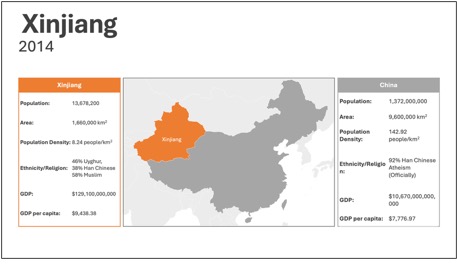
FIGURE 2: XINJIANG AND PRC COMPARISON[102]
The Free Hand & The War on Terror (1990 – present)
The final phase of PRC occupation in Xinjiang marks a transition from contested integration to totalitarian control. While repression and surveillance were long-standing features of CCP rule in the region, the post-Cold War era and especially after 9/11, granted Beijing what this study terms a “free hand” both in international legitimacy and in domestic capacity. This phase witnessed a decisive shift from managing ethnic unrest to preemptively neutralizing identity itself. Under the international legitimizing banner of counterterrorism, the CCP fused internal security doctrine, big data surveillance, and psychological warfare into an unprecedented architecture of control. The project of occupation no longer aimed at assimilation through development or ideological transformation through socialism. Instead, it pursued behavioral and cognitive conformity through technologically enabled coercion.
In the early 1990s, following the Tiananmen Square massacre and amid rising global attention to human rights, the CCP adopted a two-pronged strategy in Xinjiang: accelerated development and heightened securitization.[103] New industrial investments accompanied rapid Han in-migration and the expansion of state-run Mandarin-language schools. The 1990 Barin Uprising demonstrated a spark of organized armed resistance to PRC occupation. Attributed to a group called the East Turkestan Islamic Party by PRC authorities, this short-lived but symbolically powerful instance of armed resistance convinced Beijing that ethnic unrest in Xinjiang could no longer be contained through gradual modernization alone. What followed was a recalibration of internal threat perception. Uyghur identity, especially when coupled with expressions of Islamic faith or Central Asian solidarity, was reframed not as a cultural challenge, but as a latent insurgency.[104]
This securitization became official doctrine with the release of Central Committee Document No. 7 in 1996, which elevated “national separatism and illegal religious activities” to principal threats. It authorized widespread surveillance of mosques, tighter control over religious instruction, and the mandatory “reeducation” of clerics.[105] The years following saw the gradual implementation of “patriotic education” campaigns, the removal of “unpatriotic” content from schoolbooks, and increased monitoring of Uyghur cultural production. These measures intensified after the Ghulja Incident in 1997, when protests against religious repression turned violent, leading to widespread arrests, disappearances, and executions.[106] By the end of the 1990s, the PRC had laid the bureaucratic and legal foundation for total population surveillance and ideological engineering.
The 9/11 attacks in the United States provided the PRC with an extraordinary opportunity. By aligning its domestic counterinsurgency efforts with the global “War on Terror,” Beijing gained a degree of international legitimacy for what had previously been generally condemned as cultural repression. Whether violent, nonviolent, or merely cultural, Uyghur dissent was increasingly framed as terrorism. The Party constructed a new rhetorical triad: “separatism, terrorism, and extremism.” This conceptual fusion allowed the state to criminalize almost any expression of Uyghur distinctiveness, from traditional dress to informal prayer groups. Under this framing, even the desire to maintain cultural memory became suspect.[107]
In practical terms, the post-9/11 environment enabled the expansion of “Strike Hard” campaigns, which were coercive security operations that targeted entire communities rather than individuals. These operations included arbitrary detention, preemptive arrests, mandatory DNA collection, and the deployment of informant networks at the neighborhood level.[108] Propaganda materials emphasized that “stability is the highest human right,” recoding repression as benevolence. At the same time, new laws prohibited minors from attending mosques, banned private religious education, and criminalized religious materials not approved by the state. The social contract offered to Uyghurs was clear: accept Han-led modernization, denounce non-state religious practice, and demonstrate political loyalty or face systemic exclusion and punishment.
Under Xi Jinping, and the party secretary (Chen Quanguo) and deputy (Zhu Hailun) of UARX, this architecture of control metastasized into what is now widely understood as a system of algorithmic authoritarianism. Between 2014 and 2017, the UARX was transformed into a digital panopticon. The CCP deployed advanced surveillance technologies, developed by state-linked firms, in urban and rural areas alike. Cameras equipped with facial recognition, biometric checkpoints, and smartphone-monitoring software enabled real-time behavioral tracking. A centralized “Integrated Joint Operations Platform” (IJOP) synthesized data from multiple sources to flag “suspicious” individuals for investigation or detention. The CCP even went so far as to install Han Chinese citizen operatives into Uyghur homes through a bizarre program called, “becoming family.” These operatives lived with and reported on the activities of Uyghur families.[109] The system was designed not merely react to unrest, but to predict it and prevent it. In doing so, it criminalized intent, converted risk factors into arrest warrants, and rendered privacy extinct.
By 2017, this system was operationalized at scale through the construction of an estimated 1,000–1,200 internment facilities, euphemistically labeled “vocational training centers.” Leaked CCP documents and survivor testimonies confirm that these centers functioned as reeducation camps, where Uyghurs were subjected to political indoctrination, forced Mandarin study, denunciation rituals, and in some cases, physical abuse. Detainees were not tried or sentenced through normal legal procedures. Most were detained based on algorithmically generated suspicion, familial connections, or past travel to Muslim-majority countries.[110]
This approach effectively inverted the presumption of innocence. It assumed that Uyghur culture, religion, and transnational connectivity were inherently suspicious. In practice, the CCP’s “people-centered” governance became a euphemism for state-centered engineering of people. The population was divided into tiers of political reliability. “Model citizens” who demonstrated loyalty received modest benefits. The merely compliant lived under total surveillance. Those who deviated, sometimes unintentionally, risked detention, social ostracization, or forced labor.[111]
Importantly, the CCP paired coercion with spectacle. State media broadcast stories of Uyghur gratitude, successful “graduates” of reeducation, and scenes of ethnic harmony. Propaganda emphasized the region’s transformation from a “terrorism hotbed” to a “tourism destination.” All of this was designed not only to convince domestic audiences of the occupation’s legitimacy, but also to inoculate the regime against international criticism. Beijing’s calculated engagement with Muslim-majority states through diplomatic pressure and economic incentives has ensured that few Islamic governments publicly condemned the repression.[112]
Despite the Party’s success in sealing off internal dissent within Xinjiang, the Uyghur diaspora has emerged as a critical node of non-violent resistance and international advocacy. Forced into exile by repression or born abroad, diaspora communities have leveraged transnational networks to expose human rights abuses, challenge CCP narratives, and mobilize global pressure against the PRC. Unlike Tibet, East Turkestan had no government in exile to generate international support until very recently. Organizations such as the East Turkestan Government in Exile (ETGE), based in Washington, D.C. and only founded in 2004, have sought to position Xinjiang not merely as a site of repression but as an occupied homeland with a legitimate claim to self-determination. The World Uyghur Congress (WUC), headquartered in Germany, has focused on international lobbying and legal strategies, contributing to sanctions legislation and supporting genocide designations by several Western parliaments. Other groups, including the Uyghur Human Rights Project (UHRP) and Campaign for Uyghurs, have emphasized documentation, media advocacy, and coalition building with Tibetan, Hong Kong, and Southern Mongolian exile communities.[113]
Yet these efforts have made diaspora activists key targets of Beijing’s expanding campaign of transnational repression. PRC authorities have engaged in coercion-by-proxy tactics—threatening, interrogating, or detaining relatives of activists who remain in China. In more extreme cases, Chinese intelligence services have attempted to lure activists abroad into third countries for detention or extradition, often in violation of international law. Uyghur exiles report digital surveillance, cyber harassment, visa denials, and pressure campaigns through local Chinese embassies. Beijing has issued International Police (INTERPOL) red notices for dissidents, orchestrated extraditions from countries like Egypt and Thailand, and deployed surveillance against Uyghur students in foreign universities. [114] The goal is clear: to silence dissent abroad, sever transnational organizing, and render exile resistance both costly and dangerous. While these methods have not stopped diaspora organizing, they reflect the Party’s belief that identity-based resistance constitutes a strategic threat even outside PRC borders. The politics of occupation, in this phase, no longer end at Xinjiang’s borders. They now travel through embassies, intelligence services, and digital platforms in pursuit of global compliance.
The CCP’s occupation strategy in Xinjiang, once characterized by Soviet-inspired autonomy frameworks and United Front co-optation, has evolved into a model of total information dominance, behavioral conditioning, and identity disintegration. Unlike earlier periods, when resistance had space to operate underground or in exile, the current phase has effectively sealed off the region. The political opportunity space has collapsed to zero.
Themes of Occupation – East Turkestan (Xinjiang)
The Chinese Communist Party’s occupation of Xinjiang reveals a methodical, multi-phase strategy rooted in the logics of strategic patience, ideological control, demographic engineering, and adaptive coercion. Unlike Tibet—where symbolic sovereignty was first retained, then dismantled—Xinjiang’s occupation began with a Soviet-mediated handover and rapidly evolved into a campaign of population management and identity reengineering. Yet the two cases also share a deep structural similarity: both are examples of occupation-as-integration, where military power is subordinated to a long-term project of political transformation. The following themes synthesize the enduring mechanisms of PRC control in Xinjiang and help explain how coercive governance was normalized, adapted, and defended in the name of national unity.
Strategic Geography and Internal Security Doctrine – Xinjiang’s geostrategic position—bordering eight countries and rich in natural resources—has shaped every aspect of the CCP’s occupation approach. From the early years, Xinjiang was treated not only as a frontier but as a buffer zone—a bulwark against foreign influence and ideological contamination. The presence of Soviet-backed regimes, porous borders with Central Asia, and a sizable Muslim population rendered the region a perceived weak point in the PRC’s national security matrix. These threat perceptions persisted across decades and regimes, prompting policies that prioritized securitization over integration. While Tibet was framed as a spiritual hinterland in need of liberation, Xinjiang was seen as a node of transnational vulnerability—an ideological and ethnic fault line requiring continuous control.
Demographic Engineering as a Foundation of Control – Like Tibet, Xinjiang was subjected to large-scale Han in-migration as part of a broader strategy of demographic transformation. Yet the scale and institutionalization of this effort were more elaborate in Xinjiang, owing largely to the establishment of the XPCC: a quasi-sovereign settler-military institution responsible for both economic development and political surveillance. Unlike in Tibet, where urban Han dominance emerged gradually, Xinjiang’s northern cities like Urumqi and Shihezi became Han-majority enclaves within a generation. Demographic change was not simply tolerated by the Party; it was orchestrated and encouraged. Land, employment, and housing were redistributed to incentivize Han migration while subtly displacing Uyghur and Kazakh populations from strategic zones. The logic was clear: dilute ethnic majoritarianism, fragment resistance potential, and embed Chinese governance in the spatial structure of the region.
Identity Reengineering Through Coercion and Curriculum – The occupation of Xinjiang evolved from administrative absorption to identity reengineering. The CCP first attempted to mold Uyghur identity through selective promotion of “patriotic minorities” and managed cultural expression. Over time, however, the policy shifted from shaping identity to erasing it. Especially after 9/11, Uyghur religion, language, dress, and memory became associated with “extremism.” School curricula were rewritten to emphasize Mandarin, socialism, and Han-centric historical narratives. Religious expression was criminalized. Cultural artifacts, songs, and poetry were reclassified as evidence of separatist leanings. The goal went beyond obedience to cognitive conformity.
Tibet experienced similar attempts at ideological reshaping through “patriotic education,” but Xinjiang’s version was more systematic and data driven. The state monitored not only what people said, but what they searched, who they contacted, and where and when they prayed. Identity was transformed not through persuasion, but through algorithmic suspicion and anticipatory punishment.
Securitization and the Expansion of the Surveillance State – If Tibet pioneered the infrastructure of repression, Xinjiang perfected its digitization. From 2014 onward, under Party Secretary Chen Quanguo and his Deputy, Zhu Hailun, Xinjiang became the prototype for China’s ubiquitous technical surveillance (UTS) model. The IJOP fused biometric data, phone metadata, and social behavior into algorithmic profiles used to determine detainment eligibility. Facial recognition systems flagged deviations in movement patterns. “Safe city” initiatives turned urban neighborhoods into controlled laboratories of behavioral compliance. Surveillance went from tactical tool to the foundation of structural governance.
This system represents a key departure from earlier modes of occupation. In Xinjiang, control was no longer about domination of space. It was now about domination of individual and collective behavior. The Party aimed not only to prevent rebellion, but to eliminate the cognitive conditions in which dissent could form.
Framing Repression as Legal Counterterrorism – Following the September 11 attacks, the CCP seized the opportunity to recode its campaign in Xinjiang as part of the global “War on Terror.” Domestic repression was rebranded as counter-extremism; reeducation centers were called vocational schools; and mass incarceration was justified under national security law. This strategy mirrors the PRC’s broader approach to lawfare: coercion disguised as governance, framed in the language of legality.
Where Tibet’s integration had relied on feudalism-as-foil and Hong Kong’s (discussed in the next section) would rely on sedition laws, Xinjiang’s occupation narrative leaned on terrorism. The ambiguity of “extremism” became a potent legal tool. Under the 2015 Counterterrorism Law, activities such as wearing a veil, avoiding alcohol, or traveling abroad could be interpreted as signs of radicalization. These legal mechanisms provided the PRC with both domestic (in China) legitimacy and diplomatic cover acting as a sophisticated blend of repression and respectability.
Diaspora Resistance and Transnational Repression: Unlike Tibet, where exile governance established itself early on and has been centered around a single figurehead, Xinjiang’s diaspora is more dispersed, secularized, and digitally active. Formed late in the occupation, groups such as the East Turkestan Government in Exile, World Uyghur Congress, and Uyghur Human Rights Project have advanced a transnational campaign of non-violent resistance, legal action, and international lobbying. They have played a pivotal role in shifting international discourse from “instability” to “genocide.”
In response, the PRC has exported its repression abroad targeting dissidents. These tactics extend the occupation beyond borders. In Xinjiang, control is territorial; abroad, it is psychological. Activists live with the fear that their actions may harm relatives at home. Transnational repression has become a core strategy of PRC identity warfare, ensuring that even exile is not safe.
The Collapse of Political Opportunity Space – Throughout the occupation, moments of limited liberalization, such as the 1980s reforms, were instrumentalized to co-opt, map, and then fragment resistance. But following the 2009 Urumqi riots and especially after 2014, the political opportunity space in Xinjiang was collapsed entirely. Dissent was criminalized, civil society dissolved, and identity expression delegitimized. Resistance was pushed underground or into exile. Unlike Hong Kong, where protests lingered into 2020, or Tibet, where international religious networks preserved symbolic identity, Xinjiang’s space for collective action was structurally dismantled. In its place emerged a system of preemptive authoritarianism.
These themes reveal a logic of occupation in Xinjiang that is distinct in its scale, duration, and technological sophistication, yet consistent with broader patterns of PRC statecraft. The strategic lessons are clear: the PRC does not require large troop deployments to control contested territories. It requires infrastructure, data, co-opted elites, and a narrative that legitimizes control as modernization or security. Occupation in Xinjiang is not the failure of resistance—it is the success of a system designed to prevent resistance from forming in the first place.
1.3 Hong Kong
Roots of the Conflict – Hong Kong
The roots of the Hong Kong conflict lie in a complex colonial legacy, contested sovereignty, and a failed experiment in negotiated autonomy. Unlike Tibet and Xinjiang, which the PRC absorbed in the early years of the People’s Republic through military or political coercion, Hong Kong’s integration was the result of an internationally negotiated treaty between two sovereign powers—the United Kingdom and the PRC. But this legal and diplomatic process belied the deeper conflict: a clash between two fundamentally incompatible political systems, one grounded in rule of law and civic rights, the other in Leninist party-state authority.
Hong Kong became a British colony in stages. Following the First Opium War, the Treaty of Nanking in 1842 ceded Hong Kong Island to Britain in perpetuity. Subsequent treaties, which the CCP characterizes as part of the century of humiliation, expanded the colony to include Kowloon and the New Territories, with the latter leased to Britain for 99 years.[115] Under British colonial rule, Hong Kong developed into a global transshipment port, with strong legal institutions, a vibrant press, and by the late 20th century, a population accustomed to certain political rights and civil liberties, despite the lack of full democratic self-rule.[116]
As the 1997 expiration of the New Territories lease approached, British and Chinese negotiators began deliberations over the future of the entire territory. The resulting Sino-British Joint Declaration, signed in 1984, stipulated that Hong Kong would return to Chinese sovereignty in 1997, but would be governed under the principle of “One Country, Two Systems.” This framework, formalized in the Basic Law (a quasi-constitutional document promulgated by the PRC in 1990), promised that Hong Kong would retain its capitalist system, common law judiciary, and “a high degree of autonomy” for fifty years. The territory was to be governed by Hong Kong people, and its rights and freedoms—including freedom of speech, press, and assembly—were to be protected by law until at least 2047.[117]
British negotiators, deeply concerned about the future of civil liberties under Communist rule, pushed for legal guarantees of democratic institutions in both the Joint Declaration and the Basic Law. In the years leading up to the handover, the British Governor of Hong Kong, Chris Patten, undertook electoral reforms to expand democratic participation and strengthen the independence of key institutions. These included limited direct elections to the Legislative Council (LegCo), support for an independent judiciary, and the promotion of civil society and press freedoms. These measures were meant not only to protect Hong Kongers, but to embed liberal norms that could resist erosion under Chinese sovereignty. [118]
However, Beijing viewed these last-minute reforms as a breach of the Joint Declaration’s spirit and an act of bad faith. Chinese leaders, while publicly reaffirming the promise of “one country, two systems,” began laying the groundwork for future control through the United Front Work Department, cultivating pro-Beijing business elites and political figures well before the handover. Even as the PRC pledged non-interference, it was already mapping the institutional and discursive terrain of post-1997 governance.[119]
The fundamental contradiction was thus embedded at the moment of transfer: a liberal legal-political order inserted into an authoritarian sovereign structure. For many in Hong Kong, 1997 was not a return to the motherland, but the beginning of a long-term test of whether a Leninist state could tolerate a liberal enclave. The PRC framed the handover as the end of colonial humiliation and the rightful reunification of Chinese territory. But for the citizens of Hong Kong, the Joint Declaration was not just a diplomatic compromise. Many people in Hong Kong saw it as a promise that their identity, rights, and institutions would survive within the Chinese state. The contest over that promise is the conflict (the occupation) that followed.
Phases of the Occupation – Hong Kong
The occupation of Hong Kong by the PRC unfolded not through a sudden military campaign or political decapitation, but through a gradual, strategic erosion of autonomy. Characterized by authoritarian encroachment and conducted through institutional capture, legal reinterpretation, and elite co-optation, it stands in contrast to Xinjiang and Tibet. In the previous cases, the PRC secured effective control rapidly through force or Soviet mediation. Hong Kong’s occupation proceeded through a negotiated framework: the Sino-British Joint Declaration (1984) and the Basic Law (1990). These agreements enshrined the promise of “One Country, Two Systems,” offering Hong Kong a high degree of autonomy until 2047. Yet over the span of two decades, the CCP dismantled the institutional scaffolding of autonomy piece by piece, culminating in a rapid descent into comprehensive control after 2019. This phased transformation reflects the CCP’s capacity for strategic patience and tactical flexibility—hallmarks of its occupation doctrine.
This section traces four key phases in the PRC’s occupation of Hong Kong: (1) United Front Softening (1997–2003), (2) Legal-Institutional Consolidation (2003–2014), (3) Crisis-Driven Coercion (2014–2019), and (4) Comprehensive Security Lock-In (2019–present). Each phase represents a shift in the Party’s operational logic from narrative reassurance and soft power co-optation to full-spectrum legal, political, and informational control. Like earlier case studies, this periodization highlights how Beijing adapts its strategy in response to resistance, threat perception, and international constraint.[120]
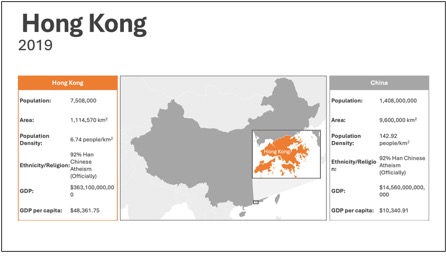
FIGURE 3: HONG KONG PRC COMPARISON.[121]
Phase 1 – United-Front Softening (pre-1997–2003)
The earliest phase of the PRC’s occupation of Hong Kong did not begin with overt coercion or institutional subversion, but with a long campaign of narrative reassurance, elite cultivation, and economic integration. This approach relied on the strategic use of ambiguity, co-optation, and elite alliance-building to establish a foundation for eventual control. It began well before the 1997 handover and continued through the early years of the new millennium. Unlike in Tibet or Xinjiang, where occupation was imposed through military presence and revolutionary authority, the PRC’s approach in Hong Kong was premised on the appearance of restraint and mutual benefit. But beneath this surface lay a calculated effort to condition political institutions, influence media narratives, and preempt resistance through elite alignment.
In the years leading up to the handover, Beijing deployed the United Front Work Department (UFWD) to systematically cultivate ties with pro-China business leaders, local political actors, and sympathetic media figures. These relationships were formalized through participation in advisory bodies such as the Basic Law Drafting Committee (BLDC) and Preparatory Committee for the Hong Kong Special Administrative Region (HKSAR), and informalized through economic incentives and social prestige.[122] By 1997, United Front affiliates and pro-Beijing figures held significant sway over one-third of all positions on key statutory advisory committees and boards, including those influencing urban planning, education, public housing, and social welfare.[123] This institutional embedding gave Beijing early leverage over the policymaking architecture of the future HKSAR, well before sovereignty was officially transferred.
The PRC also made strategic use of media acquisitions and engaged in editorial pressure. By acquiring stakes in major newspapers and cultivating loyalty among news editors, Beijing gradually reshaped the tone of Hong Kong’s public discourse.[124] While explicit censorship was not yet enforced, self-censorship became a noticeable trend, especially in coverage of Chinese politics or sensitive historical events. The Party sought to normalize its rule in the eyes of Hong Kongers through narrative saturation rather than any kind of overt suppression.
Economic integration played a parallel role. In the mid-1990s, the PRC initiated a series of preferential trade and investment policies designed to anchor Hong Kong’s business elite in a stable and profitable relationship with the mainland. These included favorable terms for property developers, listings for major Chinese firms on the Hong Kong Stock Exchange, and early access to emerging markets in the Pearl River Delta.[125] This created a powerful economic constituency in Hong Kong for “stability” and “constructive engagement” with Beijing. These actors who would later serve as buffers against popular resistance to encroaching control.[126]
Importantly, this period was characterized by the preservation of formal autonomy. The PRC allowed Hong Kong’s colonial-era legal system, civil service, and press freedoms to continue largely intact. This approach reinforced the credibility of the “One Country, Two Systems” model and lulled many residents and international observers into believing that Beijing would honor its commitments. The PRC’s posture during this phase was not overtly repressive. As with other cases, it could be characterized as strategically patient. Public messaging emphasized continuity, harmony, and non-interference.[127]
The first major test of this approach came in 2003, when the Hong Kong government, under pressure from Beijing, introduced legislation under Article 23 of the Basic Law to criminalize acts of treason, sedition, and subversion. The proposal sparked the largest protest since the 1989 Tiananmen demonstrations, with over 500,000 residents marching against the bill. The protests forced the government to withdraw the legislation, marking a rare policy reversal and signaling to Beijing the enduring strength of public mobilization in defense of civil liberties. Like the people of Taiwan (as discussed in the final section of this paper), Hong Kong residents had a tradition of non-violent resistance that would continue to manifest.[128]
While the immediate result was a retreat from coercive legislation, the episode revealed the limits of soft influence alone. Beijing had expected that a decade of reassurance, co-optation, and economic growth would defuse resistance to national security legislation. Instead, it encountered a politically active public unwilling to accept authoritarian drift. The Article 23 crisis marked the end of the first phase and a turning point in the CCP’s approach to Hong Kong: from narrative shaping and elite engagement to more direct legal and institutional consolidation.
Still, the success of this phase should not be understated. By 2003, the PRC had built a robust network of pro-Beijing stakeholders, it cultivated self-censorship in major media outlets, and it embedded economic dependency into the city’s elite class. These efforts did not eliminate resistance, but they shaped the environment in which future repression would unfold. As with earlier occupations, the CCP’s first phase was more about preparation than domination: preparing institutions for capture, elites for co-optation, and the public for gradual habituation to Party-defined boundaries of political life.
Phase 2 – Lawfare Consolidation (2003–2014)
Following the failure of Article 23 legislation in 2003, the CCP revised its occupation strategy in Hong Kong. The mass protests that year had demonstrated the limits of soft influence, elite co-optation, and economic integration. From Beijing’s perspective, the city’s population could not yet be trusted to voluntarily embrace a “harmonious” return to the motherland. The next phase of occupation, therefore, shifted from persuasion to what might be called the “lawfare” phase involving legal and institutional consolidation. Through legal reinterpretation, procedural manipulation, and selective enforcement, the PRC began dismantling the substance of Hong Kong’s autonomy while preserving its outward forms.
Central to this approach was the increasing use of the National People’s Congress Standing Committee (NPCSC) to reinterpret the Basic Law. Although framed as constitutional clarifications, these interventions carried the effect of direct amendment. Between 2003 and 2014, the NPCSC issued multiple interpretations that altered the powers of the Chief Executive, narrowed the scope of legislative initiative, and constrained electoral reform.[129] Crucially, by treating these interpretations as legally binding yet politically neutral, Beijing was able to shift the institutional foundations of Hong Kong’s governance without formally violating the Sino-British Joint Declaration. It was the legal equivalent of creeping annexation characterized by norm erosion disguised as constitutional housekeeping.
This lawfare strategy was reinforced by targeted judicial signaling and elite filtering. Pro-democracy candidates and political activists found themselves increasingly entangled in lawsuits, disqualifications, or bureaucratic technicalities that prevented them from exercising power even when they won elections.[130] The rules of the game remained intact on paper. Their enforcement, however, had become asymmetrical, favoring pro-establishment figures and penalizing those who tested the limits of permissible dissent. In essence, the CCP had transformed Hong Kong’s legal institutions from neutral arbiters into tools of ideological hygiene.
The legal campaign was accompanied by deepening economic integration and elite alignment. The Closer Economic Partnership Arrangement (CEPA), signed in 2003, marked a turning point in economic statecraft. It offered preferential market access for Hong Kong firms and incentives for financial services aligned with mainland development objectives. The result was a tighter binding of the city’s business class to Beijing’s long-term interests. Many of these same elites sat on executive committees, educational boards, and media conglomerate boards thus amplifying pro-Beijing messaging and normalizing political convergence. This form of elite capture was not merely transactional, but systemic. It gradually reconfigured the city’s political economy around Party-defined notions of “stability” and “prosperity.” [131]
Beijing also expanded its efforts to reshape public consciousness, particularly among youth. In 2012, the Hong Kong government attempted to introduce the Moral and National Education (MNE) curriculum, which promoted Chinese nationalism and portrayed the CCP in a uniformly positive light. The initiative triggered a wave of youth-led protests, culminating in the occupation of government headquarters and widespread public opposition. The campaign ultimately forced the government to withdraw the policy, but it revealed Beijing’s growing investment in identity engineering. As in Tibet and Xinjiang, the Party understood that occupation could not be sustained by force alone it had to win the cognitive domain.[132]
These developments were accompanied by a growing reliance on bureaucratic and procedural instruments to disable resistance. For instance, the expansion of pro-Beijing functional constituencies in the Legislative Council diluted the electoral influence of the pro-democracy camp. Administrative measures including control over school funding, broadcasting licenses, and civil service promotions created a bureaucratic ecosystem in which loyalty to the PRC was increasingly a precondition for career advancement and institutional survival.[133] Autonomy remained in name; in practice, it was being hollowed out by a thousand cuts.
This period also saw the emergence of self-censorship in the press and cultural sectors. Editors avoided sensitive topics. Publishers delayed or canceled politically controversial books. Radio hosts who criticized Beijing were removed from the air.[134] While explicit state censorship was rare, the chilling effect of legal pressure, advertising boycotts, and regulatory scrutiny transformed the media landscape. This mirrored earlier CCP strategies in Xinjiang and Tibet, where control over narratives preceded formal repression.
By 2014, Hong Kong’s civic institutions had been profoundly reshaped. The PRC had succeeded in establishing legal dominance over the territory’s constitutional order without invoking martial law, suspending elections, or closing courts. This phase was defined not by visible coercion, but by systemic substitution: rule of law was displaced by rule by law.[135] In the eyes of many Hong Kongers, the erosion was obvious. But to external observers, Beijing still appeared to be playing by the rules; another feature of lawfare by design.
The stage was now set for confrontation. Popular frustration with the shrinking political opportunity space, especially among youth, would erupt later that year in the Umbrella Movement, triggering a new phase of open contestation. But by then, much of the institutional groundwork for authoritarian consolidation had already been laid.
Phase 3 – Crisis-Driven Coercion (2014–2019)
The 2014 Umbrella Movement marked a rupture in the PRC’s approach to Hong Kong. What had begun as a carefully managed erosion of autonomy through legal reinterpretation, elite co-optation, and bureaucratic substitution, gave way to a period of visible confrontation and coercion. The CCP leadership had long believed that its incremental strategy of lawfare and economic integration could contain Hong Kong’s democratic aspirations. The Umbrella Movement disabused the Party of this notion. From 2014 to 2019, the CCP adopted a more openly coercive posture, aiming to extinguish the political opportunity space that had persisted since the handover.
The movement was sparked by the NPCSC decision in August 2014 to impose tight restrictions on electoral reform, effectively pre-screening candidates for the city’s Chief Executive position. The decision contradicted public expectations of gradual democratization and triggered mass protests led by students, civil society organizations, and pro-democracy legislators. For 79 days, this organized civil resistance occupied major thoroughfares in Hong Kong’s Central and Admiralty districts, erecting tents, engaging in public debates, and demanding genuine universal suffrage.[136]
Though the movement failed to secure electoral concessions, it reshaped the political landscape. The occupation galvanized a new generation of activists and civil resistance leaders, expanded political awareness across socioeconomic classes, and challenged the CCP’s assumption that dissent could be contained by economic growth and procedural reform. In response, the PRC adopted a dual-track approach: repressive legalism and targeted coercion.
In the immediate aftermath of the Umbrella Movement, the Hong Kong government, with the CCP’s backing, launched a systematic campaign of political disqualification and legal prosecution. Elected legislators who had expressed dissenting views or those sympathetic to localism or self-determination were barred from office under expansive interpretations of loyalty oaths.[137] Protest leaders, including Joshua Wong, Nathan Law, and Benny Tai, were arrested, tried, and sentenced to prison on charges ranging from unlawful assembly to public nuisance. These prosecutions sent a clear message: activism would be criminalized, and even symbolic acts of defiance would carry legal consequences.[138]
At the same time, the CCP intensified efforts to close the institutional and ideological space in which resistance operated. Universities came under increased political pressure. Student unions were monitored, controversial events were canceled, and faculty perceived as sympathetic to protesters were marginalized or dismissed. Public broadcasters, such as RTHK, faced tightening editorial controls. International journalists were denied visas or expelled for perceived bias. Surveillance technologies, including facial recognition, phone tracking, and data analytics, were quietly expanded, transforming protests into opportunities for network mapping and preemptive detention.[139]
These tactics did not unfold in isolation. They were complemented by a carefully curated propaganda campaign that sought to recast protesters as violent radicals manipulated by foreign forces. State media portrayed the Umbrella Movement as a threat to order, prosperity, and national unity.[140] The PRC’s rhetorical strategy mirrored its approach in Xinjiang and Tibet: frame resistance as extremism, cast dissenters as ungrateful or externally manipulated, and position the Party as the guardian of harmony and modernization.
Still, repression during this period remained relatively calibrated. The PRC did not impose martial law, nor did it suspend Hong Kong’s courts or legislature. Instead, the CCP sought to erode the city’s political autonomy within the boundaries of its own legal architecture. This phase of the occupation was more like institutional suffocation. It involved constricting the channels of dissent while maintaining the façade of legality. It was also an experiment in behavioral management: by increasing the cost of resistance and the uncertainty of dissent, the CCP aimed to produce compliance not through belief, but through fear and fatigue.
But this strategy did not produce acquiescence. Instead, it sowed the seeds of deeper confrontation. Disqualified lawmakers founded new movements. Imprisoned leaders became martyrs. New protest slogans emphasized identity, not just democracy. The logic of resistance shifted from reform to differentiation; from preserving autonomy to defending an emergent Hong Kong identity under existential threat.
When the government proposed the 2019 Extradition Bill, which would have allowed the transfer of suspects to mainland China, the result was not another wave of protest, but an explosion. Millions took to the streets in the largest demonstrations since the handover. What began as a legal objection transformed into a mass rejection of CCP’s rule. Civil resistance organizers adopted more decentralized, agile tactics, embraced anonymity, and called for international solidarity. The Umbrella Movement had revealed the system’s contradictions and then the 2019 protests laid them bare.[141]
Phase 3 ended not with a resolution, but with escalation. By the close of 2019, it was clear to Beijing that its hybrid model of soft coercion and legal suffocation had failed. The mass protests demonstrated that the political opportunity space, though narrowed, remained active and dangerous. The CCP’s response would be total. The next phase would bring the full weight of national security infrastructure into the city, marking the end of “One Country, Two Systems” not in theory, but in practice.
Phase 4 – Comprehensive Legal-Security Lock-In (2019–Present)
The final phase of the PRC’s occupation of Hong Kong marks the transition from incremental erosion to comprehensive control. The failed attempt to pass the 2019 Extradition Bill revealed to CCP leadership that the city’s political opportunity space, though narrowed, remained active and dangerous. Mass protests, decentralized resistance, and escalating demands for autonomy confirmed that earlier strategies of lawfare, elite co-optation, and selective repression, were insufficient to secure unchallenged authority. Beijing’s response was an escalation and a systemic reconfiguration of governance: the fusion of legal domination, security institutionalization, and identity engineering into a unified mechanism of control. The CCP stopped pretending that “One Country, Two Systems” remained intact.
The turning point was the imposition of the National Security Law (NSL) on June 30, 2020. Aided by the global pan0demic of COVID-19, the bill was drafted and passed in Beijing without consultation from Hong Kong’s legislature. The NSL criminalized four vaguely defined categories of activity: secession, subversion, terrorism, and collusion with foreign forces. These categories were broad by design, allowing authorities to target nearly any form of political expression, association, or dissent. The law applied extraterritorially, meaning that even non-Hong Kong residents speaking abroad could be prosecuted under its provisions. This extraterritorial scope represented a major expansion of PRC legal reach and a warning to diaspora and international activists.[142]
The NSL created a parallel enforcement structure with the establishment of the Office for Safeguarding National Security (OSNS), staffed by mainland agents operating outside the jurisdiction of Hong Kong’s courts. National security cases were removed from the oversight of local judges and reassigned to those handpicked by the Chief Executive. Bail was effectively eliminated for NSL offenses, and pretrial detention became a default mode of punishment. Trials were often closed to the public. In short order, hundreds of journalists, activists, students, and opposition politicians were arrested. Major civil society organizations including the Hong Kong Confederation of Trade Unions, the Professional Teachers’ Union, and Amnesty International’s Hong Kong branch disbanded or fled. The city’s once-vibrant protest culture evaporated in the space of months.[143]
Alongside legal repression came electoral restructuring. In 2021, Beijing implemented sweeping reforms to the Legislative Council (LegCo) and District Councils, eliminating most directly elected seats and creating new vetting mechanisms to ensure only “patriots” could run for office. These reforms erased the last institutional foothold for democratic opposition and completed the CCP’s capture of formal political institutions. From that point forward, Hong Kong elections became tightly choreographed performances of loyalty, indistinguishable from local elections on the mainland.[144]
The media sector was similarly transformed. The Peoples Armed Police raided and shut down independent outlets such as Apple Daily and Stand News and charged their editors and executives with national security violations. Public broadcaster RTHK was restructured to align with “patriotic” standards. New content regulations prohibited coverage of protest history, critical commentary, or symbolic references to the 2019 resistance. Journalists, librarians, and educators alike were subject to surveillance and disciplinary review.[145] The chilling effect was immediate and severe.
Education became another front in the battle for identity. The Liberal Studies curriculum, once focused on critical thinking and civic engagement, was replaced by National Security Education.[146] New textbooks omitted or revised key historical events, including the 1989 Tiananmen massacre and the Umbrella Movement.[147]
The COVID-19 pandemic provided Beijing with both a pretext and a toolkit to accelerate the suppression of dissent in Hong Kong. Under the guise of public health protection, the HKSAR government imposed strict assembly bans, effectively halting protests, vigils, and civil society events that had defined the previous year. Restrictions on group gatherings were selectively enforced: while pro-democracy demonstrations were criminalized as public health threats, pro-Beijing events proceeded with minimal interference.[148] The annual June 4th Tiananmen vigil was banned for the first time in 2020 and again in 2021, citing COVID-19 concerns, despite declining case numbers. Beyond limiting assembly, pandemic emergency powers enabled expanded surveillance and police discretion, including enhanced authority to track digital contacts, conduct warrantless searches, and limit access to public spaces.[149] Though introduced as temporary health measures, these tools quickly became normalized within the broader infrastructure of control. In effect, the pandemic created a window of reduced international scrutiny and restricted domestic mobilization, which Beijing used to routinize legal repression and entrench its security architecture without triggering the kind of mass resistance seen in 2019.
Finally, Beijing expanded its control over economic and financial structures. CCP agents pressured companies to demonstrate political alignment through public declarations and hiring practices. Authorities conditioned public contracts and business licenses on political reliability. International firms operating in Hong Kong faced new restrictions on content, partnerships, and speech. Corporate compliance became a mechanism of ideological enforcement. The goal was not merely political subjugation but identity reconstruction: to remake Hong Kongers into loyal citizens of the Chinese state.[150]
This phase represents the culmination of a multi-decade occupation strategy. What began as a diplomatic agreement and evolved through legal erosion, soft co-optation, and calibrated repression has now become a fully institutionalized authoritarian regime. The CCP no longer hides its role in governing Hong Kong; it asserts it proudly. The legal architecture, political institutions, media environment, and education system have all been transformed to reflect Party doctrine. The political opportunity space has collapsed. Dissent has been criminalized. Compliance is now performed not only through silence but through ritual acts of loyalty.
The PRC’s occupation of Hong Kong thus achieved what it could not in Tibet or Xinjiang through military conquest or revolutionary transformation: the full subjugation of a liberal society through law, narrative, and institutional infiltration. Yet this success remains fragile. It is hard to tell if resistance has disappeared or just dispersed. In the diaspora, online, and in private memory, the spirit of protest endures. But inside the city, surveillance, fear, and repression have rendered open resistance nearly impossible.[151]
The case of Hong Kong underscores a core feature of the PRC way of occupation: authoritarian rule without overt military presence whenever possible. The tools are legal codes, security organs, and ideological programming. The goal is not just control but transformation of identity, memory, and belief. In this final phase, the CCP is no longer managing autonomy; it is erasing the core elements of autonomy and replacing it with decorations and slogans.
Themes of Occupation – Hong Kong
Legal-Institutional Capture – The most consistent theme across Hong Kong’s occupation has been the strategic use of law to transform international guarantees of autonomy into instruments of control. In early phases, the CCP signaled restraint, honoring the outward structures of the basic Law and preserving judicial independence. While doing so, the party seeded institutional capture by embedding pro-Beijing elites in the Basic law Drafting Committee and cultivating narratives of legal continuity. Following the backlash to Article 23 legislation in 2003, the CCP increasingly relied on the NPCSC to reinterpret the Basic law. These interventions allowed the CCP to reshape electoral rules, constrain legislative initiative, and limit judicial autonomy. Such activities were all under the guise of constitutional clarification. By preserving the appearance of legality, Beijing conducted a creeping annexation that hollowed out Hong Kong’s autonomy while avoiding the stigma of overt violation of the original Joint Declaration.
Between 2014 and 2019, the CCP weaponized the law against activists and legislators. Expansive loyalty oath interpretations served to disqualify dissenters. The CCP prosecuted protest leaders for “public nuisance” and other legal tricks, while universities faced ever tighter legal oversight. Finally, the imposition of the NSL completed the legal capture. Drafted in Beijing and enforced through a parallel security bureaucracy, the NSL criminalized dissent under vague categories of secession, subversion, terrorism, and collusion with foreign forces. Its extraterritorial scope extended occupation beyond Hong Kong’s borders, silencing diaspora voices and asserting a global reach. What began as lawfare disguised as constitutionalism culminated in law as direct coercion. The theme of legal-institutional capture demonstrates how the Party turned law into both shield and sword: a shield against international critique and a sword against domestic resistance.
Security Embedding – A second theme is the gradual embedding of mainland security structures into Hong Kong’s policing, intelligence, and judicial systems. In Phase 1, Beijing refrained from overt security integration, relying instead on elite cultivation and reassurance. Yet the Article 23 controversy foreshadowed the Party’s intent: when resistance emerged, security infrastructure would be expanded. By Phase 2, this embedding was underway. Surveillance capacities increased, and security coordination between mainland agencies and the Hong Kong Police Force became routine. The Umbrella Movement in Phase 3 accelerated the process. Police mapped protest networks through digital surveillance, targeted student leaders for prosecution, and justified disqualification campaigns as security measures against “splittism.” Finally, in Phase 4, security embedding became institutionalized. The Office for Safeguarding National Security (OSNS) operated outside Hong Kong’s jurisdiction, staffed by mainland officers, while reassigning national security cases to handpicked judges. The CCP formalized People’s Armed Police presence through liaison offices, blurring the boundary between “one country, two systems” and direct Party oversight. Security embedding was no longer covert coordination but structural dominance.
This theme highlights how occupation in Hong Kong was achieved not by replacing institutions outright, but by duplicating and subordinating them. Security embedding created a dual system: one visible to reassure international observers, another invisible but decisive in ensuring Party control.
Electoral Redesign – A third theme is the systematic redesign of Hong Kong’s electoral institutions to strip democratic participation while maintaining a façade of representation. In Phase 1, the Party tolerated limited direct elections to LegCo and preserved district council autonomy, calculating that elite alliances and economic co-optation would suffice. Phase 2 marked the beginning of electoral manipulation. Functional constituencies were expanded to dilute the pro-democracy camp, while NPCSC interpretations curtailed prospects for genuine universal suffrage. This legal engineering reduced elections to managed contests.
Phase 3 escalated electoral redesign into overt suppression. The disqualification of legislators, manipulation of oath-taking rules, and criminalization of protest leaders all served to exclude resistance from institutional politics. Elections remained on the calendar, but their competitive essence was hollowed out. In Phase 4, electoral redesign culminated in the 2021 reforms that eliminated most directly elected seats, instituted candidate vetting committees, and required loyalty pledges for office. The result was a legislature indistinguishable from mainland rubber-stamp bodies. Electoral redesign thus completed the trajectory from democracy to managed authoritarianism, cloaked in procedural ritual. This theme underscores a distinctive feature of Hong Kong’s occupation: legitimacy was not seized through outright abolition of institutions but re-engineered through procedural suffocation. A process likely to be necessary in a Taiwan that has a population accustomed to over 40 years of Democratic rule.
Economic Statecraft and Identity Engineering – Economic inducement and identity transformation formed another core theme. In Phase 1 and 2, the Closer Economic Partnership Arrangement (CEPA) and preferential access to mainland markets bound Hong Kong’s business elite to Beijing’s interests. These measures created a powerful constituency for stability and economic integration, echoing similar strategies of elite co-optation in Tibet and Xinjiang. Mainland firms listed on the Hong Kong Stock Exchange, property developers prospered through access to mainland markets, and pro-Beijing elites leveraged economic ties into political capital. Economic dependency became a mechanism of compliance. Yet resistance persisted, especially among youth. Beijing therefore turned to identity engineering. The attempted introduction of Moral and National Education in 2012 signaled a shift toward shaping civic consciousness. Though defeated by student-led protests, it revealed the Party’s recognition that occupation required not only economic loyalty but cognitive conformity.
Phase 3 and 4 institutionalized identity engineering. National Security Education replaced Liberal Studies, new textbooks erased sensitive history, and schools became sites of patriotic programming. Corporate compliance was also politicized: firms were pressured to declare loyalty, align hiring practices with Party standards, and police employee speech. In this sense, economic statecraft fused with identity engineering, tying livelihood and status to ideological conformity. The theme illustrates the dual logics of Hong Kong’s occupation: buying elites while remolding citizens, fusing material dependency with cognitive reshaping.
Borderless Information Control – The final theme is the construction of an information regime that extended beyond Hong Kong’s borders. In Phase 1, control was subtle: media acquisitions and editorial pressure fostered self-censorship. Phase 2 expanded these pressures into systemic chilling effects, with advertising boycotts and regulatory scrutiny silencing critical outlets. By Phase 3, information control became coercive. The CCP denied international journalists visas, restructured public broadcasters, and framed protest movements as foreign-instigated extremism. The Party’s narrative discipline mirrored Tibet’s “feudal liberation” and Xinjiang’s “counterterrorism” logics: dissent was reframed as illegitimacy.
Phase 4 culminated in comprehensive information control. Apple Daily and Stand News were shut down under national security charges, journalists were imprisoned, and public libraries purged politically sensitive works. Beyond Hong Kong, the NSL’s extraterritorial provisions targeted diaspora activists, and Beijing deployed transnational repression against exiled journalists and lobbyists. The goal was total narrative dominance—occupation not only of territory but of discourse, memory, and history.
This theme shows how Hong Kong’s occupation blurred the boundary between domestic control and global information warfare. By criminalizing dissent abroad, the PRC sought to close the last refuge of resistance: the transnational information space.
Taken together, these themes demonstrate that Hong Kong’s occupation was not an anomaly but a variant of the PRC’s broader occupation doctrine adjust for context. Like Tibet and Xinjiang, it combined lawfare, co-optation, surveillance, and identity engineering. Yet its uniqueness lies in method: where force was central in Tibet and Xinjiang, law and narrative were central in Hong Kong. Each theme traces its lineage through the phases of occupation, showing how reassurance gave way to erosion, erosion to repression, and repression to comprehensive control.
Hong Kong illustrates that the PRC does not require military conquest to achieve occupation. By weaponizing law, embedding security, redesigning elections, fusing economics with identity, and controlling information across borders, the Party transformed a liberal enclave into an authoritarian city. The outcome is a model of occupation-by-submersion: sovereignty asserted through international law, autonomy hollowed through institutional capture, and identity reshaped through coercion masked as governance.
1.4 Conclusion
The three case studies demonstrate the adaptability of the PRC in pursuing occupation across dramatically different contexts. Tibet and Xinjiang represent the Party’s early efforts to consolidate frontier regions that, though historically linked to Chinese empires, retained distinct ethnic, cultural, and religious identities. Both were vast, sparsely populated, economically underdeveloped, and poorly integrated into global networks. These conditions enabled Beijing to employ strategies of coercive incorporation, demographic engineering, and ideological remolding over decades, gradually transforming contested territories into securitized zones under direct Party control. The PRC’s occupation model here relied heavily on physical presence including PLA garrisons, the Xinjiang Production and Construction Corps, and large-scale Han migration, all supported by ideological campaigns that framed “liberation” as modernization.
Hong Kong, by contrast, presented an entirely different contextual challenge, some of which is similar to Taiwan. Rather than a remote and underdeveloped frontier, Hong Kong was an economic jewel: a densely populated, highly educated, globally connected city with a vibrant civil society and entrenched rule-of-law traditions. Military conquest was neither feasible nor necessary. Instead, Beijing employed a long game of legal manipulation, elite co-optation, and information control, culminating in the imposition of the National Security Law. Where Tibet and Xinjiang illustrate occupation through coercion and demographic transformation, Hong Kong represents occupation through lawfare, institutional erosion, and the deliberate hollowing out of political opportunity space.
What unites these otherwise disparate cases is the Party’s patience, adaptability, and persistence. The PRC has demonstrated a willingness to accept decades of resistance, reputational costs, and international criticism so long as the long-term trajectory points toward integration. In Tibet, strategic patience allowed the Party to recover from the 1959 uprising and eventually transform the region into a heavily surveilled administrative zone. In Xinjiang, international outrage over repression has not altered Beijing’s course, as the Party continues to rely on high-technology surveillance and coercive reeducation. In Hong Kong, two decades of gradual erosion culminated in decisive authoritarian consolidation, showing that Beijing can succeed without tanks or overt conquest.
Together, these cases underscore that occupation for the PRC is not a singular event but a long arc of transformation representing good strategy and adaptive strategic thinking. Each context required different tools—military force in Tibet, counterterrorism rhetoric and surveillance in Xinjiang, and lawfare in Hong Kong—but the underlying logic remains consistent: fragment resistance, co-opt or displace elites, embed Party authority in local institutions, and wait until dissent is exhausted or irrelevant. For the CCP, time is not a constraint but a strategic asset. Whether in remote plateaus, borderlands, or global cities, the Party has shown that persistence, flexibility, and the slow erosion of autonomy to prevent resistance or external support to resistance.
2 – Contemporary PRC Doctrine and Reforms
Strategic culture and ways of war give us broad patterns, but they remain abstract. The same holds true for the concept of a PRC way of occupation. The three case studies reveal important themes such as strategic patience, adaptability, and persistence. They also highlight recurring practices and approaches that include (1) shaping operations before invasion, (2) careful use of legal arguments and the manipulation of legal institutions, (4) deliberate shaping of identity through multiple means, (5) reliance on technical surveillance, and (6) the systematic and deliberate fragmentation of opposition. These insights matter, but they remain too abstract to guide resistance planning or policy.
To move from the abstract to the more concrete, we must examine the doctrines and reforms that shape how the CCP and the PLA operate today. Doctrinal texts reveal how Party leaders think about control, legitimacy, and coercion. Recent institutional reforms show how they organize the tools of occupation and prepare them for use. Together, these sources allow us to refine the themes drawn from history by assessing present-day capacity and intent.
This section therefore turns to the CCP’s evolving doctrine and organizational reforms. It asks a single, focused question: What do contemporary reforms and CCP doctrines tell us about a PRC way of occupation? To answer, the section examines three domains: The highest policy and doctrines of the PRC including Xi Jinping Thought and the Science of Military Strategy, the creation of the Information Support Force and related reorganizations, and reforms to the People’s Armed Police. While this sampling is by no means comprehensive, each selection illuminates how Beijing prepares to extend sovereignty into contested spaces and sustain control under conditions of resistance.
2.1 – Xi Jinping Thought and the Science of Military Strategy
For the CCP and the PLA, the two most authoritative guides for strategic practice are Xi Jinping Thought and the Science of Military Strategy (SMS).[152] These documents shape both the political logic of occupation and the operational methods through which control is asserted. Xi Jinping Thought articulates the overarching political objectives and the ideological basis for the contemporary managing unwilling populations. The SMS codifies doctrinal approaches to civilian control, stability maintenance, and the integration of military and civilian tools in contested environments. Together, they reveal not only the determination of the CCP to seize and hold Taiwan but also the methods by which the Party intends to transform the population and ensure long-term compliance.
Policy Influences of Xi Jinping Thought
Xi Jinping Thought functions as the Party’s most authoritative political framework. It establishes the principles of Party supremacy, ideological conformity, and comprehensive social management that guide all state action. For occupation scenarios, it provides clear direction on how the CCP expects to govern populations that resist integration. Key among these is fused authoritarianism, population control and surveillance, and legal and ideological control. Hong Kong serves as the most comparable template given its proximity in time, demographics and population density to Taiwan. Taiwan’s geography; however, offers additional challenges.
Xi Jinping replaced the earlier system of “fragmented authoritarianism,” in which bureaucratic actors and local institutions possessed some limited autonomy, with what scholars describe as “fused authoritarianism.”[153] In this model, all authority flows directly to the Party center, embodied in Xi himself. Competing power centers, whether within state institutions, civil society, or the private sector, are systematically eliminated. Xi identifies civil society, press freedom, judicial independence, and citizens’ rights not as assets but as threats. He calls for their vigorous opposition. The principle of the “Two Maintenances”—loyalty to Xi personally and to the Central Committee—formalizes this approach. Occupation under Xi Thought therefore requires the elimination of alternative authorities and the absorption of all institutional life into the Party’s orbit.[154]
Xi also emphasizes the use of surveillance and grassroots governance systems to manage resistant populations. The grid governance model divides communities into digitally monitored units of a few hundred households.[155] Neighborhood committees and local monitors report in real time, while surveillance cameras and data systems provide constant oversight. The state then integrates this reporting into larger surveillance platforms that track and score behavior. During COVID-19, authorities used grid governance to control urban populations; after 2020, they extended it to Hong Kong. Though they have proven far more difficult to implement and are less pervasive that some western China watchers once believed, social credit systems further reinforce this logic by numerically scoring compliance, rewarding loyal behavior, and punishing dissent.[156] The combination of surveillance and scoring creates an environment in which resistance becomes costly, and loyalty becomes materially rewarding.[157]
In Xi Jinping Thought on the Rule of Law, he explicitly subordinates all legal processes to Party control. The “Eleven Upholds” affirm that Party leadership overrides judicial independence, constitutional limits, or citizens’ rights. Laws do not function as neutral arbiters; they legitimize political repression, religious regulation, and ethnic assimilation. Xi pairs this with ideological enforcement. Schools, universities, and workplaces now require mandatory study of Xi Jinping Thought. The Party directs these institutions to suppress Western liberal values and promote a Sino-centric worldview that recodes democracy as disorder and Party rule as harmony.[158]
Hong Kong demonstrates how Xi Jinping Thought applies to populations with democratic traditions and strong civic identity. After 2019, Beijing imposed “patriots-only” governance, eliminated opposition parties, and rewrote electoral laws to ensure Party dominance.[159] The NSL criminalized dissent and created a parallel security structure staffed by mainland personnel. Civil society organizations dissolved, while schools implemented patriotic curricula and media outlets faced closure or capture. These measures converted a liberal city into an authoritarian system within two years. For Taiwan, the Hong Kong experience signals how the CCP would dismantle democratic institutions, criminalize resistance, and impose comprehensive surveillance in the early stages of occupation.[160]
Xi Jinping Thought is not shy on the topic of Taiwan. It frames Taiwan policy as an essential step in the larger project of national rejuvenation. It casts reunification as a historical necessity and a moral obligation that ends the wounds of division. The narrative links past humiliation to present resolve, arguing that only a unified and strong China can deliver dignity and prosperity to people on both sides of the Strait. Xi states that the leadership holds the will, the confidence, and the capability to defeat any form of Taiwanese separatism, and that the state will never allow anyone to separate any piece of Chinese territory from China.[161]
Within this framework, Beijing presents peaceful reunification under one country, two systems as the best path. The formula claims to reconcile two different social systems inside a single sovereign state. The pitch to Taiwan stresses high autonomy, long-term stability, and improved well-being. The political logic, however, assigns supremacy to the one country principle. Xi describes one country as the root and the foundation, while two systems remain subordinate and derived. The mainland’s socialist system sets the premise and the guarantee. Under that premise, the center may permit Taiwan to maintain market institutions for a long time, but only as a function of national unity and Party leadership.[162]
This structure serves two audiences. For Taiwanese citizens, it offers peace, development, and international respect. For the domestic audience, it affirms sovereignty, security, and the non-negotiable priority of national unity. The three case studies qualify the promise that two systems can operate as a stable and equal arrangement. Tibet, Xinjiang, and Hong Kong show that the CCP implements one country as one system with different decorations rather than different substance. Autonomous regions do not exercise meaningful autonomy. Party committees and security organs direct the core functions of governance, while legal texts, curricula, and media programming align local institutions with central priorities. Hong Kong further demonstrates that the center will revise electoral rules, restrict civil society, and impose a national security regime when local actors resist. These outcomes do not reflect temporary exceptions. They reveal the structure of the model.
If a crisis moved toward PRC control over Taiwan, Xi Jinping Thought points to a dual-track approach. Beijing would publicize a peaceful reunification offer under one country, two systems. It would claim that reunification secures prosperity and dignity, and it would promise long periods of institutional continuity. At the same time, authorities would define the scope of autonomy through the one country premise. They would set bottom lines on sovereignty and security, and they would use law, administration, and security tools to enforce those lines. The Party would treat the offer and the enforcement as complementary. The message to Taiwan would emphasize benefits and continuity. The practice would prioritize central control.
This logic interacts with the PLA’s concept of fighting while talking.[163] Negotiation and coercion move in parallel. Authorities might open dialogue with business leaders, local notables, and moderate politicians, while security services target organizers, shape public opinion, and prosecute high-profile cases. The center would reward cooperation with market access and protection, and it would penalize noncompliance through legal, financial, and administrative measures. The model aims to divide opposition, to present autonomy as secure while the one country premise narrows its scope, and to move the political center of gravity toward irreversible integration.
The Science of Military Strategy
If Xi Jinping Thought provides the political logic of occupation, the Science of Military Strategy (SMS) offers the PLA’s doctrinal implications for execution. The document addresses the themes of both major wars and military operations other than war or “stability maintenance.” Published in 2013 and revised in 2020, the SMS treats non-war military activities as critical instruments for stability maintenance and population control. The PLA’s approach to occupation does not rest only on battlefield success. It integrates political work, legal warfare, and psychological operations as co-equal with kinetic force. Unsurprisingly, the foundational document emphasizes party control through Commissars and Cadre, the importance of integrating the PLA with other security services, grid governance and surveillance, as well as military and civil fusion along with the expansion of reserve forces. Perhaps most significantly, the doctrine of “Fighting while talking” implies a willingness to engage with civil resistance to buy time for its suppression and the erosion of its support.
The SMS underscores that the PLA serves the Party rather than the state. Political commissars and Party committees exist at every echelon to guarantee loyalty, enforce discipline, and transmit Party directives. During an occupation, commissars would extend their authority into civilian domains, ensuring that Party priorities guide administration, propaganda, and security. This structure allows the CCP to fuse military and civilian governance, minimizing the space for autonomous decision-making by local institutions.[164]
The PLA doctrine emphasizes coordination with the People’s Armed Police (PAP) and local civilian authorities. SMS sections on non-war military operations includes disaster relief as much as occupation and suppression of dissent from party positions.[165] During crises or occupation, the PLA and PAP operate jointly to suppress unrest and enforce political control., The PAP specializes in riot control, internal security, and managing large civilian populations. The PLA provides logistical and technological support. Together, they create a comprehensive apparatus for stability maintenance. In Taiwan, this would likely involve embedding PAP units in major cities while PLA forces secure infrastructure and communication hubs.
The SMS endorses grid governance as a method of controlling occupied populations. The PLA would rapidly divide urban centers into manageable blocks, overlay surveillance networks, and assign security personnel to monitor compliance.[166] This method has already been tested in Tibet, Xinjiang, and Hong Kong. In Taiwan, grid governance would be extended through existing digital infrastructure, integrating telecom data, financial records, and public cameras into mainland systems. This would likely happen well prior to any invasion or subsequent occupation. In other words, it is highly likely that the PRC already maintains searchable and dynamic digital records of Taiwanese citizens and their activities. The goal is to prevent resistance from organizing by saturating the environment with monitoring and preemptive intervention. Taiwanese and allied authorities should pay special attention to pre-invasion or takeover efforts where the PAP and PRC entities may already be monitoring the behavior and beliefs of Taiwanese citizens to identify citizens most likely to participate in resistance to PRC occupation.
The SMS highlights the integration of civilian and military resources as a cornerstone of future operations. Civil–military fusion extends across the defense technology industry, education, personnel training, and national defense mobilization, with the explicit goal of converting China’s vast civilian capacity into wartime power. In an occupation scenario, this principle would likely translate into mobilizing civilian technical expertise to construct surveillance networks, establish a Chinese digital firewall over Taiwan, and maintain digital control of information space.[167] At the same time, Chapter 25 of the SMS emphasizes the construction and development of reserve forces as a strategic project to consolidate national defense.[168] Reserves include militias, pre-commissioned personnel, and registered civilians who can be rapidly mobilized in war. SMS 2020 calls for raising the quality of reserves by attracting technical talent, modernizing training to include counterterrorism and stability operations, and updating equipment. For Taiwan, the combined weight of civil–military fusion and a robust reserve system would provide the PLA with both the technical workforce needed to build control infrastructure and the manpower to garrison occupied areas, suppress unrest, and support policing functions. In effect, even though Taiwan represents the largest population that the PRC has attempted to occupy, the Party has the resources and envisions occupation as a whole-of-society enterprise, where national economic and human resources are fully mobilized to enforce sovereignty and stabilize contested populations.
Like many documents of the PLA, the SMS emphasizes the “Three Warfares:” legal warfare, psychological warfare, and public opinion warfare.[169] Legal warfare provides the justification for repression, casting resistance as criminal rather than political. Psychological warfare aims to intimidate, demoralize, and fragment opposition through visible displays of power and targeted repression. Public opinion warfare seeks to control international narratives by framing occupation as lawful and stabilizing. In Taiwan, this triad would likely criminalize pro-independence activity, intimidate civilians through selective punishment, and project messages of normalization to international observers.
A central feature of PLA doctrine is the principle of “fighting while talking.” This concept rejects the Western notion that war and diplomacy occur in sequence. Instead, the PLA treats force and negotiation as concurrent, mutually reinforcing instruments. Military action creates leverage at the negotiating table, while negotiation buys time, divides opponents, and secures favorable conditions for further coercion. The PLA applies this concept to both armed and unarmed resistance. Against armed resistance, the PLA and PAP conduct aggressive operations while simultaneously offering amnesties, surrender terms, or selective negotiations designed to fragment opposition. Against nonviolent protest, authorities might engage moderate leaders in dialogue, promise limited concessions, or stage consultations, while at the same time arresting radicals, deploying riot police, and prosecuting organizers. In both cases, “fighting while talking” allows the Party to calibrate repression and negotiation in real time, sow confusion, and retain the initiative.
This approach has appeared repeatedly in PRC occupations. In Tibet, authorities combined violent crackdowns with selective engagement of elites. In Hong Kong, the government held staged consultations with civil society leaders during protest movements while prosecuting activists and tightening security laws. In Xinjiang, Beijing framed its reeducation program as vocational training even as security forces escalated mass detention. For Taiwan, the implication is clear. The CCP would likely combine selective dialogue with opposition elites or moderates with simultaneous coercion, arrests, and propaganda. This dual-track approach undermines unity, confuses external observers, and ensures that the Party, not the resistance, dictates the pace of escalation and de-escalation.
Policy Strategy Synthesis
Xi Jinping Thought supplies the narrative, the legal hierarchy, and the principle that one country defines the limits of any local system. The SMS supplies the method for turning that principle into control. Together they create a combined political and operational design for occupation and post-crisis governance.
The political design relies on a sequential promise that emphasizes peace, prosperity, and dignity, while it anchors every promise in the supremacy of Party-led sovereignty. One country, two systems functions as the vehicle for persuasion. The center sets the conditions under which two systems can continue, and it retains the right to revise those conditions whenever sovereignty or security comes into question. The case studies indicate how this revision proceeds in practice. Legal interpretation, security embedding, curricular change, and media control reduce the substantive space in which a local system can operate. Over time, the decorative differences remain, while core functions converge on the Party’s standards.
The operational design relies on commissar and cadre control, coordination with the People’s Armed Police, grid governance, political work, and the “Three Warfares.” Fighting while talking links these instruments to political objectives. The approach uses negotiation to split coalitions, to collect intelligence, and to create images of normalcy, while coercion constrains actors who reject the new order. Authorities can escalate or de-escalate within this structure without losing the initiative. They can offer leniency, signal flexibility, and absorb elites, while they maintain enforcement and surveillance that prevents re-mobilization.
The revised alignment of these sections yields a clear expectation. In any Taiwan scenario, Beijing will present peaceful reunification as the optimal and humane choice, framed as part of national rejuvenation. It will center one country as the root that defines the permissible scope of any Taiwanese system. It will negotiate while it enforces. It will promise stability and development, while it constructs the legal and security architecture that ensures convergence with Party rule. The model does not depend on sudden transformation. It depends on patience, on institutional capture, and on a steady narrowing of political opportunity until resistance becomes fragmented and costly.
2.2 – Organizational and Legal Reforms
Recent reforms within the PRC have reshaped the architecture of coercion in ways directly relevant to occupation. The most significant organizational changes have expanded the size, integration, and centralization of two institutions: the People’s Armed Police (PAP) and the Information Support Force (ISF). The CCP has elevated the PAP as the primary internal security arm, operating under direct Party and Central Military Commission control. Its expanded capabilities allow Beijing to surge personnel into contested spaces, perform riot control, and sustain long-term stability operations. The ISF, meanwhile, fuses cyber, electronic warfare, and information operations under a unified structure, giving the CCP the ability to dominate the digital environment of an occupied territory and leverage the civilian tech industry. Together, these reforms give the Party an apparatus to impose both physical and informational control in the aftermath of a Taiwan contingency.
Parallel to these organizational reforms, Beijing has enacted a suite of new legal instruments that provide both domestic cover and international justification for repression. National defense, state secrecy, personal data, and counter-espionage laws expand the CCP’s authority to monitor citizens, suppress dissent, and target foreign actors. These laws are not defensive in practice. They provide the Party with a legal foundation for preemptive surveillance, censorship, and the rapid neutralization of resistance networks. Hong Kong illustrates the model: national security legislation was paired with technical surveillance and police powers to dismantle civil society. Applied to Taiwan, this fusion of organizational reforms and legal authority would enable Beijing to consolidate sovereignty quickly, projecting an image of lawful governance while constructing a dense security apparatus. These changes reveal how the Party conceives of occupation not only as a military problem but as an integrated project of security, information, and law.
Information Support Forces
The Information Support Force (ISF), established in 2024 to replace the Strategic Support Force, now serves as the PLA’s “nerve center” for digital, cyber, and information dominance. It was designed for precisely the kind of theater-wide, multi-domain operations that an occupation requires, giving the Party the organizational muscle to integrate cyber, electronic, and informational tools into campaigns of population control.[170]
A central ISF mission is personnel surge capacity. Unlike traditional combat arms, the ISF deploys specialists forward alongside PLA and People’s Armed Police (PAP) units, embedding technical skills directly at the operational edge. These specialists provide cyber resilience, communications repair, electronic warfare, and network operations to sustain command and control in contested environments. In an occupation context, the ISF could rapidly embed teams to secure telecommunications infrastructure, build firewalls, enable AI tools, and restore surveillance and propaganda broadcasts after disruption.[171]
The ISF also emphasizes resilience and continuity of information flows. Training drills highlight the ability to rapidly reestablish networks, reroute communications, and maintain data dominance under degraded conditions.[172] In occupation scenarios these skills translate into the capacity to impose digital order, ensuring that the CCP maintains both command integrity and cognitive control over the population.
Reform documents describe the ISF as an institutional hub for emerging technologies, incorporating artificial intelligence, “intelligentized” decision support, and cross-domain operations. AI-enabled platforms help commanders anticipate resistance patterns, identify networks of dissent, and adapt rapidly in fluid political environments. The ISF’s centralized architecture enables it to scale quickly: surge personnel can be relocated from other theaters and embedded into occupied zones, extending the Party’s digital presence as fast as it extends its political one.[173]
The ISF’s technical expertise extends beyond the military. Civil–military fusion policies ensure that civilian engineers, coders, and data specialists can be mobilized into ISF operations. Chapter 25 of the SMS stresses mobilization of civilian reserves as a key dimension of “informationized” and “intelligentized” warfare. In an occupation, these reserves would be critical to erecting a Chinese firewall on Taiwan, constructing mass surveillance systems, and hardening digital perimeters against foreign interference.
Finally, the ISF embodies the CCP’s emphasis on interagency fusion. Its creation simplifies the integration of Party, military, and police information systems. The PLA, PAP, Ministry of State Security, and United Front Work Department can now draw upon a single digital infrastructure to monitor, suppress, and manipulate contested populations. For Taiwan, this means that occupation would not be managed by the PLA alone. It would be supported by a fused information-security complex capable of simultaneous coercion, propaganda, and population management across every domain.
Peoples Armed Police Reforms
The PAP has emerged from recent reforms as the PRC’s principal instrument for domestic coercion and occupation-style control. Centralized command under the CMC gives the PAP a direct line of integration with PLA operations. This structure enables national-level mobilization and rapid deployment of “mobile contingents” configured for fast insertion into contested areas.[174] In an occupation context, such as Taiwan, the PAP could arrive alongside advancing PLA units and immediately assume the tasks of riot suppression, administrative security, and population management.
The scale of the PAP makes this possible. With a force of up to 1.5 million personnel, and with growing maritime security responsibilities, the PAP can be surged into urban centers, ports, and infrastructure nodes to consolidate control. Its integration with PLA logistics ensures that large numbers of personnel can deploy quickly and sustain operations for extended periods.[175] Precedents in Tibet and Xinjiang illustrate how the PAP has conducted robust and often harsh methods of population control, combining checkpoint systems, armed patrols, mass arrests, and political indoctrination programs. In Taiwan, the PAP would likely replicate these practices, embedding coercion into everyday life to erode resistance and establish a constant atmosphere of surveillance and enforcement.
Legal Reforms
In recent years, Beijing has passed a suite of laws that transform legal codes into instruments of occupation. While the whole suite of laws that might affect occupation approaches is to vast to account for here, three recent laws illustrate legal methods that would likely be in play and have already demonstrated their efficacy in Honk Kong. The State Secrets Law grants sweeping authority to classify vast domains of information, criminalizing disclosure and silencing dissent under the guise of national security. In practice, it allows authorities to label political opposition, investigative reporting, or even routine civic activity as a threat to state secrecy.[176] This legal tool prepares the ground for suppressing Taiwan’s information space after an occupation, ensuring that resistance voices are treated as illegal disclosures rather than legitimate political expression.
The Counter-Espionage Law broadens the definition of espionage to cover nearly any contact with foreign organizations, data-sharing, or unapproved civic activity. Authorities now have legal cover to investigate, detain, and prosecute individuals or groups with foreign ties, regardless of intent.[177] Applied to Taiwan, this law would enable immediate action against activists, journalists, or civic groups with U.S., Japanese, or other international connections. It justifies coercion as “defense against foreign infiltration,” while giving security services the authority to dismantle resistance networks under the rubric of counterespionage.
The Personal Information Protection Law (PIPL), often compared to the EU’s GDPR, claims to protect privacy but strengthens state control. It centralizes data collection under PRC authorities, requiring companies and institutions to store and provide access to personal information for security purposes and gives state entities a waiver of its seemingly comprehensive protections.[178] In an occupation scenario, this law would enable the rapid creation of a surveillance grid in Taiwan by forcing telecoms, financial institutions, and social media platforms to share data with the state, though its sweeping language of privacy and notification of individuals might provide resistance and opposition groups with a legal means of fighting back. Together, these three laws give the CCP the legal architecture to legitimize repression, cloak surveillance in legality, and rapidly purge resistance while presenting its actions as lawful governance.
2.3 – Conclusion
The analysis of contemporary PRC doctrine and reforms underscores that CCP has moved beyond abstract concepts of strategic culture and historical precedent. It has built concrete institutional and legal mechanisms to enforce control over contested populations. Xi Jinping Thought provides the political logic, framing occupation as part of national rejuvenation and embedding the supremacy of “one country” above any real autonomy. The SMS (2020) adds the doctrinal blueprint, highlighting civil–military fusion, expanded reserve forces, grid governance, and the “Three Warfares” as central to future stability operations.
Organizational reforms have operationalized this logic. The creation of the ISF in 2024 institutionalizes digital and cyber dominance, ensuring Beijing can rapidly embed technical capacity to control communications and information flows during occupation perhaps easier than it can in joint combat operations. Parallel reforms to the PAP expand its capacity for rapid, large-scale mobilization to suppress unrest and manage populations. Together, these forces give the CCP the means to project coercive power across both physical and informational domains. Legal reforms reinforce this architecture, providing cover for repression through sweeping definitions of secrecy, espionage, and data control. These measures illustrate how Beijing seeks to present coercion as lawful governance while closing political opportunity space.
This section does not offer a complete picture of every doctrinal and institutional reform as they might relate to the PRC way of occupation, but it highlights critical developments with direct relevance to occupation scenarios. The analysis is intentionally broad rather than exhaustive, designed to spark deeper questions: How might these reforms operate in Taiwan’s specific context? Which tools could prove most effective—or most vulnerable—to resistance? And how can Taiwan and its partners anticipate and prepare for the organizational, legal, and informational mechanisms that Beijing has so deliberately constructed?
3. The Context of Taiwan
The previous sections established the themes of occupation and examined how doctrine and reforms have equipped the PRC to consolidate control over contested populations. This section turns to Taiwan itself. Using the method of difference, it compares Taiwan’s political, military, economic, social, informational, infrastructural, and geographic context with that of Tibet, Xinjiang, and Hong Kong. The PMESII-PT framework organizes this comparison. The central question guiding the analysis is straightforward: How do Taiwan’s differences affect the way the PRC might approach occupation?
Taiwan’s context diverges sharply from the earlier case studies. Tibet and Xinjiang presented Beijing with sparsely populated frontier regions, economically underdeveloped societies, and populations whose religious and cultural identities contrasted sharply with the Han majority. Hong Kong, though dense and wealthy, lacked sovereignty and relied on an inherited colonial legal system. Taiwan combines features of all three cases yet differs in critical ways: it is a vibrant democracy with strong institutions and de facto sovereignty, a capable military, a globally integrated economy, and despite an ethnic Han majority, it has a distinct identity shaped by decades of separation. These differences suggest that Beijing cannot simply replicate prior methods. Instead, it must adapt its occupation strategy to Taiwan’s unique political and social environment. The subsections that follow apply PMESII-PT framework to trace those differences and assess their implications.
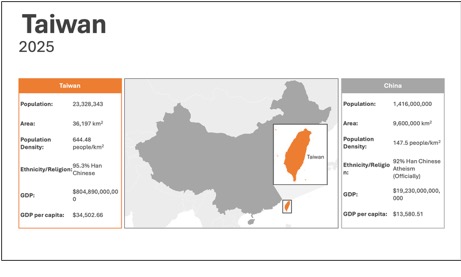
FIGURE 4: TAIWAN AND PRC COMPARISON.[179]
3.1 Key Factors of Difference
Political
Taiwan functions as a representative democratic republic under a distinctive five-power constitution based on the model of Sun Yat-sen.[180] Executive authority rests with the president, who is directly elected by popular vote, and the premier, who is appointed by the president. Legislative authority resides in the Legislative Yuan, while the independent judicial, examination, and control (ombudsman) branches provide strong checks and balances. Since democratization in the late 1980s and the first direct presidential election in 1996, Taiwan has developed a highly competitive multiparty system. The Democratic Progressive Party (DPP) and Kuomintang (KMT) dominate political life, though smaller parties also compete.[181] This party structure supports a vibrant political culture marked by free speech, independent media, and robust civil society organizations. Democracy lies at the heart of Taiwan’s national identity. Surveys confirm that civic values have displaced older divides rooted in ethnicity or history, and electoral participation demonstrates high levels of commitment to democratic governance. Taiwan ranks among the most resilient democracies in Asia, combining pluralism and the rule of law with peaceful transfers of power and transparent governance. While polarization, socioeconomic inequality, and external interference remain challenges, democratic consensus continues to anchor the political order.[182]
This political structure differs sharply from the pre-occupation systems of Tibet and Xinjiang. Both were governed by fragmented, hierarchical, and largely authoritarian institutions prior to their incorporation into the PRC. Tibet’s theocratic aristocracy and Xinjiang’s warlord-dominated politics lacked participatory legitimacy, making them vulnerable to elite co-optation and military dominance. Taiwan, by contrast, sustains a consolidated democratic order that commands broad popular legitimacy and enjoys international recognition in practice, if not always in formal sovereignty. The comparison with Hong Kong is more apt. Like Taiwan, Hong Kong enjoyed an active political culture, significant non-violent protest traditions, and institutions that allowed open contestation of authority. Both societies fostered strong civil society networks and media pluralism. Yet even Hong Kong did not enjoy the full sovereignty, independent judiciary, or electoral authority that Taiwan exercises. These factors likely make Taiwan’s political system far more resistant to the legal-institutional capture and gradual erosion that Beijing used in Hong Kong.
For the PRC, Taiwan’s political environment poses profound challenges to occupation. A system rooted in direct elections, democratic participation, and strong civic identity resists attempts to dismantle legitimacy through legal formalism or elite co-optation. Efforts to dissolve institutions or criminalize opposition would immediately confront deep reservoirs of civic resistance and international scrutiny.[183] The CCP might attempt to frame occupation through “patriots only” governance and impose national security laws, as it did in Hong Kong, but such measures would face greater opposition in Taiwan due to entrenched democratic norms and widespread distrust of Beijing. Taiwan’s robust political institutions therefore raise the cost of occupation. They constrain opportunities for gradual absorption and increase the likelihood that Beijing would rely more heavily on coercion, surveillance, and repression to close political opportunity space. The PRC’s way of occupation would need to adapt accordingly, blending legal cover with overwhelming force while seeking to fracture Taiwan’s political coalitions and neutralize its democratic identity.
Military
Taiwan maintains a modernizing and increasingly professional military, designed not for power projection but for the survival of the state and the defense of its population. The armed forces include an army, navy, air force, marine corps, and military police, supported by integrated civil defense systems. The 2025 defense budget totals NT$648 billion (about $20.25 billion, 2.45% of GDP), reflecting steady investment in deterrence and modernization.[184] These funds prioritize high-tech capabilities, including indigenous submarines, upgraded surface vessels, advanced fighter aircraft, and unmanned systems. Taiwan has also extended conscription from four months to one-year, realigned force structures to emphasize a professional standing force of about 210,000 personnel (180,000 volunteers) and created a more realistic training environment.[185] Exercises now stress rapid response and adaptability rather than ceremonial drill. Complementing these reforms is a whole-of-society defense strategy that integrates government, private sector, and civil society into regular mobilization and resilience exercises. Stockpiles of critical supplies, infrastructure protection protocols, and strong cybersecurity planning support this defense-in-depth approach.[186]
This military posture stands in sharp contrast to the pre-occupation situations in Tibet and Xinjiang. Tibet’s small and underdeveloped military could not withstand the PLA’s invasion in 1950 and disintegrated within weeks of the Battle of Chamdo. Xinjiang also lacked the capacity for sustained military resistance. Armed resistance remained sporadic and localized, and Beijing augmented PLA dominance with the militia-based Xinjiang Production and Construction Corps (Bingtuan), which combined security, agricultural, and colonization functions. By contrast, Taiwan maintains a standing military with modern capabilities, substantial resources, and a professionalized command system. Taiwan’s position resembles Hong Kong more in its exposure to modern information warfare and asymmetric coercion than in military preparedness; unlike Hong Kong, Taiwan fields armed forces specifically designed to resist the PLA. This fundamental difference means that Beijing faces not only a political but also a military landscape far more formidable than in earlier occupations. If Taiwan fails to resist an invasion, a defeated and fragmented military could still survive as a dispersed armed resistance.
For the PRC, Taiwan’s military context raises distinct challenges for occupation. The PLA would almost certainly achieve battlefield overmatch through size and resources, but Taiwan’s strategy of asymmetric warfare, combined with societal resilience, threatens to delay or complicate the consolidation of control. An invasion would likely produce significant infrastructure damage and civilian casualties, creating conditions for ongoing resistance even after formal defeat. Whole-of-society defense planning, civil defense mobilization, and decentralized stockpiles increase the likelihood of sustained disruption during and after occupation. Beijing could not expect to replicate the rapid and decisive suppression it achieved in Tibet, or the gradual security embedding used in Xinjiang and Hong Kong. Instead, it would need to prepare for extended pacification operations, balancing large-scale coercion with simultaneous efforts to prevent resistance networks from regenerating. Taiwan’s military modernization thus does not eliminate the possibility of occupation but makes it costlier, riskier, and far more uncertain for the PRC. It also makes the method by which the PRC takes control of Taiwan (subversion, coercion, or compellance) a critical factor in how occupation and resistance might play out.
Economic
Taiwan sustains one of the most advanced and globally integrated economies in Asia. In 2025, its nominal GDP reached $793.2 billion, while GDP measured by purchasing power parity totaled $1.638 trillion. Per capita GDP (PPP) stands above $70,000, making Taiwan one of the wealthiest economies in the region. Growth remains steady at around 4.3 percent.[187] This prosperity rests on a high-value industrial base, with semiconductors as the defining sector. Taiwan Semiconductor Manufacturing Company (TSMC) alone controls more than 60 percent of the global foundry market, making the island indispensable to the production of advanced electronics worldwide.[188] Beyond semiconductors, Taiwan excels in electronics, computer components, displays, precision instruments, petrochemicals, and automation technologies. Heavy investment in research and development drives innovation in emerging areas such as medical devices and life sciences, reinforcing Taiwan’s reputation as a reliable and technologically advanced partner.[189] Strong legal protections and transparent governance further enhance its status as a trusted supplier in global supply chains.[190]
Taiwan’s trade profile reflects this global integration. Mainland China and Hong Kong remain Taiwan’s largest combined market for exports and imports, but Taipei has steadily diversified toward other partners. The United States and Japan play crucial roles in supporting high-tech and defense-related industries, while the European Union, ASEAN, and South Korea supply markets for advanced manufacturing and growth sectors.[191] Agriculture contributes just under two percent of GDP, but it remains technologically advanced, with rice, fruit, and aquaculture forming the core outputs. Taiwan’s efficiency in agriculture reflects its advanced infrastructure and innovation capacity, though the island remains dependent on imports for grains and animal feed.[192] Taken together, these characteristics define Taiwan as a mature, resilient economy with diverse global connections, high living standards, and an industrial profile tied to some of the world’s most critical technologies.
This context diverges sharply from Tibet and Xinjiang before occupation. Tibet functioned largely as a subsistence society with limited infrastructure, dominated by a feudal-theocratic elite whose power was easily undermined by Beijing’s promises of modernization. Xinjiang had greater integration into trade networks but remained poor, fragmented, and vulnerable to both military overmatch and state-directed development schemes. In both cases, Beijing leveraged promises of economic progress, infrastructure investment, and integration into national markets to secure elite compliance and pacify resistance. Taiwan could not be more different. Its economic system is diversified, globally competitive, and already far more advanced than mainland China in key high-technology sectors. The comparison with Hong Kong is more apt. Like Taiwan, Hong Kong entered the twenty-first century with a wealthy, globally connected economy and a vibrant middle class. Yet Taiwan’s base is broader than Hong Kong’s finance and service-oriented model. Taiwan anchors global production networks in ways Hong Kong never did, particularly through manufacturing and semiconductors. This creates both stronger resilience and greater international stakes in Taiwan’s economic fate.
For Beijing, this wealth and diversity make occupation far more complex. The CCP cannot credibly present itself as a modernizing force, since Taiwan’s population already enjoys prosperity, stability, and technological sophistication well beyond that of the average mainland citizen.[193] Promises of development that resonated in Tibet and Xinjiang will have little appeal. Instead, Beijing will likely have to adapt its Hong Kong playbook by targeting business elites through the United Front Work Department, co-opting or coercing them into partnership while restricting political opposition. Yet even this approach faces serious obstacles, since Taiwan’s elites are deeply embedded in international supply chains and derive legitimacy from democratic institutions, not from Beijing’s favor.
Special Case: The Semiconductor Dilemma
The semiconductor sector represents a unique strategic challenge for any PRC occupation of Taiwan. Taiwan’s fabs are simultaneously a vital global asset, a potential trigger for foreign intervention, and a liability for Beijing’s long-term goals. Semiconductor fabrication plants are fragile and could be destroyed in conflict either deliberately or as collateral damage. Their continued operation after an invasion would require stability, secure power, and specialized supply chains that extend beyond Taiwan itself.[194] For Beijing, the fabs present a paradox. Preserving them might ensure Taiwan retains global economic relevance, but it would also perpetuate international concern for the island’s autonomy and elevate pressure on foreign governments to counter Chinese control. Conversely, allowing or even orchestrating their destruction could reduce Taiwan’s leverage in international politics and accelerate the PRC’s effort to grow its own semiconductor sector.[195] What Beijing may value most, however, is not the physical plants but the human and intellectual capital of Taiwan’s engineers, managers, and research talent. In an occupation scenario, PRC strategy would likely focus on retaining this workforce, relocating key individuals to the mainland, and leveraging their expertise to accelerate China’s domestic industry. This effort could be paired with policies that deliberately diminish Taiwan’s independent role in global supply chains, making the island less a technological hub and more a dependent periphery of the PRC economy.
Ultimately, Taiwan’s economic profile complicates the PRC way of occupation. A wealthy globally connected population cannot easily be persuaded through development promises. Instead, Beijing might need to rely on coercion, elite capture, and the construction of economic dependencies. The semiconductor dilemma further amplifies this challenge by tying Taiwan’s fate to global markets in a way no previous occupied territory has experienced. Managing that dilemma through destruction, co-optation, or talent extraction, would become central to Beijing’s occupation strategy. The CCP’s problem in Taiwan is not how to lift a poor society into modernity but how to break and remake a prosperous, democratic society that already thrives.
Social
Taiwanese society is defined by diversity, civic participation, and a deeply rooted democratic culture.[196] The island’s population is majority Han, but it contains important subgroups, including Hoklo, Hakka, Mainlanders who arrived after 1949, Indigenous peoples, and more recent migrant communities.[197] Each community contributes to Taiwan’s civic fabric, and the state has worked to safeguard minority rights and expand representation. Civil society is vibrant and multifaceted, encompassing labor unions, women’s groups, LGBTQ+ advocates, indigenous rights movements, and environmental organizations. These groups consistently mobilize with creativity and independence, shaping Taiwan’s laws, policies, and public debates.[198]
Taiwan also has a long tradition of protest and grassroots mobilization. Since the end of martial law in 1987, movements have driven democratic reforms, shaped major policies, and reinforced civic identity.[199] The 228 Incident of 1947 remains a national trauma and a focal point of transitional justice, linking past repression to democratic vigilance.[200] More recent milestones, such as the 2014 Sunflower Movement, saw students occupy parliament to oppose opaque cross-strait agreements, sparking the rise of new political parties and underscoring the functional power of nonviolent resistance.[201] Freedoms of expression, assembly, and association are robustly protected and widely exercised, embedding protest into the political culture.[202]
National identity reflects these currents. Over the past three decades, surveys show that identification as “Taiwanese” has steadily increased, now reaching 65-75 percent of the population, while “Chinese only” identity has fallen below 10 percent.[203] This trend is especially pronounced among younger generations, though even older cohorts increasingly identify as Taiwanese. Dual identities remain, but they represent a shrinking minority.[204] Importantly, a Taiwanese identity does not always equate to support for formal independence, but it does reflect a broad consensus that Taiwan is politically and culturally distinct from the PRC. These social foundations make democratic norms, pluralism, and civic identity inseparable from everyday life.
Another factor is the presence of organized crime. Though violent crime rates in Taiwan are among the lowest in the world, groups such as the Bamboo Union, Four Seas Gang, and Heavenly Way Gang maintain some influence in certain sectors of politics, business, and society.[205] While overt violence has decreased since the 1990s, gangs continue to operate across Taiwan and throughout the region, engaging in cybercrime, trafficking, and money laundering. Their influence in local politics and business networks provides both a challenge for law enforcement and a potential vulnerability in the event of PRC infiltration. The historical ties between some Taiwanese gangs and mainland intelligence highlight this as a possible vector of influence and disruption.[206]
Compared to Tibet and Xinjiang at the time of occupation, Taiwan presents a radically different social environment. Both frontier regions had diverse ethnic and religious populations that Beijing could manipulate through a mix of accommodation and coercion, but neither had strong civic institutions or democratic traditions. Taiwan, like Hong Kong, is majority Han, but ethnicity is a deceptive proxy for collective identity. Instead, Taiwan’s collective identity is increasingly tied to its civic and democratic traditions and practices. In this respect, it resembles Hong Kong’s protest culture, but Taiwan’s national identity is even more firmly tied to democratic struggle and distinct historical memory, such as the 228 Incident.[207]
For the PRC, this presents an unprecedented challenge. Occupying a society that has defined itself around democratic participation, transitional justice, and nonviolent resistance means confronting a civic identity fundamentally at odds with party control. The CCP may attempt to co-opt elites, infiltrate civic groups, or exploit organized crime networks, but such measures will face pushback from a society accustomed to mobilization and resilient to manipulation. More likely, Beijing would resort to coercion, seeking to close the political opportunity space quickly and decisively, even at the cost of significant bloodshed. This approach risks making Taiwan a poisoned chalice. Heavy-handed repression may impose temporary compliance, but it could also strengthen narratives of resistance, threaten spillover effects into the mainland, and entrench Taiwan’s symbolic role as a beacon of democratic defiance.
Informational
Taiwan sustains one of the most open and dynamic information environments in Asia. Citizens access a diverse media ecosystem that includes free press outlets, independent broadcasters, and a wide range of digital and social media platforms.[208] Internet penetration exceeds 95 percent, and nearly 80 percent of the population uses social media regularly. Mobile networks provide 5G coverage for more than 85 percent of residents, and the government maintains over 10,000 iTaiwan Wi-Fi hotspots to ensure broad access.[209] Taiwanese audiences increasingly consume news through YouTube and other digital outlets, particularly younger generations, while television and print remain influential among older demographics. The media landscape is pluralistic, though politically polarized, with outlets linked to both pan-Green and pan-Blue camps.[210] The government treats cyber defense as a national security priority, integrating state, industry, and civil society into a whole-of-society approach against cyberattacks and disinformation.[211]
Taiwan’s information domain diverges sharply from Tibet and Xinjiang at the time of their occupation. Both frontier regions had limited connectivity, weak literacy, and little access to independent information networks, making them susceptible to Beijing’s monopoly on narratives. Hong Kong, by contrast, more closely resembles Taiwan’s hyper-connected society. Before 2020, Hong Kong enjoyed vibrant media pluralism, international connectivity, and widespread digital engagement. Beijing eventually imposed its information controls there by dismantling press freedom, closing outlets, and embedding surveillance technologies. Taiwan presents an even greater challenge. Unlike Hong Kong, it possesses sovereignty over its communications infrastructure, a long history of democratic media freedom, and years of preparation for PRC information operations. Civic awareness of disinformation and foreign interference is high, reinforced by polling data that tracks public opinion and resilience against hostile influence. This makes Taiwan a more difficult environment to dominate than any of the earlier case studies.
Special Case: Submarine Cable Vulnerability
Taiwan’s global connectivity depends heavily on its submarine cable infrastructure, with 10-14 cables carrying roughly 95 percent of all international data. These cables link Taiwan to the United States, Japan, and other partners, forming the backbone of its economy, media environment, and political life.[212] They are both an asset and a vulnerability. In a conflict or occupation scenario, the PRC could sever or disrupt these links, isolating Taiwan from global information flows and forcing reliance on networks controlled from the mainland. Repairing damaged cables requires time, specialized ships, and international cooperation, all of which would be difficult under blockade or occupation. At the same time, Taiwan’s government has prioritized redundancy and resilience, pursuing satellite backups, distributed data systems, and international partnerships. How Beijing chooses to handle these cables would have major implications: cutting them could accelerate occupation by isolating Taiwan but would also raise global alarm and signal coercion; preserving them, could keep international communications alive but at the cost of leaving open channels for resistance and global exposure.
For the PRC, controlling Taiwan’s information environment would involve more than technical intervention.[213] It would require dismantling privacy protections, embedding surveillance into resilient networks, and forcing a population accustomed to pluralism to accept Party narratives as fact. Beijing could attempt to replicate its Hong Kong strategy of legal repression, co-opted influencers, and controlled platforms, but Taiwan’s defacto sovereignty over its digital infrastructure and its experience in countering Chinese information operations would make this a prolonged and resource-intensive struggle. The task would not only involve constructing a Chinese-style firewall (a complex array of multiple systems and activities) but also persuading or coercing citizens to abandon independent sources and embrace Party-sanctioned narratives.[214] Untangling Taiwan’s hyper-connected information society would be one of the most difficult tasks in an occupation, and any failure would leave open pathways for resistance communication and international mobilization against PRC control.
Infrastructure
Taiwan possesses some of the most advanced infrastructure in the world, characterized by dense networks of roads, high-speed rail, efficient public transportation, modern ports, and digitally integrated energy distribution systems.[215] This infrastructure underpins the island’s role as a global hub for advanced manufacturing, particularly semiconductors, and sustains its export-driven economy. Yet these strengths come with vulnerabilities. Taiwan’s infrastructure is highly centralized, heavily import-dependent, and increasingly targeted in both physical and cyber domains. Nearly all of Taiwan’s energy—96 to 99 percent—is imported, with coal, liquefied natural gas (LNG), and oil arriving by sea.[216] This creates critical chokepoints at major ports like Kaohsiung and Taichung, which, if disrupted, could lead to cascading grid collapse and industrial shutdowns within days. Power is largely generated in the south but consumed in the more urbanized north, meaning that disruptions in centralized transmission lines can trigger island-wide blackouts.[217] Past events—including widespread outages in 2017, 2021, and 2022—demonstrate the fragility of the grid, which at times operates with dangerously low reserve margins of 5 percent or less.[218]
These physical vulnerabilities are amplified in the cyber domain. Taiwan experiences persistent advanced persistent threat (APT) activity from PRC-linked actors, as well as phishing, ransomware, and database exploitation. Government and private sector networks alike suffer from siloed implementation, legacy systems, and uneven enforcement of security protocols.[219] This creates a permissive environment for long-dwell intrusions, where attackers can remain undetected for extended periods. Industrial and government assessments warn that cyberattacks could be paired with kinetic strikes against substations, LNG terminals, or cable landing sites, producing rapid, large-scale outages.[220] With its last nuclear reactor decommissioned in 2025, Taiwan’s energy reliance will only deepen, further exposing the economy to external coercion.[221] Given the centrality of electricity to semiconductor production and other key industries, even limited disruptions could reverberate through global supply chains.
By contrast, Tibet and Xinjiang were profoundly underdeveloped at the time of their incorporation into the PRC. Infrastructure there was sparse, fragmented, and largely absent from rural areas. The CCP leveraged this backwardness to legitimize its control, framing its occupation as liberation through modernization. Roads, railways, and energy projects were both material benefits and political tools of integration, binding frontier regions into the Chinese state while facilitating military mobility and surveillance. Hong Kong, at the opposite extreme, already possessed world-class infrastructure at the 1997 handover. In that case, the CCP’s challenge was not building but safeguarding systems critical to global finance, while gradually integrating transport, communications, and energy flows with the mainland. In all three cases, infrastructure was integral to the CCP’s legitimacy narratives: modernization for Tibet and Xinjiang, stability and connectivity for Hong Kong. Taiwan presents a different challenge—its infrastructure already exceeds PRC levels in many respects and is deeply entangled in the global economy.
For a PRC occupation of Taiwan, the implications are complex. If control is secured primarily through coercion and blockade, much of Taiwan’s infrastructure may remain intact, providing a ready-made platform for the occupier to leverage. However, if the CCP attempts to compel capitulation through force, large portions of Taiwan’s infrastructure may be degraded or destroyed in the process, requiring costly repair and reconstruction. Either way, the occupier’s incentive will be to restore and maintain infrastructure, but with a different logic than the current Taiwanese state. Rather than optimizing efficiency or global integration, systems would likely be reoriented toward control, surveillance, and dependency. Ports and energy facilities would be secured as strategic assets, with connectivity redesigned to bind Taiwan into the mainland system. Submarine cables and digital infrastructure would be fortified but also censored and firewalled to sever external narratives.
For resistance movements, this creates a dilemma. Much of Taiwan’s infrastructure—transport corridors, ports, power grids, and data networks—would remain essential to civilian life and national survival. Resistance actors might therefore seek to preserve the status quo ante, while selectively targeting those nodes most symbolic of occupation or most critical to CCP control. In practice, infrastructure would thus become both a tool of occupation and a battleground of resistance, blurring the boundaries between economic, informational, and physical domains. This overlap underscores a broader theme in the PMESII-PT analysis: in Taiwan, categories of power are tightly integrated, making infrastructure not only a physical resource but also an arena of contestation in law, narrative, and identity.
Physical Terrain
Taiwan is a volcanic island situated in the Western Pacific, roughly 180 km (112 miles) across the Taiwan Strait from mainland China. The island stretches 394 km north to south and 144 km at its widest point, covering about 36,000 km². Its geography is sharply divided between a heavily populated western corridor and the rugged mountains of the east. Roughly 90 percent of Taiwan’s 23 million people live on the western plains, which are fertile, urbanized, and serve as the locus of industry, agriculture, and governance.[222] The eastern two-thirds of the island, by contrast, are dominated by five mountain ranges, with peaks reaching nearly 4,000 meters, dense forests, and sparsely populated valleys. Indigenous communities are concentrated in these less accessible regions, while the urban north—centered on Taipei, New Taipei, and Taoyuan—houses nearly 40 percent of the population, creating densities surpassing 9,000 people per km² in some districts. Taiwan’s environment is further shaped by frequent earthquakes, typhoons, and seasonal monsoons, all of which have implications for infrastructure resilience and military operations.[223]
Geography defines Taiwan’s strategic isolation. Unlike Tibet and Xinjiang, Taiwan has no land borders; its immediate neighbors—China, Japan, and the Philippines—are separated by narrow seas. This insularity cuts both ways. On the one hand, it reduces the possibility of insurgents or external supporters moving men and materiel across porous frontiers, a condition that prolonged resistance in Xinjiang and Tibet. On the other hand, Taiwan’s maritime proximity to allies—just 110 km from the Ryukyu Islands, 350 km from the Philippines, and less than 700 km from Okinawa—means that external support could, under favorable conditions, reach the island by air or sea.[224] These geographic distances shrink further in an era of precision strike, drones, and satellite communications, but their strategic weight remains: Taiwan’s position at the seam of the East and South China Seas makes it an essential node in regional security and commerce.
The contrast with earlier PRC occupations is stark. Tibet and Xinjiang were vast frontiers with low population densities and extensive land borders. Control in those cases required dominating both urban centers and dispersed rural communities, while countering insurgencies sustained by cross-border sanctuaries and external aid. Hong Kong, by contrast, is geographically small, coastal, and hyper-urbanized, with occupation focused on embedding control into dense, contiguous urban terrain and leveraging pre-existing connectivity to the mainland. Taiwan combines elements of both. Like Hong Kong, it is densely urbanized along its western littoral, but like Tibet and Xinjiang, it possesses difficult mountainous interiors that could serve as refuges for resistance networks. Unlike all three, however, Taiwan’s island geography ensures that occupation cannot be conceived solely in terms of internal pacification. The PLA and the CCP would need to execute a truly joint maritime, air, and land campaign to sustain occupation, incorporating blockade, quarantine, and control of sea lanes as integral tools of governance.
For the PRC way of occupation, Taiwan’s physical terrain implies several conditions. First, seizure and maintenance of ports, airports, and western urban corridors would be paramount; these nodes concentrate the population, economy, and international access points. Second, the mountainous east could become a natural redoubt for resistance, particularly if remnants of Taiwan’s military or civil defense retreat there. Pacifying these regions would require extensive deployment of People’s Armed Police and PLA units trained in counterinsurgency in difficult terrain, potentially replicating aspects of the Tibet and Xinjiang experiences but without the advantage of porous land borders to cut off.[225] Third, the maritime dimension would be decisive. For the first time, blockade and quarantine would become not just tools of coercion before occupation, but core features of sustaining occupation itself. By sealing the island, Beijing would aim to prevent external resupply of resistance movements and limit international visibility into conditions on the ground.
For resistance planners, the implications are mixed. Taiwan’s dense population centers offer opportunities for civil disobedience, urban disruption, and information dissemination, but these same areas would be heavily surveilled and garrisoned. The mountains and forests offer concealment and the possibility of long-term survival, but without external land borders, supplying an insurgency would be exceptionally difficult. In practice, resistance would likely depend less on smuggling of arms and more on covert information, financial flows, and technological linkages maintained across maritime and cyber domains. Geography thus conditions both occupation and resistance: it empowers the occupier to isolate Taiwan physically, but it also creates natural spaces—urban and rural—for resistance to adapt and endure. In this sense, Taiwan’s physical terrain would force the PRC to innovate beyond its prior occupations, combining territorial control with maritime denial and information dominance as essential pillars of governance
Time
Time, in the Taiwan context, refers less to physical geography or infrastructure and more to the historical and social trajectories that shape both identity and strategic outlook. Over the past three decades, a distinct Taiwanese national identity has steadily risen, particularly among younger generations. Whereas in the early 1990s many citizens described themselves as both Chinese and Taiwanese, today survey data shows that 65–75 percent identify as exclusively Taiwanese, with fewer than 10 percent describing themselves as solely Chinese.[226] This shift is generational: younger Taiwanese overwhelmingly reject the idea of cultural or political integration with the mainland, while older cohorts—though more likely to hold dual identities—have also trended toward Taiwanese self-identification. Each passing year deepens this identity divergence, making it harder for the PRC to present occupation as a project of “national reunification.” Instead, it would be viewed by much of the population as foreign conquest.
This historical trajectory contrasts sharply with the three prior case studies. In Tibet and Xinjiang, the CCP could exploit fragmented political structures and claims of historic sovereignty to frame its presence as “liberation” or modernization, even if these narratives were contested by local populations. Hong Kong, though far more developed, was legally transferred to PRC sovereignty in 1997 under an international treaty, which Beijing used as the foundation for its incremental encroachment. Taiwan, by contrast, has experienced uninterrupted self-governance since 1949, developed its own democratic institutions, and cultivated a civic identity tied to pluralism and autonomy. Unlike Hong Kong, there is no treaty framework legitimizing PRC claims in practice; and unlike Tibet or Xinjiang, Taiwan’s society is already deeply mobilized and internationally connected. Time, therefore, works against Beijing in Taiwan in ways it did not in the earlier occupations.
At the same time, time pressures weigh on the PRC leadership. Historically, Beijing has preferred coerced transitions and gradual consolidation over outright invasion. The Party’s record in Tibet, Xinjiang, and Hong Kong shows a preference for calibrated coercion—leveraging law, narrative, and selective force to avoid costly wars. Yet in the Taiwan case, military realities complicate this preference. The PLA has modernized rapidly, conducting large-scale joint exercises that rehearse blockade, decapitation strikes, and amphibious landings.[227] These preparations make clear that while coercion remains the preferred path, compellence through invasion is a serious option. The so-called “Davidson Window,” identified by the U.S. commander in the Indo-Pacific as the period between 2027 and 2030 when the PLA could achieve full readiness for an invasion, underscores the narrowing strategic timeline.[228]
Compounding this is the aging leadership of Xi Jinping, who has personally tied his legitimacy and historical legacy to the “great rejuvenation of the Chinese nation” and the completion of reunification. For Xi, Taiwan is not just a geopolitical objective but a personal milestone. That is why this report refers to the PRC seizure of Taiwan as “the greatest strategic intelligence certainty of our time”: the PRC will attempt to assert sovereignty over the island, the only uncertainties being when and how.
The historical backdrop further complicates this temporal dimension. Beijing bases its sovereignty claims on Qing annexation of Taiwan in 1683, its formal administration until cession to Japan in 1895, and post–World War II agreements such as the Cairo and Potsdam Declarations. It emphasizes the Kuomintang’s retreat to Taiwan in 1949 as evidence that the island has always been part of “China,” temporarily separated by civil war.[229] Yet Taiwan’s counter-narrative emphasizes its long history of distinct governance—including periods under Dutch, Spanish, Qing, Japanese, and ROC control—and its uninterrupted de facto independence since 1949. This contested historical memory amplifies the temporal pressures on occupation: each passing year strengthens Taiwan’s distinct civic identity while undermining Beijing’s ability to frame reunification as restoration.
For the PRC way of occupation, “time” is thus both an asset and a liability. It is an asset in the sense that Beijing has historically demonstrated patience, treating occupation as a long arc of assimilation. Yet it is a liability in Taiwan, where the window for occupation that can plausibly be framed as reunification is closing. As Taiwanese identity hardens and as global awareness of Taiwan’s democracy deepens, any future occupation will face higher legitimacy costs than in Tibet, Xinjiang, or Hong Kong. In this sense, time does not favor Beijing’s objectives. It accelerates the divergence of identity, raises the cost of coercion, and narrows the space for occupation to be accepted as anything other than conquest.
3.2 – Conclusion
Taiwan’s context diverges fundamentally from the PRC’s prior occupation cases. Unlike Tibet and Xinjiang, Taiwan is not an underdeveloped frontier whose elites could be co-opted under promises of modernization, nor is it a city like Hong Kong where lawfare and incremental institutional capture sufficed. Instead, Taiwan is a sovereign democracy with entrenched political legitimacy, a capable military, advanced infrastructure, and a resilient civic identity. These factors sharply limit Beijing’s ability to rely on occupation approaches that proved effective elsewhere. Where modernization was a source of legitimacy in Tibet and Xinjiang, and where “One Country, Two Systems” provided a legal scaffold in Hong Kong, Taiwan presents a wealthy, globally connected society that views itself as distinct and democratic.
This means that the PRC way of occupation in Taiwan will be shaped as much by how control is seized as by the conditions under which it is sustained. If Beijing were able to compel Taiwan’s surrender through coercion, blockade, or elite bargains, the physical and institutional fabric of the island might remain largely intact. In that case, occupation would focus on co-opting existing systems while reorienting them toward surveillance, control, and gradual identity reshaping. Domestic legitimacy contests would play out primarily in the information and legal domains, with Beijing framing its control as peaceful reunification. Resistance under these conditions would likely exploit civic networks, digital platforms, and international linkages to contest CCP narratives and preserve a distinct Taiwanese identity.
If, however, the PRC attempts compellence through invasion, the outcome would be profoundly different. The destruction of military forces, infrastructure, and critical industries would produce a shattered social and economic landscape. Occupation in this scenario would require not only rebuilding infrastructure but doing so under conditions of widespread trauma, delegitimization, and potential insurgency. The PLA and People’s Armed Police would face prolonged pacification operations in urban centers and mountain redoubts, with resistance fueled by a population that already overwhelmingly identifies as Taiwanese. International sympathy and support for resistance would be amplified, and the very act of invasion would undermine Beijing’s claims to legitimacy.
Thus, Taiwan’s unique differences highlight a central tension in analyzing the PRC way of occupation: while the CCP’s historical repertoire emphasizes patience, adaptability, and integration, the Taiwanese case forces Beijing to confront a society whose political identity hardens against it with each passing year. The mode of seizure,subversion, coercion, or compellance will profoundly affect not only the legitimacy of occupation but also the feasibility of resistance. A coerced transition might allow Beijing to leverage existing systems, but a compelled invasion risks producing conditions in which occupation resembles counterinsurgency more than assimilation. In either case, Taiwan’s differences ensure that the PRC cannot simply replicate past models. Instead, occupation would demand innovations in control—combining coercion, surveillance, and maritime isolation—while confronting resistance that will be more resilient, networked, and internationally visible than in any previous case.
4 – The PRC Way of Occupation (Key Themes)
The preceding sections established that PRC occupation strategies are not ad hoc but patterned, blending coercion, law, narrative, and long-term identity reshaping. Tibet, Xinjiang, and Hong Kong reveal recurring logics of control, while recent doctrinal reforms and Taiwan’s unique political, military, and social environment highlight how those logics might be adapted to new conditions.
The CCP and PLA now possess institutionalized mechanisms including the PAP, ISF, and a suite of national security laws, that make the tools of occupation more integrated, rapid, and scalable than in past cases. Taiwan’s democratic institutions, advanced infrastructure, and hardened civic identity, however, complicate Beijing’s task. The PRC’s “way of occupation” must therefore be understood as both consistent in logic and adaptive in application.
The following seven themes synthesize historical precedents, contemporary doctrine, and Taiwan’s contextual differences to outline how a PRC occupation would likely proceed.
Theme 1: Occupation Begins Before Invasion
In analyzing the PRC’s occupation strategy, one of the most consistent and underappreciated insights is that occupation does not begin with the entry of troops or the raising of a flag. Instead, the PRC initiates its occupation campaign long before conventional conflict, using a comprehensive set of pre-occupation shaping operations to prepare the political, institutional, and psychological conditions for later control. This pre-invasion shaping is not an ancillary effort. It is central to how the CCP reduces resistance and accelerates legitimacy claims once physical control is imposed. The CCP lays the groundwork for international legitimacy of its claims and actions well in advance to help stem the possibility of future external support to resistance. The PLA’s Science of Military Strategy codifies this principle: non-war shaping, legal warfare, and psychological operations are integral to victory.
In Tibet and Xinjiang, occupation began through strategic ambiguity and negotiated surrender. In the 1950s, PLA forces entered Tibetan territory accompanied by “peace emissaries” and offers of autonomy. Though a limited conflict ensued to defeat and encircle most of the small Tibetan army, the political and economic centers of the region initially remained unoccupied. The PRC positioned itself not as an invader but as a unifier, invoking historical claims of suzerainty and regional brotherhood. In Xinjiang, the PRC entered following the collapse of the short-lived East Turkestan Republic, co-opting local elites and exploiting divisions between ethnic groups to assert “people’s liberation.” In both cases, these early engagements were framed as administrative transitions rather than occupations.
In Hong Kong, the process was even more drawn out. From 1997 to 2019, the PRC exercised a slow, methodical erosion of civic and institutional autonomy under the framework of “One Country, Two Systems.” Pro-Beijing business leaders were cultivated, civil society was monitored, and mainland legal and education standards were gradually imported. The 2019 protests marked a turning point, but by then, much of the groundwork for centralized control had already been laid. The National Security Law of 2020 formalized and accelerated processes that had been underway for years.
Taiwan is already subject to this pre-occupation campaign. United Front efforts target business elites, media figures, and religious organizations. Cyber and disinformation operations erode trust in institutions, amplify partisan divides, and question U.S. reliability. PRC white papers and legal statements construct a legal narrative framing future occupation as an “internal matter.” These operations reflect the doctrine of “fighting while talking,” in which negotiation and coercion proceed in tandem to fracture unity.
For Taiwan, this means that resistance cannot wait until invasion. The political opportunity space is being narrowed now, through gray-zone pressure, elite infiltration, and cognitive warfare. By the time physical control is asserted, the foundation for occupation may already be in place.
Taiwan, unlike Tibet, Xinjiang, or Hong Kong, remains unoccupied in any formal sense. But PRC shaping operations are already extensive and well-documented. These include:
United Front Work: Persistent efforts to co-opt or compromise Taiwanese elites, particularly within media, business, religious, and political institutions.
Cyber and Information Warfare: Targeted disinformation campaigns aimed at eroding trust in democratic institutions, sowing confusion during elections, and exacerbating political polarization.
Legal Warfare: PRC white papers, diplomatic communiqués, and reinterpretations of the Anti-Secession Law construct a quasi-legal foundation for a future occupation, portraying it as an internal matter rather than a violation of sovereignty.
Cognitive Domain Operations: Targeting public morale, national identity, and perceptions of U.S. reliability through both overt and covert channels.
These activities constitute the early phase of occupation. Their purpose is to narrow the “political opportunity space” for resistance before coercion or compellence ever begins. In this sense, the PRC treats psychological, institutional, and narrative domains as contiguous with military operations. By the time conventional forces arrive, the groundwork for occupation including legal, symbolic, and interpersonal aspects may already be in place.
This pattern suggests a critical challenge for Taiwan and its partners: resistance planning must begin during peacetime, before the occupation is kinetic or physical. If Taiwan waits until PLA forces land, it may be too late.
Theme 2: Coercion is Wrapped in Legal Formalism
A defining feature of PRC occupation strategy is its consistent use of law not just as a tool of governance but as an instrument of coercion and influence. Across Tibet, Xinjiang, and Hong Kong, the CCP has deployed legal formalism as a core method of legitimizing repression, criminalizing dissent, and rendering occupation as orderly and “administrative.” This fusion of coercion with legality is a hallmark of CCP statecraft.
Rather than relying solely on brute force or extrajudicial authority, the PRC enacts new laws, policies, and administrative decrees that recast resistance as illegality. In Tibet, following the 1951 Seventeen Point Agreement, initial promises of autonomy were rapidly eroded through legal mechanisms that subordinated Tibetan governance structures to PRC provincial authorities. Monastic privileges, land ownership, and freedom of movement were gradually restricted through regulation rather than sudden martial law. When mass arrests began in the 1960s, they were carried out with legal justifications rooted in newly promulgated national security and anti-feudalism statutes.
In Xinjiang, the logic was taken further. Encouraged by international efforts to combat Islamic extremism, first against al-Qaeda in the early 2000’s and then in 2014 with the rise of the Islamic State, the PRC had a solid international narrative to employ the most repressive measures in Xinjiang. The so-called “People’s War on Terror” was constructed on an extensive legal foundation that defined extremism so broadly as to include religious expression, foreign contact, and online speech. Vocational Education and Training Centers (VETCs), the euphemism for internment camps, were justified as lawful administrative detention for deradicalization. Massive data collection and predictive policing were made routine under counter-terror laws passed by the regional People’s Congress.
In Hong Kong, the 2020 National Security Law exemplifies the full maturation of this strategy. Passed by the NPCSC and applied extraterritorially, the law redefined protest, journalism, and foreign affiliation as criminal acts of sedition, collusion, or terrorism. Despite international condemnation, the PRC insisted the law was necessary to restore “law and order.” Nearly all significant civil society actors, including newspapers, unions, and student groups, were disbanded under threat of legal sanction. Courts, once semi-independent, became vehicles for enforcement.
Doctrine and reforms deepen this practice. Xi Jinping Thought subordinates all legal institutions to Party leadership, while new national security, counterespionage, and data laws provide sweeping authority to criminalize opposition. The PAP and ISF operationalize these laws on the ground, embedding surveillance and coercion in the language of legality.
In Taiwan, occupation would likely preserve a façade of constitutional continuity through a “transitional authority” staffed by co-opted elites, while PRC law overrides core functions. Courts and ministries could be rebranded as “autonomous” yet subordinated to PRC directives. Acts of resistance such as strikes, protests, sabotage, would be prosecuted not as political defiance but as criminality: separatism, terrorism, or collusion with foreign powers. For moderates, legalism provides cover to accommodate; for resistors, it strips legitimacy and narrows options.
This legalism serves multiple purposes. It pacifies moderates, gives cover to collaborators, and confuses international observers who struggle to distinguish legality from legitimacy. It also allows the PRC to maintain a narrative of progress and normalization, even as it dismantles civil liberties. In practice, resistance under these conditions becomes increasingly difficult, as even symbolic acts of dissent can result in criminal prosecution under a veneer of legal propriety.
Taiwanese resistance strategies must account not only for overt repression but for legal manipulation. When occupation comes, it will arrive not only with soldiers, but with statutes and lawyers.
Theme 3: Identity is the Long-term Battleground
At the heart of PRC occupation strategy lies a sustained effort to reshape the identities of contested populations. Control is not merely exercised through laws or force-it is embedded in the cultural, linguistic, demographic, and psychological structures that shape how people see themselves and their place in the polity. In Tibet, Xinjiang, and Hong Kong, the CCP has approached identity as a strategic terrain to be governed, reorganized, and, where necessary, replaced.
Historically, much attention has focused on reeducation and ideological indoctrination as primary tools of identity transformation. In Tibet, this took the form of suppressing monastic institutions and replacing traditional Buddhist teachings with “patriotic education” that emphasized loyalty to the PRC. In Xinjiang, this evolved into mass internment of Uyghurs under the pretext of “de-extremification,” where detainees were forced to renounce their faith, language, and ethnic distinctiveness. In Hong Kong, the state’s post-2019 campaign has reengineered school curricula, dismantled civic organizations, and criminalized forms of expression associated with Hong Kong localism and democratic values.
Yet these methods tell only part of the story. The PRC has also pursued a parallel and profoundly impactful strategy: the demographic restructuring of contested regions through state-facilitated Han Chinese migration. In both Tibet and Xinjiang, the CCP encouraged large-scale Han resettlement as a means of diluting the political, cultural, and demographic weight of indigenous populations. This was accomplished through:
Economic incentives: Han cadres and workers were offered subsidies, housing, and preferential access to jobs in government, education, and construction in Tibet and Xinjiang.
State-led infrastructure development: Major transportation and urbanization initiatives-such as the Qinghai-Tibet Railway and sprawling development zones in Urumqi and Kashgar-served as channels for Han in-migration while simultaneously reshaping the physical and cultural landscape.
Garrison settlements: Military-linked settlements, PAP barracks, and resource extraction towns acted as both symbols and instruments of permanent occupation, often staffed and populated disproportionately by Han citizens.
The effects of this policy have been profound. In Tibet, Han residents now dominate many urban centers, even as the overall population remains majority Tibetan. In Xinjiang, the demographic transformation has been more extensive. While Uyghurs constituted around 75% of the population in the 1950s, that figure has declined significantly-today, Han Chinese are the majority in several key cities and administrative regions. This has created new political geographies of control, in which the centers of economic power, governance, and surveillance are largely administered by Han officials and cadres.
The purpose of this demographic strategy is not merely to “assimilate” minority populations, but to alter the identity equilibrium of entire regions-replacing contested identities with “normalized” national ones anchored in Han-centric cultural narratives and CCP legitimacy.
Taiwan poses the greatest challenge. A distinct Taiwanese identity—anchored in democracy and civic participation—is entrenched and rising, especially among youth. Demographic engineering on the Tibetan or Xinjiang model would be impractical for a population of 23 million. Instead, Beijing would likely pursue subtler identity reshaping: curriculum revisions, patriotic indoctrination, co-opted media, and selective privileging of “loyal” communities. Incentives for migration of mainland professionals or cadres to key industries and administrative hubs might follow.
For Taiwan, identity is not a side issue. Rather, it is the center of the struggle. Resistance must safeguard civic and cultural memory, ensuring that democratic and Taiwanese identities endure under pressure.
Applied to Taiwan, this strategy faces enormous logistical and political constraints-but it should not be dismissed out of hand. Taiwan’s population of 23 million is highly educated, deeply embedded in global supply chains, and marked by a resilient sense of civic identity. Although many Taiwanese identify ethnically and linguistically as Han Chinese, the national identity / self-identification of Taiwan’s population as “Taiwanese” is growing. Direct demographic engineering would likely provoke strong resistance. Nevertheless, future occupation scenarios might feature:
- Relocation or incentivization programs for loyal CCP members and Han Chinese professionals, bureaucrats, or “patriotic volunteers” to settle in Taiwan post-invasion, particularly in key industries and administrative hubs.
- Preferential housing and employment policies designed to attract PRC-aligned citizens to key urban zones, echoing the structure of garrison towns or development enclaves in Tibet and Xinjiang.
- Selective reconfiguration of property rights or land-use laws under the guise of economic reform, could also enable the transfer of property from “non-cooperative” locals to compliant or external actors.
The strategic intent behind such policies would be to weaken the cultural, linguistic, and psychological foundations of Taiwanese identity-not solely by coercing the existing population, but by changing who the population is over time.
In this sense, PRC identity warfare about demography, urbanism, infrastructure, and institutional design. Taiwan’s resistance strategy must therefore address cognitive and narrative resilience, as well as the long-term implications of demographic manipulation as a tool of occupation and assimilation.
Theme 4: Surveillance is Structural, Not Just Tactical
Surveillance in PRC-occupied territories is not a tactical accessory, but it is a central pillar of governance. In Tibet, Xinjiang, and Hong Kong, surveillance systems have evolved beyond conventional intelligence gathering to become the backbone of state control, enabling real-time monitoring, behavioral prediction, and preemptive suppression. The architecture of surveillance in PRC-administered areas is deeply integrated into daily life, forming what scholars and practitioners increasingly refer to as ubiquitous technical surveillance (UTS). Institutional reforms make surveillance even more central. The ISF fuses cyber, electronic warfare, and data dominance into a single command, ensuring that occupation includes immediate seizure of telecommunications, financial networks, and media. PAP units embed surveillance in daily policing, while legal reforms mandate data sharing across institutions. Together, these form a UTS regime.
In Xinjiang, the scale of this system is most evident. The IJOP combines biometric data, GPS location records, facial recognition inputs, purchasing history, and digital communication logs to produce individualized risk scores. These scores can trigger visits from local cadres, mandatory “reeducation,” or travel restrictions. Residents are encouraged or coerced into downloading government-monitored mobile applications that scan their contacts, images, and location data. Surveillance cameras mounted throughout neighborhoods use AI-powered facial recognition to detect deviations from approved patterns of movement or attire. The result is a system of anticipatory control, where dissent is neutralized not in response to protest, but in advance of it.
In Tibet, the mechanisms are less publicized but functionally similar as many of the concepts were first implemented in Tibet by Chen Quanguo who served as Party Secretary of the Tibet Autonomous Region before taking over that same position in 2014 in Xinjiang. In Tibet, government monitors are embedded in monasteries, schools, and rural districts. Internet access is restricted or monitored through state-provided gateways. Travel between prefectures requires justification, and local police maintain extensive dossiers on “sensitive” individuals and families. These measures do not rely solely on force. They rely on the psychological effects of being constantly watched.
Hong Kong presents a different case. There, the PRC has grafted its surveillance practices onto a modern, globalized city. After the 2019 protests, authorities employed digital tracking techniques to identify demonstrators through phone metadata, Octopus transit card logs, and facial recognition footage. Independent media reported on state acquisition of CCTV infrastructure from private firms, data-sharing agreements between telecom companies and law enforcement, and the deployment of covert monitoring in universities and workplaces. Protestors adapted with counter-surveillance tactics such as masking faces and using burner phones, but the state responded with ever more sophisticated methods.
For Taiwan, the implications are significant. As an advanced digital society, Taiwan already has dense networks of data, infrastructure, and connectivity. In the event of PRC occupation, how quickly could this architecture be repurposed? What would it take to bring telecom companies, app stores, financial platforms, and even social media channels under PRC regulatory oversight? What would it take to retrofit surveillance systems developed for traffic control, public health, or municipal services to monitor dissent, map relationships, and identify resistance leaders? Perhaps most importantly, How much data has the PRC already collected?
Moreover, the CCP’s “social management” approach relies not only on technical systems but on human informants. Neighborhood Committees, “grid management” personnel, and community-based monitors play critical roles in identifying and reporting deviation from state norms. This fusion of digital and interpersonal surveillance creates an environment in which resistance cannot organize openly, and trust is hard to establish.
For resistance in Taiwan, surviving surveillance will be as important as surviving repression. Movement strategies might include secure communication channels, distributed leadership models, digital hygiene education, and methods of counter-surveillance. Traditional clandestine methods such as dead drops, oral communication, and paper maps may once again become vital tools of survival.
Theme 5: Tactical Flexibility and Strategic Patience in Political Opportunity Space
One of the clearest lessons from the PRC’s history of occupation is that success depends on the deliberate use and manipulation of political opportunity space. This concept, drawn from political sociology, refers to the openness of a regime’s institutions, the permissibility of dissent, expression of grievances, and nonviolent action. Under PRC occupation, this space is deliberately and systematically opened and constricted; sometimes abruptly, sometimes gradually, but always with strategic intent. Doctrine formalizes this flexibility. The PLA’s Science of Military Strategy emphasizes “fighting while talking” or conceding selectively while eroding resistance capacity. Legal reforms and administrative tools allow incremental tightening, giving the illusion of autonomy while hollowing out substance.
In Tibet, the closure of political opportunity space was not immediate. It wasn’t until after the 1959 uprising, that the PRC dismantled traditional governance structures and imposed direct Party rule. Religious leaders were exiled, and monastic institutions were placed under surveillance or dissolved entirely. What limited space had existed for nonviolent protest or negotiation disappeared. Resistance, stripped of institutional channels, was pushed underground or into exile. However, some political opportunity reappeared after the death of Mao and the end of the cultural revolution. It was constricted again after the Tiananmen Protests in 1989.
In Xinjiang, political opportunity space was initially wider. During the 1990s and early 2000s, limited cultural autonomy was tolerated. Uyghur language instruction remained in some schools, and religious practices continued semi-openly. However, this changed dramatically in the late 2000s, when ethnic unrest and terrorism “concerns” led to a hardline shift. Civil society was crushed, mosques closed, and informal gatherings criminalized. By the mid-2010s, resistance no longer had any legal, social, or cultural venues to operate within.
In Hong Kong, the constriction of the political opportunity space followed a slower trajectory. For two decades after the 1997 handover, the city retained robust civil society, independent media, and active protest culture. But beginning with the Umbrella Movement around 2014, the CCP began tightening its grip. Universities were targeted, media outlets were acquired by pro-Beijing entities, and protest permits were increasingly denied. The 2020 National Security Law formalized this closure: political organizations were dissolved, opposition lawmakers were disqualified, and expressions of dissent were reclassified as threats to national security. Furthermore, the public health crisis of COVID-19 provided the justification for the permanent establishment of the surveillance state.
In all three cases, the PRC’s approach was adaptive. Rather than applying uniform repression, it identified and eliminated specific sources of organizational capacity including student unions, professional associations, independent newspapers, and legal aid centers, until collective action became nearly impossible. Importantly, this strategy often involved selective toleration. Certain protests were allowed, some publications permitted, giving the illusion of space even as key levers were dismantled. In some ways this aligns with the doctrinal principle found in the CCP’s Science of Military Strategy of “Fighting while talking.”
For Taiwan, the danger lies not only in the sudden loss of political opportunity space, but in its incremental erosion. Even under coerced or hybrid scenarios, the PRC may preserve some democratic forms while neutering their substance. Local elections might be held, but with vetted candidates. NGOs may remain, but only under surveillance. Resistance networks may be allowed to exist just long enough to map and dismantle them.
Understanding how political opportunity space functions, and how it can be preserved or reopened, is critical. Resistance movements must anticipate legal constraints, use overlapping and redundant organizational structures, and be prepared to shift from overt to covert tactics. Leveraging both non-violent civil resistance and violent resistance requires a nuanced understanding of the political opportunity space. International support can play a role in maintaining space for resistance, but only if it understands the CCP’s tactics of suppression disguised as normalization.
Theme 6: Resistance is Fragmented by Design
The CCP has long recognized that unified resistance is difficult to defeat, but fragmented resistance is easy to manage. In all PRC-occupied territories, fragmentation is an intentional outcome of governance strategies designed to divide, isolate, and pacify potential opposition. These efforts include co-optation of elites, targeted repression, social stratification, and disinformation. The goal is to prevent resistance from coalescing into a coherent movement capable of challenging the state.
In Tibet, the strategy began with the selective incorporation of religious and tribal leaders into regional governance. Those who accepted Party authority were allowed to retain ceremonial status or minor administrative roles. Those who resisted were removed, imprisoned, or exiled. Over time, local loyalties were exploited to create factionalism within Tibetan society, with some communities benefiting from development projects while others remained marginalized.
In Xinjiang, the PRC introduced policies that created sharp distinctions between “good Muslims” (compliant, secularized, or Han-assimilated Uyghurs) and “extremists” (those who retained religious or cultural practices). Government propaganda emphasized “model minorities,” while those labeled as threats faced surveillance or internment. Within the Uyghur diaspora, the CCP used intimidation and economic leverage to silence activists or divide organizations. This fragmentation extended to digital platforms, where bots and trolls sowed mistrust among diaspora networks.
In Hong Kong, post-2019 repression was accompanied by efforts to fragment the protest movement along ideological, generational, and tactical lines. Nonviolent activists were pitted against “frontliners” who favored direct action. Older residents were courted through economic incentives and appeals to order, while younger protesters were targeted for arrest or intimidation. Pro-Beijing unions and neighborhood organizations were created to undermine traditional civil society networks.
In Taiwan, the seeds of fragmentation already exist. Political divisions between parties, generational differences in views on identity, and geographic disparities in economic opportunity create vulnerabilities the PRC could exploit. Under occupation, we should expect to see selective collaboration with compliant local leaders, economic benefits for cooperative communities, and targeted disinformation campaigns designed to turn groups against one another.
Resistance planning must anticipate this strategy. Movements must build cohesion across identity lines, create protocols for coordination and communication, and avoid dependence on any single demographic or institutional base. Internal discipline, vetting procedures, and contingency leadership plans are essential. External support should be careful not to exacerbate internal divisions or favor one faction over another.
Ultimately, successful resistance may depend not only on capacity, but on unity. Some level of fragmentation may be inevitable and levels of compartmentalization of resistance movements are prudent but fights over the internal legitimacy of resistance leadership could severely weaken the chances of success.
Theme 7: Time is a Strategic Asset
The CCP takes a long-term approach to occupation in part because they do not see these efforts as occupation, they view this as (Re)unification. Across Tibet, Xinjiang, and Hong Kong, the PRC has demonstrated a consistent capacity to absorb short-term costs and international criticism in service of long-term strategic goals. The CCP plays a deliberate game of erosion, attrition, and normalization, confident that both its domestic and foreign adversaries will lose patience long before it does.
This approach is rooted in strategic culture. Chinese political thought, from Sun Tzu to Mao, emphasizes endurance, adaptation, and the manipulation of perception. The Party’s operational logic assumes that resistance will emerge in the early stages of occupation, but that it can be contained, fragmented, and slowly delegitimized. At the same time, international protest, economic sanctions, and diplomatic backlash are treated as transient but serious phenomena that can be weathered, outlasted, or undermined.
In Tibet, the CCP accepted decades of reputational damage following the 1959 uprising and the Dalai Lama’s exile. Rather than attempting to fully reintegrate Tibetan society through reconciliation, it waited. Over time, the global focus on Tibet waned, foreign governments reduced their advocacy, and domestic efforts to revive Tibetan culture were increasingly repressed without consequence. Today, Tibetan resistance continues in exile and diaspora, but it has been rendered largely irrelevant within the PRC’s internal political calculus despite the occasional increase in international attention.
In Xinjiang, the CCP endured waves of international condemnation in the 2010s as reports of mass internment, forced sterilization, and cultural destruction emerged. Sanctions were imposed, Western companies reduced exposure, and human rights organizations launched investigations. Yet the PRC did not retreat. Instead, it relied on diplomatic outreach, economic incentives, and denial campaigns to manage reputational risk to international legitimacy. By the early 2020s, attention had shifted to other crises. Many countries resumed business with China, and the long-term process of assimilation continued.
In Hong Kong, the 2019–2020 protests generated intense global scrutiny. The imposition of the National Security Law triggered sharp reactions including media closures, mass arrests, and emigration waves. But again, Beijing held firm. Over time, resistance leaders were jailed or exiled, civil society was hollowed out, and Beijing succeeded in transforming a vibrant, semi-autonomous city into one where dissent is muffled, and loyalism is normalized. International outrage subsided; business and diplomacy mostly resumed.
In Taiwan, however, time is more contested. Each year identity divergence deepens, making reunification harder to frame as legitimate. The PRC, likely recognizing this, goes to great lengths to delegitimize a separate Taiwanese identity to legitimize its future occupation and prevent outside interference. The “Davidson Window” highlights a narrowing period in which the PLA may seek readiness for invasion, and Xi Jinping’s personal legacy adds urgency. Yet Beijing still sees time as its ally: enduring sanctions, protests, or global criticism until new facts on the ground normalize occupation.
Once Taiwan is occupied and the PRC has gained initial control, the temporal strategic approach suggests that the CCP does not need to achieve immediate pacification. It needs only to endure long enough for the international community to adapt to the new status quo. If occupation occurs, the first year may be intense and chaotic. Yet, the PRC will count on global fatigue, the prioritization of other geopolitical issues, and the erosion of media and public attention. The same logic applies domestically: the longer occupation persists, the more “facts on the ground” become accepted reality.
For resistance movements, time cuts both ways. The initial surge of solidarity and international support must be leveraged to establish durable networks, institutional memory, and intergenerational cohesion, and, perhaps most importantly, meaningful international support through a government-in-exile if necessary. Otherwise, resistance risks becoming episodic, reactive, and unsustainable. Long-term planning, both inside Taiwan and among its allies, should be designed not just to respond to immediate repression, but to outlast the PRC’s strategy of patient domination.
5 – Conclusion
The PRC way of occupation is coherent, adaptive, and patient. It begins with pre-invasion shaping. It formalizes coercion through law. It wages a generational struggle over identity. It embeds surveillance structurally. It manipulates political space with tactical flexibility. It fragments resistance by design. It treats time as its greatest ally. In doing all these things, it attempts to prevent outside interference in its occupation strategies. These themes appear in Tibet, Xinjiang, and Hong Kong, and contemporary doctrine under Xi Jinping reinforces them. Taiwan presents a different challenge, yet the PRC will likely approach it using the same underlying logic.
A structured comparison of earlier occupations shows a durable model of control and even admirable strategic adaptability. Beijing combines coercion with claims of legality. It embeds surveillance into daily life. It divides populations to weaken resistance. It accepts reputational costs while it waits for new political realities to take hold. In doing these things, the PRC always keeps an eye on preventing meaningful external interference. Tibet demonstrates the use of military coercion and elite co-optation. Xinjiang shows securitization and algorithmic control. Hong Kong illustrates lawfare and institutional erosion. Each case confirms that Beijing does not define sovereignty as a battlefield event. Instead, it views sovereignty as a long arc of political transformation.
Doctrinal and institutional reforms demonstrate that the PRC has built the tools to apply this model with greater speed and precision than in the past. Xi Jinping Thought codifies fused authoritarianism and demands the subordination of all institutions to Party control. The Science of Military Strategy directs the PLA to pair coercion with political work, the “Three Warfares,” and the useful principle of “fighting while talking.” The creation of the Information Support Force and the centralization of the People’s Armed Police give Beijing the capacity to dominate both digital and physical domains. New legal codes provide sweeping authority to criminalize dissent, delegitimize resistance, and present repression as lawful governance. These reforms have already proven effective in Tibet, Xinjiang, and Hong Kong.
Taiwan differs from these earlier cases in decisive ways. It has a consolidated democracy with resilient institutions. It has an advanced economy that is deeply integrated into global supply chains. Its people increasingly identify as Taiwanese and place high value on their democracy. Finally, it continues to use its influence and economic power to maintain the possibility of external support to help it resist invasion. These differences limit Beijing’s ability to gain legitimacy by promising modernization or by citing legal continuity. Unlike in Tibet or Xinjiang, there is no narrative of “liberation” to deploy. Unlike Hong Kong, there is no treaty to invoke. Taiwan’s institutions, economy, relationships to powerful friends, and civic identity make it one of the hardest environments in which the PRC could impose durable control.
The method of seizure will shape how Beijing proceeds with occupation. A coerced capitulation that follows a blockade, elite bargains, or other forms of pressure would leave infrastructure and institutions intact. In that case, Beijing could leverage Taiwan’s existing systems while gradually reshaping them through law, surveillance, and co-optation. Resistance would emerge through civic networks, international outreach, and digital platforms. A forced invasion would create a different outcome. The destruction of infrastructure, the trauma of combat, and the delegitimizing effect of compellence could fuel long-term resistance. The PLA and the PAP would face not only the task of rebuilding but also the need to conduct counterinsurgency against a mobilized population with international sympathy.
In either scenario, Taiwan’s context ensures that the PRC cannot replicate past successes without adaptation, something which the CCP has repeatedly shown a willingness to do. Occupation would require innovation that blends coercion, surveillance, and maritime isolation with an effort to weaken and eventually replace democratic identity. Resistance in Taiwan would also differ from earlier cases. It would need to operate across society, remain digitally resilient, connect internationally, and endure across generations.
This study yields two central insights. First, the PRC has a proven way of occupation rooted in history and reinforced by modern doctrine. Second, Taiwan presents the most difficult test of this way. Beijing cannot assume success, yet Taiwan cannot assume failure for the PRC either. Outcomes will depend on how Beijing seizes control, how well Taiwan prepares its resistance in advance, how quickly Taiwanese resistance adapts, and how consistently the international community supports Taiwan.
In its preparation, Taiwan needs to integrate pre-planned underground resistance into its greater resilience efforts. This involves both public and highly secretive efforts. It will require legal structures, and the integration of overt resistance to invasion mobilization efforts that are carefully tied to clandestine underground resistance efforts that are ready for the dreaded prospect of occupation. Many studies have demonstrated that the establishment of legal frameworks and preparation may increase the chances of successful resistance or even help deter invasion.[230] In this way, countries like Taiwan that are likely to face occupation can be prepared to resist effectively with external support and both international and domestic legitimacy.
Occupation of Taiwan would not end on the battlefield. It would extend into a struggle over legitimacy, identity, and endurance. Beijing treats time as an asset. Taiwan must treat time as a resource for resilience and organized resistance. Only by preparing resistance before crisis can Taiwan ensure that its institutions, identity, and sovereignty survive an attempted occupation.
[1] Note on the use of AI in this study. Researchers used Perplexity AI to help identify secondary sources during the research phase of this study. They also leveraged Perplexity to confirm the veracity of sources during the editing and fact checking phase. Authors used Grammarly AI during the proofreading phase to ensure grammar and syntax. Researchers iterated with Chat-GPT 5 to condense the abstract and executive summary sections.
[2] Matthew Tetreau, “Where the Wargames Weren’t: Assessing 10 Years of U.S.-Chinese Military Assessments,” War on the Rocks, September 22, 2023, https://warontherocks.com/2023/09/where-the-wargames-werent-assessing-10-years-of-u-s-chinese-military-assessments/. Mark F. Cancian et al., The First Battle of the Next War: Wargaming a Chinese Invasion of Taiwan, January 9, 2023, https://www.csis.org/analysis/first-battle-next-war-wargaming-chinese-invasion-taiwan.
[3] Party School of The central Committee of the Communist Party of China, “ITOW: Basic Issues of Xi Jinping Thought on Socialism with Chinese Characteristics for a N,” October 30, 2023, https://www.airuniversity.af.edu/CASI/Articles/Article-Display/Article/3568996/itow-basic-issues-of-xi-jinping-thought-on-socialism-with-chinese-characteristi/.
[4] Mallory Shelbourne, “Davidson: China Could Try to Take Control of Taiwan In ‘Next Six Years,’” USNI News, March 9, 2021, https://news.usni.org/2021/03/09/davidson-china-could-try-to-take-control-of-taiwan-in-next-six-years.
[5] Joel B. Predd et al., Thinking Through Protracted War with China: Nine Scenarios (2025), https://www.rand.org/pubs/research_reports/RRA1475-1.html. Military and Security Developments Involving the People’s Republic of China 2024 (2024), https://media.defense.gov/2024/Dec/18/2003615520/-1/-1/0/MILITARY-AND-SECURITY-DEVELOPMENTS-INVOLVING-THE-PEOPLES-REPUBLIC-OF-CHINA-2024.PDF.
[6] Mark F. Cancian, Matthew Cancian, and Eric Heginbotham, “The First Battle of the Next War: Wargaming a Chinese Invasion of Taiwan,” January 9, 2023, https://www.csis.org/analysis/first-battle-next-war-wargaming-chinese-invasion-taiwan.. “Red Dragon Rising? Insights from a Decade of China Conflict Studies and Wargames | Center for International Maritime Security,” February 28, 2024, https://cimsec.org/red-dragon-rising-insights-from-a-decade-of-wargames/. John Mauk, “FACTS ARE STUBBORN THINGS: THE DANGERS OF A PROTRACTED WAR WITH CHINA,” War Room – U.S. Army War College (blog), April 27, 2023, https://warroom.armywarcollege.edu/articles/stubborn-things/. David Barno and Nora Bensahel, “America Is Not Prepared for a Protracted War,” War on the Rocks (blog), December 4, 2024, https://warontherocks.com/2024/12/america-is-not-prepared-for-a-protracted-war/. Joel B. Predd et al., “Thinking Through Protracted War with China: Nine Scenarios,” February 26, 2025, https://www.rand.org/pubs/research_reports/RRA1475-1.html.
[7] Based on the definitions of irregular warfare.. Rebecca D. Patterson et al., Winning Without Fighting: Irregular Warfare and Strategic Competition in the 21st Century (Cambria Press, 2024).
[8] Alexander L. George and Andrew Bennett, Case Studies and Theory Development in the Social Sciences, Belfer Center Studies in International Security, ed. Steven E. Miller and Jacqueline L. Hazelton (MIT Press, 2005).
[9] Joint Publication 2-0
[10] “DoD Dictionary of Military and Associated Terms” (Department of Defense, February 2025), https://jdeis.js.mil/jdeis/.
[11] Jon Iden et al., “The Nature of Strategic Foresight Research: A Systematic Literature Review,” Technological Forecasting and Social Change 116 (March 2017): 87–97, https://doi.org/10.1016/j.techfore.2016.11.002.
[12] Gray, Colin S. 1999. “Strategic Culture as Context: The First Generation of Theory Strikes Back.” Review of International Studies 25 (1): 49–69. Gray, Colin S. 1999. Modern Strategy. Oxford: Oxford University Press.
[13] Weigley, Russell F. 1973. The American Way of War: A History of United States Military Strategy and Policy. Bloomington: Indiana University Press.
[14] Freedman, Lawrence. 2013. Strategy: A History. Oxford: Oxford University Press.
[15] “Occupation | ICRC,” July 28, 2014, https://www.icrc.org/en/law-and-policy/occupation.
[16] Otto C. Fiala and Joint Special Operations University Press, Resistance Operating Concept (Independently published, 2020).
[17] Julia Straus, “Morality, Coercion and State Building by Campaign in the Early PRC: Regime Consolidation and After, 1949-1956,” The China Quarterly 2006 (2006): 891–912. Central Intelligence Agency, “Counterrevolutionary Activities in China,” Central Intelligence Agency, October 4, 1950, https://www.cia.gov/readingroom/docs/CIA-RDP80-00809A000600390004-4.pdf.
[18] Jared M. Tracy, “From ‘irregular Warfare’ to Irregular Warfare: History of a Term,” Veritas 19, no. 1 (2023), https://arsof-history.org/articles/v19n1_history_of_irregular_warfare_page_1.html.
[19] Rebecca D. Patterson, Susan Bryant, and Jan K. Gleiman, Winning Without Fighting: Irregular Warfare and Strategic Competition in the 21st Century (Amherst, New York: Cambria Press, 2024).9-15
[20] Rebecca D. Patterson, Susan Bryant, and Jan K. Gleiman, Winning Without Fighting: Irregular Warfare and Strategic Competition in the 21st Century (Amherst, New York: Cambria Press, 2024).
[21] Joseph S. Nye Jr, Bound To Lead: The Changing Nature Of American Power (New York: Basic Books, 1992).
[22] Ian Hurd, “Legitimacy,” The Princeton Encyclopedia of Self-Determination, accessed October 12, 2023, https://pesd.princeton.edu/node/516.
[23] David Scheffer, “Strategizing Lawfare as a Key Irregular Warfare Modality,” PRISM (Forthcoming), November 2025. Indeed, the word legitimacy itself comes from the Latin word legitimus meaning -in accordance with the law (lex). This is in part why the term lawfare has recently increased among scholars as it reflects the activities undertaken to use institutions of law to establish the legitimacy of various claims and therefore advance strategic objectives.
[24] David H. Ucko and Thomas A. Marks, Crafting Strategy for Irregular Warfare: A Framework for Analysis and Action, 2nd ed. (Washington, DC: National Defense University Press, 2022), https://ndupress.ndu.edu/Media/News/News-Article-View/Article/3163915/crafting-strategy-for-irregular-warfare-a-framework-for-analysis-and-action-2nd/. David S. Meyer, “Political Opportunities,” in The Blackwell Encyclopedia of Sociology (John Wiley & Sons, Ltd, 2007), https://doi.org/10.1002/9781405165518.wbeosp039.
[25] PMESII-PT acronym stands for Political, Military Social, Economic, Society, Information, Infrastructure, Physical Environment, and Time. Ovidijus Jurevicius, “PMESII-PT Explained: In-Depth Guide – SM Insight,” Strategic Management Insight, April 8, 2024, https://strategicmanagementinsight.com/tools/pmesii-pt/.
[26] “The Great Unity Debate 大一統之辯 – Fairbank Center for Chinese Studies,” accessed June 19, 2025, https://fairbank.fas.harvard.edu/research/blog/the-great-unity-debate/.
[27] Tsering Shakya, The Dragon in the Land of Snows: A History of Modern Tibet Since 1947 (New York, N.Y: Penguin Publishing Group, 2000).2-4
[28] The CCP’s concept of “nation” (minzu) blends attributes of “ethnicity,” “race,” and “nationhood,” and has shifted from pluralist recognition among distinct groups (“five races under one union”) to an assimilationist vision of a single Chinese nation. Scholars agree that these translation and conceptual problems have major implications for both minority policy and state legitimacy, as the CCP uses flexible definitions of “unity” to diminish group autonomy under the banner of national strength. Thomas Mullaney, Coming to Terms with the Nation: Ethnic Classification in Modern China | Department of History (University of California Press, 2010), https://history.stanford.edu/publications/coming-terms-nation-ethnic-classification-modern-china. Aaron Glasserman, “Is Assimilation the New Norm for China’s Ethnic Policy? | Epicenter,” Epicenter, February 25, 2022, https://epicenter.wcfia.harvard.edu/blog/assimilation-new-norm-chinas-ethnic-policy.
[29] “Battle of Pingjin (1948-1949),” Ecph-China, December 21, 2017, https://www.berkshirepublishing.com/ecph-china/2017/12/21/battle-of-pingjin-1948-1949/. Christopher R. Lew, The Third Chinese Revolutionary Civil War, 1945-49 (Routledge Taylor and Francis group, 2009), 103-134.
[30] It is important to note that many historians use the term suzerainty, rather than sovereignty, to describe the relationship between the Qing dynasty and the Tibetan government. Suzerainty is a feudal-era or imperial relationship, where a weaker state recognizes a symbolic or ritual authority of a stronger one but maintains internal autonomy; there is no direct administrative or legal control exercised by the suzerain.
[31] Goldstein, The Snow Lion and the Dragon: China, Tibet, and the Dalai Lama. (Berkeley: University of California Press, 1997). 6. Tsering Shakya, The Dragon in the Land of Snows: A History of Modern Tibet Since 1947 (New York, N.Y: Penguin Publishing Group, 2000). 31
[32] Xinyang Wang, “The Tibet-Dzungar Ideological Alliance’s Challenege to the Qing Empire and the Adaptaion of Qing Ideology in the Mid-18th Century” (Uppsalla Universitat, 2021), https://www.diva-portal.org/smash/get/diva2:1560598/FULLTEXT01.pdf.
[33] Dr. B.V. Dhananjaya Murthy, “Rethink the Status of Tibet: The Sino-Tibetan Dispute, Issues of Sovereignty and Legal Status,” International Journal of Humanities and Social Science Invention 12, no. 9 (2023): 222–27, https://www.ijhssi.org/papers/vol12(9)/1209222227.pdf.
[34] Ibid. Also see Tsering Shakya, The Dragon in the Land of Snows: A History of Modern Tibet Since 1947 (Penguin Publishing Group, 2000).
[35] Melvyn Goldstein, “Tibet and China in the Twentieth Century,” in Governing China’s Multiethnic Frontiers (University of Washington Press, 2004), https://www.jstor.org/stable/j.ctvbtzm7t.10?seq=1.
[36] Goldstein, The Snow Lion and the Dragon: China, Tibet, and the Dalai Lama. (Berkeley: University of California
Press, 1997). 21
[37] “The Simla Agreement in the Context of the Three ‘ISMS’ – Realism, Imperialism and Nationalism,” Tibet Policy Institute, May 23, 2014, https://tibetpolicy.net/simla-agreement-context-three-isms-realism-imperialism-nationalism.
[38] Tsering Shakya, The Dragon in the Land of Snows: A History of Modern Tibet Since 1947 (Penguin Publishing Group, 2000).
[39] Melvyn Goldstein, “Tibet and China in the Twentieth Century,” in Governing China’s Multiethnic Frontiers (University of Washington Press, 2004), https://www.jstor.org/stable/j.ctvbtzm7t.10?seq=1.
[40] Mao, Zedong. Selected Works of Mao Tse-Tung, Volume V. Beijing: Foreign Languages Press, 1977. p.15-18
[41] Goldstein, The Snow Lion and the Dragon: China, Tibet, and the Dalai Lama. (Berkeley: University of California
Press, 1997). p. 40-41
[42] Source: https://pubmed.ncbi.nlm.nih.gov/12321528 (Tibet-Pop). https://www.macrotrends.net/global-metrics/countries/chn/china/population (China-Pop)). https://www.drishtiias.com/daily-news-analysis/60-years-of-1959-tibetan-uprising (Tibet-Area). https://library.law.fsu.edu/Digital-Collections/LimitsinSeas/pdf/ibs085.pdf (China-Area). https://www.cctv.com/english/special/tibet/20090924/104610.shtml (Tibet-GDP-gross)
https://www.stats.gov.cn/english (GDP – China). Note: GDP figures are adjusted for inflation but not for PPP. This leads to much different numbers if you do this, although the basic contrast is the same, the average citizen of China was much wealthier than the average citizen of Tibet. Figures from 1959 are based off scholarly estimates, not hard financial data. The Chinese government published nothing publicly in this era. Sources given are Chinese state-controlled research centers, but U.S. sources generally agree with their findings, or cannot dispute them due to lack of publicly available data
[43] This is a rough construction based on our own assessment of various historians who have examined the history of PRC involvement in Tibet. Further suppression and integration of Tibetan culture is briefly discussed in the following section where under the leadership of Chen Quanguo, the PRC used Tibet as a beta test for its massive technological repression. Melvyn C. Goldstein, The Snow Lion and the Dragon: China, Tibet, and the Dalai Lama (University of California Press), accessed June 4, 2025, https://www.researchgate.net/publication/227923025_The_Snow_Lion_and_the_Dragon_China_Tibet_and_the_Dalai_Lama. Tsering Shakya, The Dragon in the Land of Snows: A History of Modern Tibet Since 1947 (New York, N.Y: Penguin Publishing Group, 2000). Dalai Lama, Voice for the Voiceless: Over Seven Decades of Struggle with China for My Land and My People (William Morrow, 2025).
[44] – TIBET: BARRIERS TO SETTLING AN UNRESOLVED CONFLICT: Hearing at Congressional Executive Commission on Chian (2023). https://www.govinfo.gov/content/pkg/CHRG-117jhrg47897/html/CHRG-117jhrg47897.htm.
[45] Melvyn Goldstein, “Tibet and China in the Twentieth Century,” in Governing China’s Multiethnic Frontiers (University of Washington Press, 2004), https://www.jstor.org/stable/j.ctvbtzm7t.10?seq=1.
[46] Tsering Shakya, The Dragon in the Land of Snows: A History of Modern Tibet Since 1947 (New York, N.Y: Penguin Publishing Group, 2000). 33-45
[47] Melvyn C. Goldstein, The Snow Lion and the Dragon: China, Tibet, and the Dalai Lama (University of California Press), accessed June 4, 2025, https://www.researchgate.net/publication/227923025_The_Snow_Lion_and_the_Dragon_China_Tibet_and_the_Dalai_Lama. 52
[48] Mao, Zedong. Selected Works of Mao Tse-Tung, Volume V. Beijing: Foreign Languages Press, 1977. 313
[49] Tsering Shakya, The Dragon in the Land of Snows: A History of Modern Tibet Since 1947 (New York, N.Y: Penguin Publishing Group, 2000). 132
[50] Tsering Shakya, The Dragon in the Land of Snows: A History of Modern Tibet Since 1947 (New York, N.Y: Penguin Publishing Group, 2000). 92-124
[51] Tsering Shakya, The Dragon in the Land of Snows: A History of Modern Tibet Since 1947 (Penguin Publishing Group, 2000).92-124. Also see. Melvyn C. Goldstein, The Snow Lion and the Dragon: China, Tibet, and the Dalai Lama (Berkeley: University of California Press, 1997), https://www.researchgate.net/publication/227923025_The_Snow_Lion_and_the_Dragon_China_Tibet_and_the_Dalai_Lama.
[52] Dolma Tsering, “The U.S., Kuomintang and Tibetan Resistance 1950–1960: Covert Operations, Consequences and Tibetan Paratroops in Taiwan,” Asian Affairs 55, no. 2 (2024): 317–38, https://doi.org/10.1080/03068374.2024.2386400.
[53] Tsering Shakya, The Dragon in the Land of Snows: A History of Modern Tibet Since 1947 (New York, N.Y: Penguin Publishing Group, 2000). 17. Also see John Kenneth Knaus, Orphans of the Cold War: America and the Tibetan Struggle for Survival, 1st ed. (PublicAffairs, 1999).
[54] Carole McGranahan, “Tibet’s Cold War: The CIA and the Chushi Gandrug Resistance, 1956-1974,” Journal of Cold War Studies 8, no. 3 (2006): 102–30, https://www.colorado.edu/anthropology/sites/default/files/attached-files/mcgranahantibetscoldwar.pdf.
[55] Tibet Policy Institute, “China and Strategic Infrastructures in Tibet: CCP’s Recipe for a Troubled Relationship,” Tibet Policy Institute, May 16, 2023, https://tibetpolicy.net/china-and-strategic-infrastructures-in-tibet-ccps-recipe-for-a-troubled-relationship. Jigme Yeshe Lama, “The Seventeen Point Agreement: China’s Occupation of Tibet | Origins,” May 21, 2021, https://origins.osu.edu/milestones/seventeen-point-agreement-seventy-years-china-s-occupation-tibet.
[56] G. L. Jain, “India and the Tibetan Revolt,” The Atlantic, December 1, 1959, https://www.theatlantic.com/magazine/archive/1959/12/india-and-the-tibetan-revolt/642964/. Thomas Hader et al., China’s Gray-Zone Infrastructure Strategy on the Tibetan Plateau: Roads, Dams, and Digital Domination, June 4, 2025, https://www.csis.org/analysis/chinas-gray-zone-infrastructure-strategy-tibetan-plateau-roads-dams-and-digital-domination.
[57] Human Rights Watch, China’s “Bilingual Education” Policy in Tibet: Tibetan-Medium Schooling Under Threat, 978-1-6231–38141 (Human Rights Watch, 2020), https://www.hrw.org/sites/default/files/report_pdf/tibet0320_web_0.pdf. “China Launches New Propaganda Center in Lhasa,” News From Other Sites, Central Tibetan Administration, September 12, 2024, https://tibet.net/china-launches-new-propaganda-center-in-lhasa/.
[58] Lauren Kiesel, Tibet Uprising 1956-59, Case Study Study Sequence No. 21, Case Studies: Study of Internal Conflict (n.d.), https://media.defense.gov/2023/Dec/04/2003351064/-1/-1/0/TIBETUPRISING_1956-59_20231201.PDF. Dalai lama, “The Office of His Holiness The Dalai Lama,” The 14th Dalai Lama, accessed September 8, 2025, https://www.dalailama.com/messages/tibet/appeal-to-the-chinese-people.
[59] Dolma Tsering, “The U.s., Kuomintang and Tibetan Resistance 1950–1960: Covert Operations, Consequences and Tibetan Paratroops in Taiwan,” Asian Affairs 55, no. 2 (2024): 317–38, https://doi.org/10.1080/03068374.2024.2386400.
[60] Jonathan Mirsky, “Tibet: The CIA’s Cancelled War,” ChinaFile, April 9, 2013, https://www.chinafile.com/library/nyrb-china-archive/tibet-cias-cancelled-war.
[61] Tsering Shakya, The Dragon in the Land of Snows: A History of Modern Tibet Since 1947 (Penguin Publishing Group, 2000).185-200.
[62] Ibid.
[63] Aritra Banerjee, “China’s Capture Of Lhasa In 1959: A Turning Point Of Repression And Transformation – Analysis,” sec. 1, Eurasia Review, March 24, 2025, https://www.eurasiareview.com/24032025-chinas-capture-of-lhasa-in-1959-a-turning-point-of-repression-and-transformation-analysis/.
[64] Clayton D. Brown, “China’s Great Leap Forward,” Education About Asia 17, no. 3 (2012): 29–34, https://www.asianstudies.org/publications/eaa/archives/chinas-great-leap-forward/. Aritra Banerjee, “China’s Capture Of Lhasa In 1959: A Turning Point Of Repression And Transformation – Analysis,” sec. 1, Eurasia Review, March 24, 2025, https://www.eurasiareview.com/24032025-chinas-capture-of-lhasa-in-1959-a-turning-point-of-repression-and-transformation-analysis/.
[65] Tsering Shakya, The Dragon in the Land of Snows: A History of Modern Tibet Since 1947 (Penguin Publishing Group, 2000).287-302
[66] Tsering Shakya, The Dragon in the Land of Snows: A History of Modern Tibet Since 1947 (Penguin Publishing Group, 2000).316
[67] Ibid
[68] Kunga Jigmey, “Revisiting the ‘Cultural Revolution’ in Tibet,” Tibet Museum, October 31, 2016, https://tibetmuseum.org/revisiting-the-cultural-revolution-in-tibet/.
[69] Alec Ash, “Tibet’s Cultural Revolution,” China Books Review, April 25, 2024, https://chinabooksreview.com/2024/04/25/tibets-cultural-revolution/.
[70] Tsering Shakya, The Dragon in the Land of Snows: A History of Modern Tibet Since 1947 (Penguin Publishing Group, 2000).314-343
[71] Tsering Shakya, The Dragon in the Land of Snows: A History of Modern Tibet Since 1947 (Penguin Publishing Group, 2000).352
[72] Dalai lama, “The Office of His Holiness The Dalai Lama,” The 14th Dalai Lama, accessed September 8, 2025, https://www.dalailama.com/the-dalai-lama/events-and-awards/travels.
[73] “An Overview of Sino-Tibetan Dialogue,” Central Tibetan Administration, accessed August 24, 2025, https://tibet.net/important-issues/sino-tibetan-dialogue/an-overview-of-sino-tibetan-dialogue/. Tsultim Zangmo, “The New Trends of Han Migration to TAR,” The Tibet Journal 44, no. 1 (2019): 53–67, https://www.jstor.org/stable/26921467.
[74] Elliott Abrams, “The Dalai Lama’s Testament | Council on Foreign Relations,” accessed September 8, 2025, https://www.cfr.org/blog/dalai-lamas-testament. Tsering Shakya, The Dragon in the Land of Snows: A History of Modern Tibet Since 1947 (Penguin Publishing Group, 2000).440
[75] Sarah Cook, “Tibetan Buddhism: Religious Freedom in China,” Freedom House, accessed September 8, 2025, https://freedomhouse.org/report/2017/battle-china-spirit-tibetan-buddhism-religious-freedom. Clayborne Mawiyah, “Tibet’s Dalai Lama Receives the Nobel Peace Prize | Research Starters | EBSCO Research,” EBSCO, accessed September 8, 2025, https://www.ebsco.com.
[76] Thomas Hader et al., China’s Gray-Zone Infrastructure Strategy on the Tibetan Plateau: Roads, Dams, and Digital Domination, June 4, 2025, https://www.csis.org/analysis/chinas-gray-zone-infrastructure-strategy-tibetan-plateau-roads-dams-and-digital-domination.
[77] Human Rights Watch, China: Alarming New Surveillance, Security in Tibet | Human Rights Watch, March 20, 2013, https://www.hrw.org/news/2013/03/20/china-alarming-new-surveillance-security-tibet. International Campaign for Tibet, “The Origin of the ‘Xinjiang Model’ in Tibet under Chen Quanguo: Securitizing Ethnicity and Accelerating Assimilation,” International Campaign for Tibet, December 19, 2018, https://savetibet.org/the-origin-of-the-xinjiang-model-in-tibet-under-chen-quanguo-securitizing-ethnicity-and-accelerating-assimilation/.
[78] Chenyu Wang, The Status of Tibet in International Law – From the 1840s to the 1950s (University of Utrecht, 2021), https://research-portal.uu.nl/ws/portalfiles/portal/104107229/the%20final%20draft%20of%20chenyu%20wangs%20dissertation%20-%20616582bd63dbd.pdf.
[79] Paul Mooney and David Lague, “China Controls Dissidents Abroad through Relatives Back Home,” Reuters, December 30, 2015, http://www.reuters.com/investigates/special-report/china-uighur/.
[80] James A. Millward, Eurasian Crossroads: A History of Xinjiang, Revised and Updated, Revised and Updated Edition (Columbia University Press, 2021), 520 Pages.
[81] Ibid
[82] James A. Millward, Eurasian Crossroads: A History of Xinjiang (New York: Columbia University Press, 2007), 121–165.
[83] Andrew D. W. Forbes, Warlords and Muslims in Chinese Central Asia: A Political History of Republican Sinkiang, 1911–1949 (Cambridge: Cambridge University Press, 1986), 133–150. Explanation: Forbes details the 1933 Kashgar East Turkestan Republic, its declaration of independence, and suppression by Hui Muslim warlord Ma Zhancang’s forces aligned with the Nationalists.
[84] Ibid., 198–220.
[85] Linda Benson, The Ili Rebellion: The Moslem Challenge to Chinese Authority in Xinjiang, 1944–1949 (Armonk, NY: M.E. Sharpe, 1990), 1–25.
[86] James A. Millward, Eurasian Crossroads: A History of Xinjiang (New York: Columbia University Press, 2007), 221–225; Linda Benson, The Ili Rebellion: The Moslem Challenge to Chinese Authority in Xinjiang, 1944–1949 (Armonk, NY: M.E. Sharpe, 1990), 206–210. Both works describe the 1949 plane crash that killed several East Turkestan Republic leaders en route to Beijing, noting that while suspicion remains, there is little evidence of CCP orchestration; the effect was to decapitate Uyghur political autonomy at a pivotal moment.
[87] Andrew D. W. Forbes, Warlords and Muslims in Chinese Central Asia: A Political History of Republican Sinkiang, 1911–1949 (Cambridge: Cambridge University Press, 1986), 251–263; Linda Benson and Ingvar Svanberg, China’s Last Nomads: The History and Culture of China’s Kazaks (Armonk, NY: M.E. Sharpe, 1998), 142–146.
These sources cover the aftermath: the surrender of the Three Districts leadership, the PLA’s entry into Xinjiang with little resistance, the defection of Nationalist commanders such as Tao Zhiyue, and the Soviet diplomatic role in smoothing the handover.
[88] James A. Millward, Eurasian Crossroads: A History of Xinjiang (New York: Columbia University Press, 2007), 243–246.
[89] Alexa Olesen, “China’s Vast, Strange, and Powerful Farming Militia Turns 60,” Foreign Policy, October 8, 2014, https://foreignpolicy.com/2014/10/08/chinas-vast-strange-and-powerful-farming-militia-turns-60/. Nicolas Becquelin, “Staged Development in Xinjiang,” The China Quarterly, no. 178 (June 2004): 358–378.
[90] James A. Millward, Eurasian Crossroads: A History of Xinjiang (New York: Columbia University Press, 2007), 243–247.
[91] Stanley W. Toops, “Demographics and Development in Xinjiang after 1949,” in S. Frederick Starr, ed., Xinjiang: China’s Muslim Borderland (Armonk, NY: M.E. Sharpe, 2004), 241–263.
[92] Gardner Bovingdon, The Uyghurs: Strangers in Their Own Land (New York: Columbia University Press, 2010), 71–79.
[93] Stanley Toops, “Demographics and Development in Xinjiang after 1949,” East-West Center, no. 1 (May 2004), https://www.eastwestcenter.org/sites/default/files/private/EWCWwp001.pdf.
[94] Sean R. Roberts, The War on the Uyghurs: China’s Internal Campaign against a Muslim Minority (Princeton: Princeton University Press, 2020), 37–44.
[95] Charles Kraus, “Laying Blame for Flight and Fight: Sino-Soviet Relations and the ”Yi-Ta” Incident in Xinjiang, 1962,” The China Quarterly, no. 238 (2019): 504–23, https://www.jstor.org/stable/26865636.
[96] Linda Benson, The Ili Rebellion: The Moslem Challenge to Chinese Authority in Xinjiang, 1944–1949 (Armonk, NY: M.E. Sharpe, 1990), 210–218; James A. Millward, Eurasian Crossroads: A History of Xinjiang (New York: Columbia University Press, 2007), 230–236.
[97] Nury Turkel, No Escape: The True Story of China’s Genocide of the Uyghurs: (Hanover Square Press, 2022). James A. Millward, Eurasian Crossroads: A History of Xinjiang (New York: Columbia University Press, 2007), 236–241.
[98] Miles Maochun Yu, The 1969 Sino-Soviet Border Conflicts As A Key Turning Point Of The Cold War (Hoover Institution, n.d.), accessed August 12, 2025, https://www.hoover.org/research/1969-sino-soviet-border-conflicts-key-turning-point-cold-war.
[99] Thomas Cliff, Oil and Water: Being Han in Xinjiang (Chicago: University of Chicago Press, 2016), 59–66; Nicolas Becquelin, “Staged Development in Xinjiang,” The China Quarterly, no. 178 (June 2004): 358–378.
[100] Gardner Bovingdon, The Uyghurs: Strangers in Their Own Land (New York: Columbia University Press, 2010), 83–88; Justin M. Jacobs, Xinjiang and the Modern Chinese State (Seattle: University of Washington Press, 2016), 192–198.
[101] Andrew Small, The China-Pakistan Axis: Asia’s New Geopolitics (London: Hurst & Company, 2015), 65–70; Sean R. Roberts, The War on the Uyghurs: China’s Internal Campaign against a Muslim Minority (Princeton: Princeton University Press, 2020), 44–49.
[102] https://www.stats.gov.cn/english/PressRelease/201502/t20150228_687439.html (X – Pop) https://datatopics.worldbank.org/world-development-indicators (China – Pop) https://www.sciencedirect.com/science/article/pii/S2589004225003748 (X – Land Area) Same as above (China – Land Area) https://auckland.china-consulate.gov.cn/eng/gdxw/202012/t20201228_156142.htm (X – GDP) https://data.worldbank.org/indicator/NY.GDP.MKTP.KD.ZG?locations=CN (China – GDP)
[103] Nicolas Becquelin, “Xinjiang in the Nineties,” The China Journal, no. 44 (July 2000): 65–90.
[104] Gardner Bovingdon, “The Not-So-Silent Majority: Uyghur Resistance to Han Rule in Xinjiang,” Modern China 28, no. 1 (2002): 39–78, https://doi.org/10.1177/009770040202800102.
[105] ETGE, Chinese Communist Party Central Committee Document No. 7 (1996), June 24, 2020, https://east-turkistan.net/chinese-communist-party-central-committee-document-no-7-1996/.
[106] Kasim Kashgar, “Uyghurs Mark 28 Years since Ghulja Violence, Condemn Ongoing Repression,” Voice of America, February 8, 2025, https://www.voanews.com/a/uyghurs-mark-28-years-since-ghulja-violence-condemn-ongoing-repression/7967538.html.
[107] Nury Turkel, No Escape: The True Story of China’s Genocide of the Uyghurs (Hanover Square Press, n.d.), accessed August 12, 2025, https://www.amazon.com/No-Escape-Chinas-Genocide-Uyghurs/dp/1335469567.
[108] “Devastating Blows: Religious Repression of Uighurs in Xinjiang: VII. Anti-Crime Campaigns and Religious Repression,” accessed August 12, 2025, https://www.hrw.org/reports/2005/china0405/9.htm.
[109] Nury Turkel, No Escape: The True Story of China’s Genocide of the Uyghurs (Hanover Square Press, n.d.), accessed August 12, 2025, https://www.amazon.com/No-Escape-Chinas-Genocide-Uyghurs/dp/1335469567.
[110] Adrian Zenz, “Brainwashing, Police Guards and Coercive Internment: Evidence from Chinese Government Documents about the Nature and Extent of Xinjiang’s ‘Vocational Training Internment Camps,’” Journal of Political Risk 7, no. 7 (July 2019); Congressional-Executive Commission on China, Annual Report 2019 (Washington, DC: U.S. Government Publishing Office, 2019), 7–11.
[111] Darren Byler, In the Camps: China’s High-Tech Penal Colony (New York: Columbia Global Reports, 2021), 52–60; Office of the United Nations High Commissioner for Human Rights (OHCHR), Assessment of Human Rights Concerns in the Xinjiang Uyghur Autonomous Region, People’s Republic of China (Geneva: United Nations, August 31, 2022), 37–44.
[112] James Leibold, “Promoting Harmony: State Propaganda and the Politics of Uyghur Ethnicity in Post-Socialist China,” Asian Ethnicity 8, no. 2 (June 2007): 149–165; Human Rights Watch, “Eradicating Ideological Viruses”: China’s Campaign of Repression Against Xinjiang’s Muslims (New York: HRW, September 2018), 45–52.
[113] East Turkistan Government in Exile (ETGE), “About Us,” accessed September 23, 2025, https://east-turkistan.net/about-us/.
World Uyghur Congress (WUC), “Who We Are,” accessed September 23, 2025, https://www.uyghurcongress.org/en/.
Uyghur Human Rights Project (UHRP), “About Us,” accessed September 23, 2025, https://uhrp.org/about/.
Campaign for Uyghurs, “About Us,” accessed September 23, 2025, https://campaignforuyghurs.org/about-us/.
[114] Chinese Officials Are Operating in France against Dissidents, May 19, 2024, https://www.lemonde.fr/en/france/article/2024/05/19/chinese-officials-are-operating-in-france-against-dissidents_6671935_7.html. New York Times. 2015. “Thailand Deports More than 100 Uighurs to China.” New York Times, July 9, 2015. https://www.nytimes.com/2015/07/10/world/asia/thailand-deports-ethnic-uighurs-to-china.html. Human Rights Watch. 2017. “Egypt: Don’t Deport Uighurs to China.” Human Rights Watch, July 7, 2017. https://www.hrw.org/news/2017/07/07/egypt-detains-uighur-students-possible-deportation.
[115] the Convention of Peking (1860) and the Convention for the Extension of Hong Kong Territory (1898).
[116] Steve Tsang, A Modern History of Hong Kong (London: I.B. Tauris, 2004), 212–220.
[117] United Kingdom and People’s Republic of China, Joint Declaration of the Government of the United Kingdom of Great Britain and Northern Ireland and the Government of the People’s Republic of China on the Question of Hong Kong, December 19, 1984, UK Treaty Series No. 26 (1985), https://www.gov.uk/government/publications/joint-declaration-on-the-question-of-hong-kong-1984.
Ming K. Chan, “The Basic Law and Hong Kong’s Future,” The China Quarterly, no. 183 (September 2005): 457–484.
[118] Steve Tsang, A Modern History of Hong Kong (London: I.B. Tauris, 2004), 271–278; United Kingdom, House of Commons Foreign Affairs Committee, Hong Kong: Report of a Visit by the Foreign Affairs Committee (London: HMSO, 1992), 15–19.
[119] Ming K. Chan, “Democracy Derailed: Realities and Prospects of Democracy in Hong Kong,” Journal of Contemporary China 10, no. 29 (2001): 419–445; Suzanne Pepper, Keeping Democracy at Bay: Hong Kong and the Challenge of Chinese Political Reform (Lanham, MD: Rowman & Littlefield, 2008), 294–302.
[120] Xi Jinping, The Governance of China, Vol. I (Beijing: Foreign Languages Press, 2014).
[121] https://datatopics.worldbank.org/world-development-indicators (HK – Pop) https://datatopics.worldbank.org/world-development-indicators (China – Pop) https://www.landsd.gov.hk/en/resources/mapping-information/hk-geographic-data.html (Land Area – HK) Same as Above (Land Area – China) https://datatopics.worldbank.org/world-development-indicators (HK – GDP) https://datatopics.worldbank.org/world-development-indicators (China – GDP)
[122] Suzanne Pepper, Keeping Democracy at Bay: Hong Kong and the Challenge of Chinese Political Reform (Lanham, MD: Rowman & Littlefield, 2008), 291–297.
[123] Christine Loh, Underground Front: The Chinese Communist Party in Hong Kong (Hong Kong: Hong Kong University Press, 2010), 127–134.
[124] Cherian George, Freedom from the Press: Journalism and State Power in Singapore and Hong Kong (Singapore: NUS Press, 2012), 169–176.
[125] Richard C. Bush, Hong Kong in the Shadow of China: Living with the Leviathan (Washington, DC: Brookings Institution Press, 2016), 53–58.
[126] Shaun Breslin, “Beyond Diplomacy? UK Relations with China since 1997,” The British Journal of Politics and International Relations 6, no. 3 (2004): 409–25, https://doi.org/10.1111/j.1467-856X.2004.00147.x.
[127] Ming K. Chan, “Democracy Derailed: Realities and Prospects of Democracy in Hong Kong,” Journal of Contemporary China 10, no. 29 (2001): 419–445.
[128] Lily Kuo and Helen Davidson, “‘It Is Much Worse’: Veterans of Hong Kong’s 2003 Protests Fear New Law,” World News, The Guardian, June 2, 2020, https://www.theguardian.com/world/2020/jun/02/it-is-much-worse-veterans-of-hong-kongs-2003-protests-fear-new-china-law. Michael C. Davis, “Beijing’s Crackdown on Human Rights and the Rule of Law in Hong Kong,” Asia Policy 16, no. 2 (April 2021).
[129] Michael C. Davis, “Beijing’s Crackdown on Human Rights and the Rule of Law in Hong Kong,” Asia Policy 16, no. 2 (April 2021).
[130] Michael C. Davis, Making Hong Kong China: The Rollback of Human Rights and the Rule of Law (New York: Columbia University Press, 2020), 97–104.
Davis details how pro-democracy candidates and activists were targeted through judicial maneuvers, including the 2016 oath-taking disqualifications of legislators such as Sixtus “Baggio” Leung and Yau Wai-ching, as well as prosecutions against protest leaders, illustrating how Hong Kong’s legal institutions became tools of ideological control while retaining a façade of legality.
[131] Enid Y. F. Wong, “CEPA and Its Impact on Hong Kong’s Political Economy,” Asian Survey 46, no. 6 (November–December 2006): 866–889.
[132] Victoria Tin-bor Hui, “Crackdown: Hong Kong Faces Tiananmen 2.0,” Journal of Democracy 31, no. 4 (October 2020): 122–37.
[133] Ma Ngok, Political Development in Hong Kong: State, Political Society, and Civil Society (Hong Kong: Hong Kong University Press, 2007), 156–164.
[134] Francis L. F. Lee, “Press Self-Censorship and Political Transition in Hong Kong,” Asian Survey 42, no. 3 (May–June 2002): 481–499.
[135] Michael C. Davis, Making Hong Kong China: The Rollback of Human Rights and the Rule of Law (New York: Columbia University Press, 2020), 87–95.
[136] Kevin Carrico, China’s Hong Kong: A Polity on the Edge (Cambridge: Cambridge University Press, 2018), 136–142.
[137] Michael C. Davis, Making Hong Kong China: The Rollback of Human Rights and the Rule of Law (New York: Columbia University Press, 2020), 112–118.
[138] Victoria Tin-bor Hui, “Crackdown: Hong Kong Faces Tiananmen 2.0,” Journal of Democracy 31, no. 4 (October 2020): 122–37.
[139] Ibid. also see Standing Committee of the National People’s Congress (PRC), Law of the PRC on Safeguarding National Security in the HKSAR (2020).
[140] Global Times, “Occupy Central movement will only bring chaos to Hong Kong,” October 29, 2014, https://www.globaltimes.cn/content/888969.shtml.
[141] Xi Jinping, “Report to the 20th National Congress of the Communist Party of China” (speech, October 16, 2022, published by Xinhua News Agency, 2022).
[142] Xi Jinping, “Report to the 20th National Congress of the Communist Party of China” (speech, October 16, 2022, published by Xinhua News Agency, 2022).
[143] Congressional-Executive Commission on China (CECC), Annual Report 2021 (Washington, DC: U.S. Government Publishing Office, 2021), 289–296.
[144] Xi Jinping, “Report to the 20th National Congress of the Communist Party of China” (speech, October 16, 2022, published by Xinhua News Agency, 2022).
[145] Reporters Without Borders (RSF), The Great Leap Backwards of Journalism in China (Paris: RSF, December 2021), 28–32.
[146] Tai-lok Lui and Stephen Chiu, “Hong Kong’s Contentious Curriculum Reform: Liberal Studies and National Security Education,” Asian Education and Development Studies 11, no. 2 (2022): 235–249.
[147] Annie Zhang, “Rewriting History: Patriotic Education and Textbook Revision in Hong Kong,” China Perspectives, no. 2022/3 (September 2022): 45–52.
[148] Amnesty International, Hong Kong: Arrests at Tiananmen Vigil Ban Marked a New Low for Human Rights (London: Amnesty International, June 5, 2020).
[149] Human Rights Watch, Hong Kong: Events Marking Tiananmen Massacre Banned (New York: HRW, June 3, 2021).
[150] Ho-fung Hung, “The Political Economy of Hong Kong under Chinese Rule: Linking Capital to Authoritarianism,” Development and Change 53, no. 6 (November 2022): 1236–1255.
[151] Sebastian Veg, “The Politics of Silence: Hong Kong after the National Security Law,” China Perspectives, no. 2021/4 (December 2021): 5–13.
[152] Party School of The central Committee of the Communist Party of China, “ITOW: Basic Issues of Xi Jinping Thought on Socialism with Chinese Characteristics for a N,” October 30, 2023, https://www.airuniversity.af.edu/CASI/Articles/Article-Display/Article/3568996/itow-basic-issues-of-xi-jinping-thought-on-socialism-with-chinese-characteristi/. The Science of Military Strategy 2020 (China Aerospace Studies Institute, 2022), https://www.airuniversity.af.edu/CASI/Display/Article/2913216/in-their-own-words-2020-science-of-military-strategy/.
[153] Elizabeth J. Perry, “China’s Governance in the ‘New Era’ of Xi Jinping,” Perspectives on Politics 22, no. 4 (2024): 1297–303, https://doi.org/10.1017/S1537592724001683.
[154] Party School of The central Committee of the Communist Party of China, “ITOW: Basic Issues of Xi Jinping Thought on Socialism with Chinese Characteristics for a N,” October 30, 2023, https://www.airuniversity.af.edu/CASI/Articles/Article-Display/Article/3568996/itow-basic-issues-of-xi-jinping-thought-on-socialism-with-chinese-characteristi/. 92-94. Elizabeth J. Perry, “China’s Governance in the ‘New Era’ of Xi Jinping,” Perspectives on Politics 22, no. 4 (2024): 1297–303, https://doi.org/10.1017/S1537592724001683
[155] Diana Fu and Emile Dirks, “Xi Jinping-Style Control and Civil Society Responses | The Munk School,” China Leadership Monitor Fall 2021, no. 69 (2021), https://www.prcleader.org/post/xi-jinping-style-control-and-civil-society-responses.
[156] Xiaoyu Sun, “Is China’s Social Credit System As We Know It Dead?,” The China Story, October 16, 2024, https://www.thechinastory.org/is-chinas-social-credit-system-as-we-know-it-dead/.
[157] Ibid
[158] Wang Chen, Xi Jinping Thought on the Rule of Law Is a New Development and New Leap Forward in the Sinicization of Marxist Theory on the Rule of Law (National Peoples Congress, 2021), https://interpret.csis.org/translations/xi-jinping-thought-on-the-rule-of-law-is-a-new-development-and-new-leap-forward-in-the-sinicization-of-marxist-theory-on-the-rule-of-law/. Moritz Rudolf, “Xi Jinping Thought on the Rule of Law. New Substance in the Conflict of Systems with China,” SWP Comment: Stiftung Wissenschaft Und Politik April 2021, no. No 28 (2021), https://www.swp-berlin.org/publications/products/comments/2021C28_Jinping_RuleOfLaw.pdf. The eleven upholds are: uphold the party’s leadership of the comprehensive rule of law; uphold the people-centered principle; uphold the path of the socialist rule of law with Chinese characteristics; uphold the governance of the country and exercise of power based on the Constitution; uphold the promotion of the modernization of the national governance system and governance capacity on the track of the rule of law; uphold the construction of a system of socialist rule of law with Chinese characteristics; uphold the common promotion of national governance, exercise of power, and administration based on law and the integrated construction of a country ruled by law, a government ruled by law, and a society ruled by law; uphold the overall promotion of scientific legislation, strict law enforcement, fair justice, and respect for the law by all people; uphold the overall promotion of the domestic rule of law and international rule of law; uphold the building of a high-quality legal work team with both ability and political integrity; and uphold the seizing on the “critical minority” of leading cadres.
[159] China: Building a ‘Patriots Only’ Hong Kong | Human Rights Watch, June 29, 2025, https://www.hrw.org/news/2025/06/29/china-building-a-patriots-only-hong-kong.
[160] Michael Mazza, “Why the Hong Kong National Security Law Matters for Taiwan,” Global Taiwan Institute, July 15, 2020, https://globaltaiwan.org/2020/07/why-the-hong-kong-national-security-law-matters-for-taiwan/.
[161] Party School of The central Committee of the Communist Party of China, “ITOW: Basic Issues of Xi Jinping Thought on Socialism with Chinese Characteristics for a N,” October 30, 2023, https://www.airuniversity.af.edu/CASI/Articles/Article-Display/Article/3568996/itow-basic-issues-of-xi-jinping-thought-on-socialism-with-chinese-characteristi/. 348-351
[162] Ibid. “The core of “one country, two systems” lies in “one country.” Comrade Xi Jinping pointed out:”‘One country’ is the root, and deep roots can make Ye Mao; ‘One country’ is the foundation, and the foundation can prosper.1 “One country” is the premise and basis for the implementation of “two systems”, which are subordinate to and derived from “one country” and unified within “one country.” The “two systems” within “one country” are not equal and shoulder to shoulder, and the main body of the country must implement the socialist system.”
[163] The Science of Military Strategy 2020 (China Aerospace Studies Institute, 2022), https://www.airuniversity.af.edu/CASI/Display/Article/2913216/in-their-own-words-2020-science-of-military-strategy/.259-260
[164] Alison A. Kaufman and Peter W. Mackenzie, “The Culture of the Chinese People’s Liberation Army,” Center for naval Analysis, February 2009, https://apps.dtic.mil/sti/pdfs/ADA495052.pdf.
[165] The Science of Military Strategy 2020 (China Aerospace Studies Institute, 2022), https://www.airuniversity.af.edu/CASI/Display/Article/2913216/in-their-own-words-2020-science-of-military-strategy/. Chap 14.
[166] Ibid. 428
[167] Ibid 420
[168] Ibid Chap 25
[169] Ibid 135, 199, 477
[170] Brendan Mulvaney, “The PLA’s New Information Support Force,” Air University (AU), April 22, 2024, https://www.airuniversity.af.edu/CASI/Articles/Article-Display/Article/3749754/the-plas-new-information-support-force/.
[171] Cindy Hurst, China Introduces People’s Liberation Army-Information Support Force | TRADOC G2 Operational Environment Enterprise, OE Watch, n.d., accessed August 21, 2025, https://oe.tradoc.army.mil/product/china-introduces-peoples-liberation-army-information-support-force/. Gabriel Honrada, “New PLA Unit Underscores Intelligentized Warfare Shift,” Asia Times, April 22, 2024, http://asiatimes.com/2024/04/new-pla-unit-underscores-intelligentized-warfare-shift/.
[172] Tye Graham and Peter W. Singer, “The Future of China’s New Information Support Force,” Defense One, February 2, 2025, https://www.defenseone.com/ideas/2025/02/future-chinas-new-information-support-force/402677/. Amber Wang, “How China’s Information Support Force Gears Military up for PLA Modernisation,” News, South China Morning Post, July 25, 2025, https://www.scmp.com/news/china/military/article/3319592/how-chinas-new-information-support-force-gears-military-pla-modernisation.
[173] Ibid.
[174] Captain Tyler W. Carberry, China’s People’s Armed Police Presents A Significant Force Multiplier During Armed Conflict | TRADOC G2 Operational Environment Enterprise, Combat Operations, June 7, 2025, https://oe.tradoc.army.mil/product/chinas-peoples-armed-police-presents-a-significant-force-multiplier-during-armed-conflict/.
[175] Jake Rinaldi, “Waging War without Disruption: China’s People’s Armed Police in a Future Conflict,” US Army War College – Strategic Studies Institute, April 24, 2025, https://ssi.armywarcollege.edu/SSI-Media/Recent-Publications/Article/4165397/waging-war-without-disruption-chinas-peoples-armed-police-in-a-future-conflict/.
[176] Jeremy Daum, “Open Thoughts on the Secrets Law,” China Law Translate, February 27, 2024, https://www.chinalawtranslate.com/open-thoughts-on-the-secrets-law/.
[177] James Gong, “What You Need to Know about China’s Counter-Espionage Law,” Bird & Bird, November 8, 2023, https://www.twobirds.com/en/insights/2023/china/what-you-need-to-know-about-chinas-counter-espionage-law. Jeremy Daum, “Bad as It Ever Was: Notes on the Espionage Law,” China Law Translate, May 2, 2023, https://www.chinalawtranslate.com/bad-as-it-ever-was-notes-on-the-espionage-law/.
[178] China Briefing, “The PRC Personal Information Protection Law (Final): A Full Translation,” China Briefing News, August 24, 2021, https://www.china-briefing.com/news/the-prc-personal-information-protection-law-final-a-full-translation/. See Section 3 on Special Provisions on Processing Personal Information by State Organs.
[179] https://eng.stat.gov.tw/Point.aspx?sid=t.9&n=4208&sms=11713 (Taiwan – Pop). https://www.worldometers.info/world-population/china-population (China – Pop). https://www.taiwan.gov.tw/content_1.php (Land Area – Taiwan). Same as Above (Land Area – China). https://www.imf.org/external/datamapper/profile/TWN (Taiwan – GDP) . https://www.imf.org/external/datamapper/profile/CHN (China – GDP)
[180] Ministry of Foreign Affairs, “Political System,” text, Ministry of Foreign Affairs, Ministry of Foreign Affairs, August 23, 2025, http://www.taiwan.gov.tw/content_4.php.
[181] “A Deep Dive Into Taiwan’s Political Parties,” Taiwan Center for Security Studies, June 18, 2025, https://taiwancss.org/taiwan-political-parties/.
[182] “The Four Faces of Taiwan Democracy,” Brookings, n.d., accessed August 23, 2025, https://www.brookings.edu/articles/the-four-faces-of-taiwan-democracy/.
[183] Ming-Sho Ho, “The Activist Legacy of Taiwan’s Sunflower Movement,” Carnegie Endowment for International Peace, August 2, 2018, https://carnegieendowment.org/research/2018/08/the-activist-legacy-of-taiwans-sunflower-movement?lang=en.
[184] Rishab Rathi, “Island Defence: Assessing Taiwan’s Military Capabilities,” Modern Diplomacy, April 17, 2025, https://moderndiplomacy.eu/2025/04/17/island-defence-assessing-taiwans-military-capabilities/.
[185] Wei-Chung Chen, “Military Reforms in Taiwan: What’s behind the New Civilian Minister of National Defense?,” CEIAS, October 16, 2024, https://ceias.eu/military-reforms-in-taiwan-whats-behind-the-new-civilian-minister-of-national-defense/.
[186] Kuang-Cheng Hsu and Calvin Chu, Taiwan Bolsters Whole-of-Society Defense Resilience, April 29, 2025, https://jamestown.org/program/chinese-military-drill-escalates-tensions-underscoring-taiwans-commitment-to-whole-of-society-defense-resilience/.
[187] “Taiwan: Gross Domestic Product 2025,” Statista, accessed August 25, 2025, https://www.statista.com/statistics/321363/taiwan-gross-domestic-product/. “GDP | 2025 | 2026-2030,” World Economics, accessed August 25, 2025, https://www.worldeconomics.com/Processors/Economics-Countries-GrossDomesticProduct.aspx?Country=Taiwan. “Taiwan GDP per Capita,” World Economics, accessed August 25, 2025, https://www.worldeconomics.com/Processors/Economics-Countries-GDPPerCapita.aspx?Country=Taiwan. “World Economic Outlook (April 2025) – GDP per Capita, Current Prices,” accessed August 25, 2025, https://www.imf.org/external/datamapper/NGDPDPC@WEO.
[188] William Alan Reinsch and Jack Whitney, Silicon Island: Assessing Taiwan’s Importance to U.S. Economic Growth and Security, January 10, 2025, https://www.csis.org/analysis/silicon-island-assessing-taiwans-importance-us-economic-growth-and-security.
[189] Evan A. Feigenbaum, Assuring Taiwan’s Innovation Future (Carnegie Endowment For International Peace, 2020), https://carnegieendowment.org/research/2020/01/assuring-taiwans-innovation-future?lang=en.
[190] Evan A. Feigenbaum and Jacob Feldgoise, “Why Trust Is Taiwan’s Pivotal Competitive Advantage,” Carnegie Endowment for International Peace, March 7, 2022, https://carnegieendowment.org/posts/2022/03/why-trust-is-taiwans-pivotal-competitive-advantage?lang=en.
[191] Patrick Crotty, Taiwan’s Trade: An Overview of Taiwan’s Major Exporting Sectors, Working Paper ICA-106 (Office of Industry and Competitiveness Analysis, 2024), https://www.usitc.gov/publications/332/working_papers/taiwan_trade_overview.pdf.
[192] “Overview of Taiwan’s Agricultural Sector,” Taiwan Smart Agriweek, accessed August 25, 2025, https://www.taiwanagriweek.com/en/media-detail/503/. Oscar Lin and Steven Burgon, 2024 Taiwan Agricultural Exports Summary, Voluntary – Public Distribution TW2025-0005 (2025), https://apps.fas.usda.gov/newgainapi/api/Report/DownloadReportByFileName?fileName=2024+Taiwan+Agricultural+Exports+Summary_Taipei_Taiwan_TW2025-0005.pdf.
[193] GDP Per Capita is ~$34,430 in Taiwan vs. ~$13,306 in PRC. FOR GDP Per capita (PPP) ~$70,853 Taiwan vs. ~23,367 PRC. Amounts converted to USD. “World Economic Outlook (April 2025) – GDP per Capita, Current Prices,” accessed August 25, 2025, https://www.imf.org/external/datamapper/NGDPDPC@WEO. “Taiwan GDP per Capita,” World Economics, accessed August 25, 2025, https://www.worldeconomics.com/Processors/Economics-Countries-GDPPerCapita.aspx?Country=Taiwan..
[194] Şeymanur Yönt, “Taiwan’s Chip Dilemma: Navigating the Threat of Invasion and the Strain of Diversification,” TRT World Research Centre, October 31, 2024, https://researchcentre.trtworld.com/featured/taiwans-chip-dilemma-navigating-the-threat-of-invasion-and-the-strain-of-diversification/.
[195] Resilinc Editorial Team, “What Would Happen If China Invaded Taiwan?: China-Taiwan Semiconductor Supply Chain Risks,” Resilinc, January 17, 2025, https://resilinc.ai/blog/what-would-happen-if-china-invaded-taiwan/. David Sacks, “Threatening to Destroy TSMC Is Unnecessary and Counterproductive | Council on Foreign Relations,” accessed August 25, 2025, https://www.cfr.org/blog/threatening-destroy-tsmc-unnecessary-and-counterproductive. Roger Chifeng Liu et al., “From Vulnerabilities to Resilience: Taiwan’s Semiconductor Industry and Geopolitical Challenges,” Telecommunications Policy 49, no. 4 (2025): 102951, https://doi.org/10.1016/j.telpol.2025.102951.
[196] “BTI 2024 Taiwan Country Report,” BTI 2024, accessed August 25, 2025, https://bti-project.org/en/reports/country-report?isocode=TWN&cHash=5617b0df5babf8ef0791d8aa39ea8398.
[197] “Taiwan: The World Fact Book,” The World Factbook, August 20, 2025, https://www.cia.gov/the-world-factbook/countries/taiwan/.
[198] Chris Horton, “This Is the Story behind Taiwan’s Freedom of Expression Day, Which Falls Today,” The China Project, April 7, 2023, https://thechinaproject.com/2023/04/07/this-is-the-story-behind-taiwans-freedom-of-speech-day-which-falls-today/.
[199] Ming-Sho Ho, “The Activist Legacy of Taiwan’s Sunflower Movement,” Carnegie Endowment for International Peace, August 2, 2018, https://carnegieendowment.org/research/2018/08/the-activist-legacy-of-taiwans-sunflower-movement?lang=en.
[200] Contributors, “Black Lives Matter, Taiwan’s ‘228 Incident,’ and the Transnational Struggle For Liberation | The Black Youth Project,” The Black Youth Project | #BYP, December 20, 2016, https://blackyouthproject.com/black-lives-matter-taiwans-228-incident-and-the-transnational-struggle-for-liberation/. George Kerr, Formosa Betrayed (Da Capo Press, 1976).
[201] Ming-Sho Ho, “The Activist Legacy of Taiwan’s Sunflower Movement,” Carnegie Endowment for International Peace, August 2, 2018, https://carnegieendowment.org/research/2018/08/the-activist-legacy-of-taiwans-sunflower-movement?lang=en
[202] Dept of state, 2020 Country Reports on Human Rights Practices: Taiwan (U.S. Department of State Bureau of Democracy, Human Rights, and Labor, 2022), https://www.state.gov/reports/2022-country-reports-on-human-rights-practices/taiwan/.
[203] Taiwanese public Opinion Foundation, Taiwanese Preferences on Taiwan’s Political Future, Special report (Taiwanese public opinion Foundation, 2025), https://www.tpof.org/wp-content/uploads/2025/02/20250214-TPOF-Special-Report-Taiwanese-Preferences-on-Political-Future.pdf. “Taiwanese / Chinese Identity(1992/06~2025/06),” accessed August 25, 2025, https://esc.nccu.edu.tw/PageDoc/Detail?fid=7800&id=6961.
[204] Christine Huang and Kelsey Jo Starr, “Most People in Taiwan See Themselves as Primarily Taiwanese; Few Say They’re Primarily Chinese,” Pew Research Center, January 16, 2024, https://www.pewresearch.org/short-reads/2024/01/16/most-people-in-taiwan-see-themselves-as-primarily-taiwanese-few-say-theyre-primarily-chinese/.
[205] Global Taiwan Institute, “Taiwan’s Underworld, Part 1: Gangs, Temples, and Political Influence,” Global Taiwan Institute, August 7, 2024, https://globaltaiwan.org/2024/08/taiwans-underworld-part-1/.
[206] Thomas Bickford, “Transnational Organized Crime in the Indo-Pacific Is a US National Security Threat,” accessed August 25, 2025, https://www.cna.org/our-media/indepth/2025/04/transnational-crime-in-the-indo-pacific.
[207] Global Taiwan Institute, “The Legacy of 228: Historical Memory, Taiwanese Identity, and Cross-Strait Relations,” Global Taiwan Institute, May 4, 2022, https://globaltaiwan.org/2022/05/the-legacy-of-228-historical-memory-taiwanese-identity-and-cross-strait-relations/.
[208] Kitsch Liao, “Reading between the Lines of Taiwan’s New Quadrennial Defense Review,” Atlantic Council, March 25, 2025, https://www.atlanticcouncil.org/blogs/new-atlanticist/reading-between-the-lines-of-taiwans-new-quadrennial-defense-review/.
[209] “Social Media In Taiwan | 2025 Edition,” APAC, Digital Marketing for Asia, August 12, 2025, https://www.digitalmarketingforasia.com/social-media-in-taiwan-2025/.
[210] Alice Herait, “Taiwan’s ‘Blue’ and ‘Green’ Media Wars Encourage Misinformation,” International Journalists’ Network, accessed August 25, 2025, https://ijnet.org/en/story/taiwans-blue-and-green-media-wars-encourage-misinformation.
[211] Ryan Hass, “Taiwan President Lai’s Three Big Challenges in 2025,” Brookings, n.d., accessed August 25, 2025, https://www.brookings.edu/articles/taiwan-president-lais-three-big-challenges-in-2025/.
[212] Daniel F. Runde et al., Safeguarding Subsea Cables: Protecting Cyber Infrastructure amid Great Power Competition, August 16, 2024, https://www.csis.org/analysis/safeguarding-subsea-cables-protecting-cyber-infrastructure-amid-great-power-competition.
[213] Douglass Crawford, “What Is the Great Firewall of China and How Does It Work? – Proton VPN,” Proton VPN, February 3, 2023, https://protonvpn.com/blog/great-firewall-china?srsltid=AfmBOop_n-9HFfWblgoUJ2ztpvvlqq55gg5XO1Q0z95n5tDopsSYqcZP.
[214] Jessica Batke Edelson Laura, “The Locknet: How China Controls Its Internet and Why It Matters,” ChinaFile, accessed October 1, 2025, https://locknet.chinafile.com/the-locknet/intro/.
[215] AmCham Taiwan, “2025 Transportation & Logistics,” AmCham Taiwan, June 13, 2025, https://amcham.com.tw/2025/06/2025-transportation-logistics/. David Axe, “To Take Taiwan, China Needs Its Ports. Mines Can Protect Them,” The Strategist, May 6, 2025, https://www.aspistrategist.org.au/china-needs-taiwanese-ports-to-take-the-island-mines-are-the-key-to-protecting-them/. Jordan Institute, “Taiwan’s Electrical Grid and the Need for Greater System Resilience,” Global Taiwan Institute, June 14, 2023, https://globaltaiwan.org/2023/06/taiwans-electrical-grid-and-the-need-for-greater-system-resilience/.
[216] Adrien Simorre, Taiwan’s Energy Supply: The Achilles Heel of National Security | Ifri (Institut francais des relations internationales, 2024), https://www.ifri.org/en/papers/taiwans-energy-supply-achilles-heel-national-security.
[217] Michael Peck, “A Chinese Blockade Could Cripple Taiwan’s Electricity, War Game Warns,” Name, Defense News, August 1, 2025, https://www.defensenews.com/global/asia-pacific/2025/08/01/a-chinese-blockade-could-cripple-taiwans-electricity-war-game-warns/.
[218] Haley Zaremba, “Why Taiwan’s Power Grid Is a Major National Security Risk | OilPrice.Com,” OilPrice.Com, August 7, 2025, https://oilprice.com/Energy/Energy-General/Why-Taiwans-Power-Grid-Is-a-Major-National-Security-Risk.html.
[219] Jason Hsu and Joseph Saunders, “Resilience Is Deterrence: Why Taiwan’s Cyber Weakness Is a Strategic Risk | Hudson Institute,” August 11, 2025, https://www.hudson.org/foreign-policy/resilience-deterrence-why-taiwans-cyber-weakness-strategic-risk-jason-hsu-joseph-saunders.
[220] Jordan McGillis, “Taiwan’s Electrical Grid and the Need for Greater System Resilience,” Global Taiwan Institute, June 14, 2023, https://globaltaiwan.org/2023/06/taiwans-electrical-grid-and-the-need-for-greater-system-resilience/.
[221] Isabel Hilton, “Why Taiwan and Its Tech Industry Are Facing an Energy Crisis,” Yale E360, accessed August 27, 2025, https://e360.yale.edu/features/taiwan-energy-dilemma.
[222] “Taiwan Geography, Maps, Climate, Environment and Terrain from Taiwan | – CountryReports,” accessed August 27, 2025, https://www.countryreports.org/country/Taiwan/geography.htm. “Taiwan | History, Flag, Map, Capital, Population, & Facts | Britannica,” August 24, 2025, https://www.britannica.com/place/Taiwan.
[223] “Taiwan: The World Fact Book,” The World Factbook, August 20, 2025, https://www.cia.gov/the-world-factbook/countries/taiwan/.
[224] Andrew Faulhaber, “The Art of Protracted War: A Taiwanese Insurgency the Maoist Way and the US Department Of,” Air University (AU), April 21, 2025, https://www.airuniversity.af.edu/JIPA/Display/Article/4169901/the-art-of-protracted-war-a-taiwanese-insurgency-the-maoist-way-and-the-us-depa/. Tyler Rodriguez, “The Inevitable Invasion Is Over, Now What? Resistance in a Post-Invasion Taiwan,” Small Wars Journal by Arizona State University, August 18, 2025, https://smallwarsjournal.com/2025/08/18/the-inevitable-invasion-is-over-now-what-resistance-in-a-post-invasion-taiwan/.
[225] Tyler Rodriguez, “The Inevitable Invasion Is Over, Now What? Resistance in a Post-Invasion Taiwan,” Small Wars Journal by Arizona State University, August 18, 2025, https://smallwarsjournal.com/2025/08/18/the-inevitable-invasion-is-over-now-what-resistance-in-a-post-invasion-taiwan/.
[226] Sachin Singh, “The Case for Taiwan’s de Jure Independence,” Modern Diplomacy, December 12, 2022, https://moderndiplomacy.eu/2022/12/12/the-case-for-taiwans-de-jure-independence/. Christine Huang and Kelsey Jo Starr, “Most People in Taiwan See Themselves as Primarily Taiwanese; Few Say They’re Primarily Chinese,” Pew Research Center, January 16, 2024, https://www.pewresearch.org/short-reads/2024/01/16/most-people-in-taiwan-see-themselves-as-primarily-taiwanese-few-say-theyre-primarily-chinese/.
[227] John Dotson, “The PLA’s ‘Strait Thunder-2025A’ Exercise Presents Further Efforts to Isolate Taiwan,” Global Taiwan Institute, April 16, 2025, https://globaltaiwan.org/2025/04/the-plas-strait-thunder-exercise/. Military and Security Developments Involving the People’s Republic of China 2024 (2024), https://media.defense.gov/2024/Dec/18/2003615520/-1/-1/0/MILITARY-AND-SECURITY-DEVELOPMENTS-INVOLVING-THE-PEOPLES-REPUBLIC-OF-CHINA-2024.PDF.
[228] Mallory Shelbourne, “Davidson: China Could Try to Take Control of Taiwan In ‘Next Six Years,’” USNI News, March 9, 2021, https://news.usni.org/2021/03/09/davidson-china-could-try-to-take-control-of-taiwan-in-next-six-years.
[229] Christopher Carolan, “The ‘Republic of Taiwan’:A Legal-Historical Justification for a Taiwanese Declaration of Independence,” New Tork University Law Review 75, no. 429 (2000): 429–68, https://nyulawreview.org/wp-content/uploads/2018/08/NYULawReview-75-2-Carolan.pdf.
[230] Brian Petit, “Can Ukrainian Resistance Foil a Russian Victory?,” War on the Rocks, February 18, 2022, https://warontherocks.com/2022/02/can-ukrainian-resistance-foil-a-russian-victory/. Brian Mehan and Maciej Klisz, “Integrating Territorial Defence Forces into National Resistance Efforts: Lessons of the Polish Home Army’s Role within the World War II Polish Underground State and the Post-War Polish Independence Underground,” Journal on Baltic Security 8, no. 1 (2022): 95–119, https://journalonbalticsecurity.com/journal/JOBS/article/27. Derek Jones and Monika Lipert-Sowa, “A Response: The Promises and Pitfalls of Developing Pre-Crisis Clandestine Underground Resistance Organisations – Lessons of the WWII Polish Underground State,” Journal on Baltic Security 8, no. 1 (2022): 10–28, https://journalonbalticsecurity.com/journal/JOBS/article/28.